




























Views
Downloads
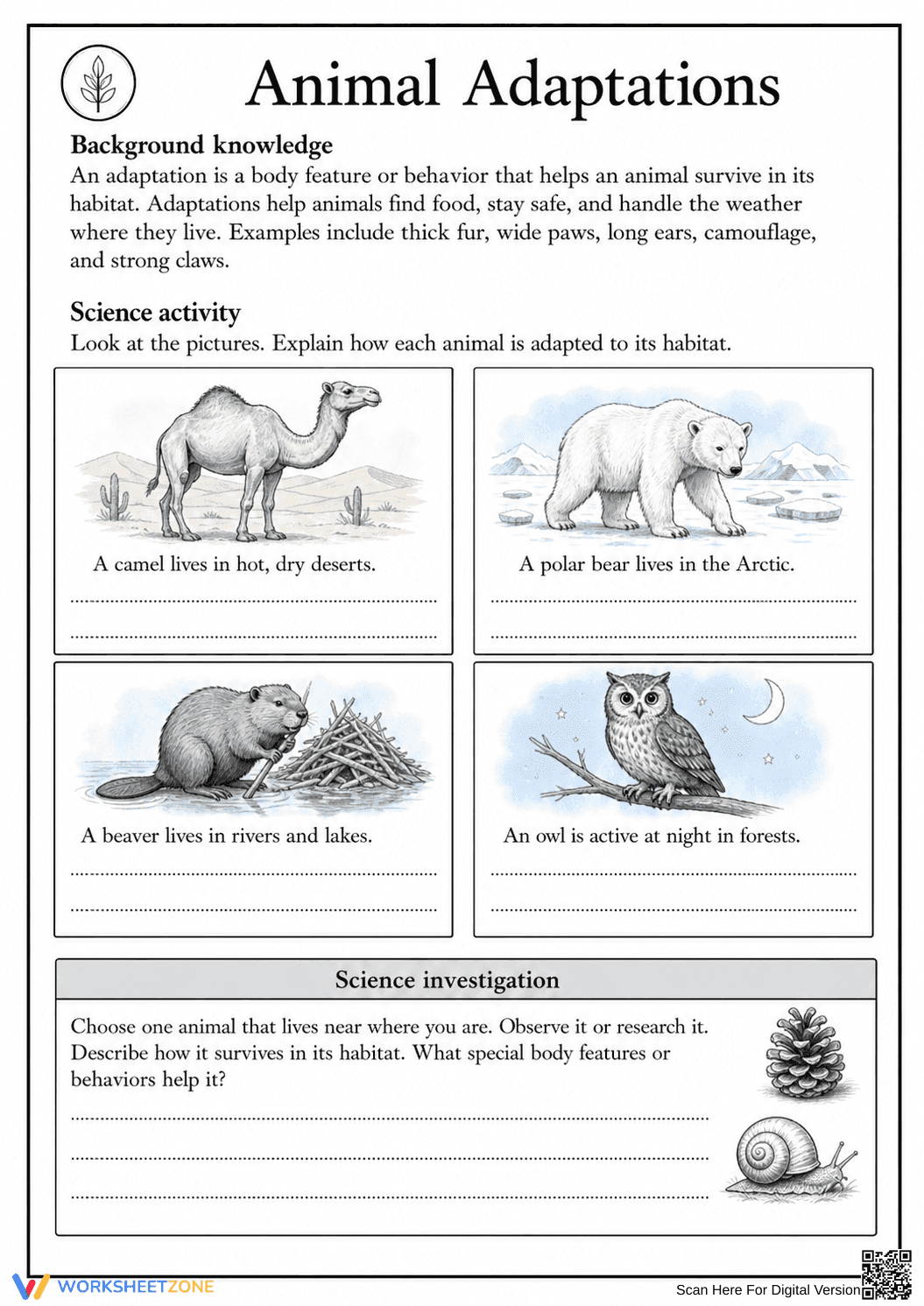

Animal Adaptations Worksheet | Grade 5 Essential Science

Paste this activity's link or code into your existing LMS (Google Classroom, Canvas, Teams, Schoology, Moodle, etc.).
Students can open and work on the activity right away, with no student login required.
You'll still be able to track student progress and results from your teacher account.
This Grade 5 science worksheet helps students explain how different animals adapt to their specific habitats to survive and thrive. By analyzing the physical traits and behaviors of organisms like the camel and polar bear, learners develop a concrete understanding of environmental fitness. This resource ensures students can articulate the relationship between biological features and environmental challenges.
At a Glance
- Grade: 5 · Subject: Science
- Standard:
3-LS4-3— Explain how organisms survive well in particular habitats based on their unique adaptations- Skill Focus: Structural and behavioral adaptations
- Format: 1 page · 5 problems · Answer key included · PDF
- Best For: Independent practice or science center activity
- Time: 20–30 minutes
The worksheet features a background knowledge section that defines adaptation and provides examples like thick fur and camouflage. The primary activity includes four image-based prompts featuring a camel, polar bear, beaver, and owl. Students must write explanations for each animal's survival mechanism. A concluding Science Investigation task prompts students to apply knowledge to local wildlife through a hands-on observation activity.
The zero-prep design allows teachers to implement this lesson in under two minutes. First, print the single-page PDF (30 seconds). Next, distribute the sheets as a bell-ringer or independent practice task (30 seconds). Finally, use the answer key to review responses or perform a quick spot-check for formative assessment (1 minute). This workflow makes it an ideal choice for emergency sub plans or reinforcement.
This resource aligns primarily with 3-LS4-3, which requires students to construct an argument with evidence that in a particular habitat, some organisms can survive well. It also supports ELA standard CCSS.ELA-LITERACY.RI.5.1 by requiring students to draw on text-based evidence to support scientific explanations. Both standard codes can be copied directly into lesson plans, IEP goals, or district curriculum mapping tools.
Use this worksheet during the explain or elaborate phase of a 5E science lesson. It serves as an excellent follow-up to a direct instruction session on biomes or animal traits. While students work, observe if they can distinguish between physical structures and behaviors. This provides immediate formative data on their ability to link traits to environmental stressors within 25 minutes of completion.
This worksheet is designed for fifth-grade students in general education, but it is also effective for ESL learners due to the clear visual prompts. It can be paired with an anchor chart on habitats or a short video clip showing animals in motion. Teachers can differentiate by providing sentence frames for the explanation sections to support struggling writers.
The study of animal adaptations is foundational for understanding ecosystem dynamics. According to EdReports 2024, high-quality science materials must provide opportunities for students to connect observable phenomena, like a polar bear's fur, to environmental contexts. This worksheet facilitates that connection by requiring students to explain the why behind biological traits. Engaging with the 3-LS4-3 standard through structured tasks builds the critical thinking skills necessary for advanced science. The inclusion of an investigation aligns with Fisher & Frey (2014) regarding the gradual release of responsibility, moving students from guided reading to independent application. This dual approach ensures that the plain-English skill of explaining survival mechanisms is reinforced through both textual analysis and real-world observation, meeting rigorous national requirements for Grade 5 instruction.


