


























Views
Downloads

Essential Animal Adaptations Worksheet | Grade 3 Science
Paste this activity's link or code into your existing LMS (Google Classroom, Canvas, Teams, Schoology, Moodle, etc.).
Students can open and work on the activity right away, with no student login required.
You'll still be able to track student progress and results from your teacher account.
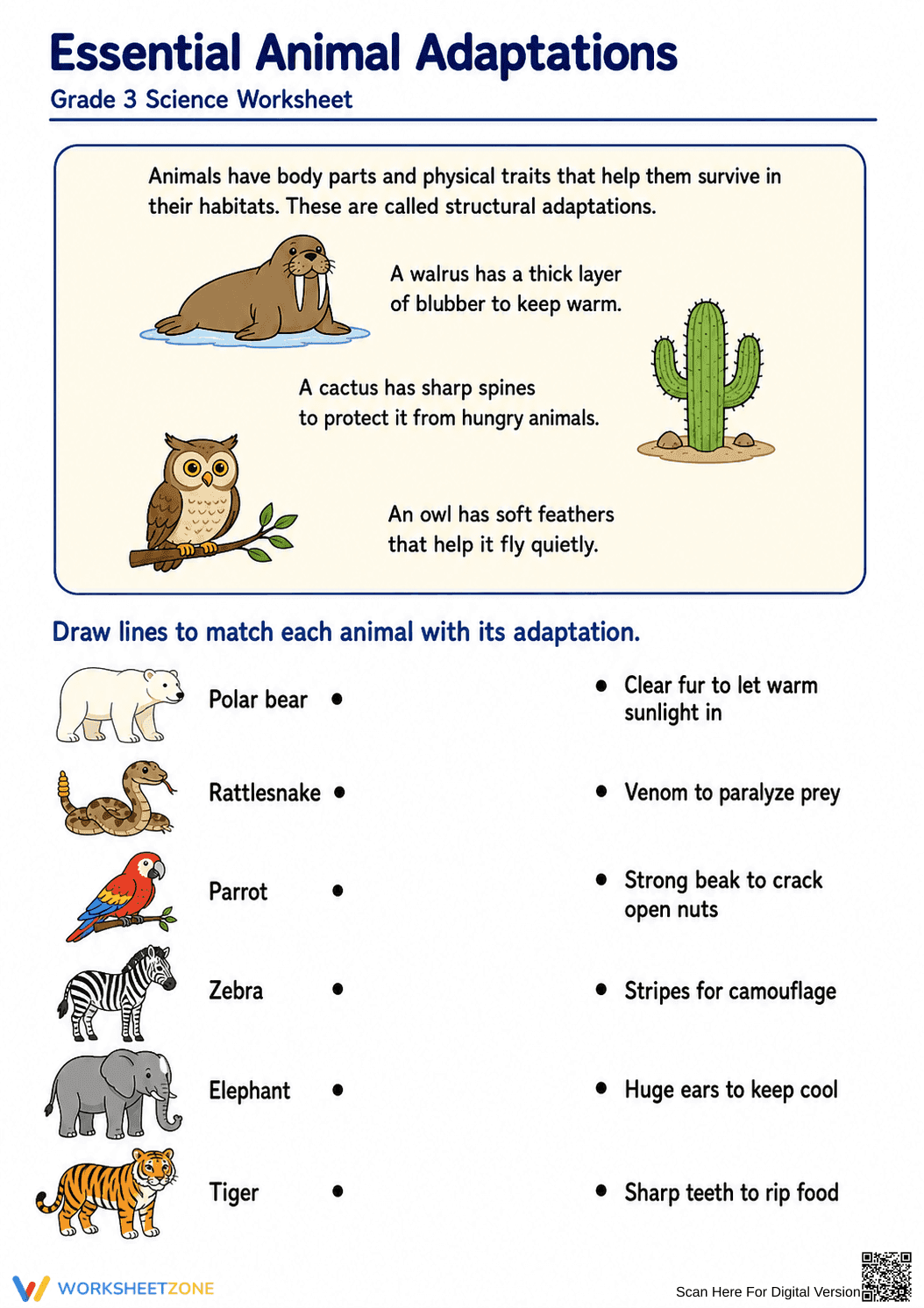
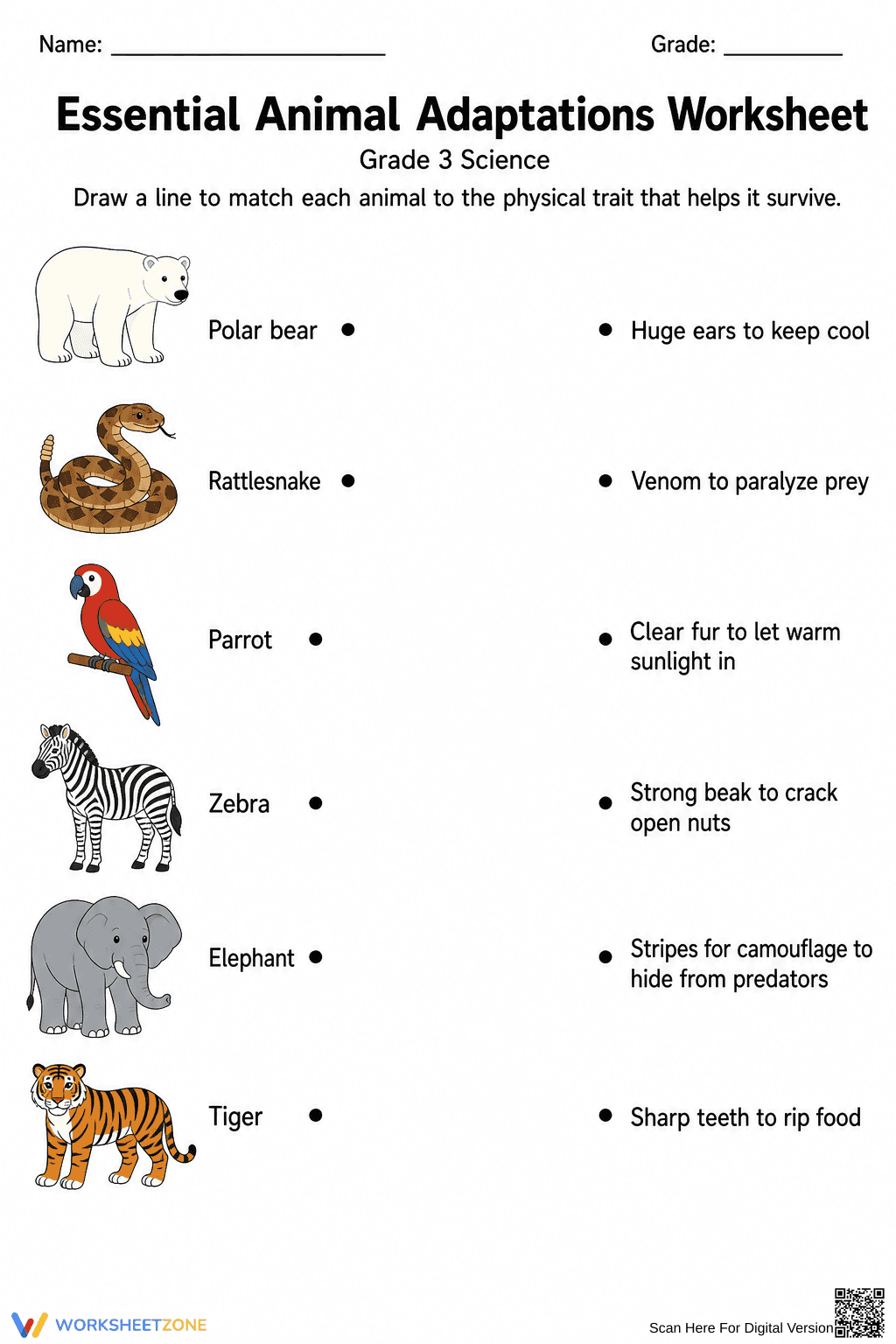
Identify how physical traits enable survival with this focused structural adaptations worksheet. Students match specific animals like polar bears and rattlesnakes to their unique survival features, from camouflage to venom. This resource helps young scientists connect biological form to environmental function, ensuring a clear understanding of how organisms thrive in diverse habitats.
At a Glance
- Grade: 3 · Subject: Science
- Standard:
3-LS4-3— Construct an argument that some organisms survive well in particular habitats- Skill Focus: Structural adaptations and physical survival traits
- Format: 2 pages · 6 problems · Answer key included · PDF
- Best For: Quick check or science center activity
- Time: 10–15 minutes
This two-page PDF includes a concise instructional header defining structural adaptations with illustrated examples, including the thermal blubber of walruses and the protective spines of cacti. The primary task consists of six matching problems where students pair high-interest animals with their specific physical traits. A complete, color-coded answer key is provided for rapid grading or student self-correction.
Zero-Prep Workflow
Implementation is designed for maximum efficiency in active classrooms. First, print the single-sided worksheet in under 30 seconds. Second, distribute to students for a 12-minute independent practice session. Third, review using the provided answer key in less than one minute. This streamlined workflow makes it an ideal choice for emergency sub plans or transition periods where instructional momentum is critical.
Standards Alignment
Aligned to 3-LS4-3, which requires students to construct an argument with evidence that in a particular habitat some organisms can survive well. By identifying traits like "clear fur to let warm sunlight in," students build the foundational evidence needed for complex ecological arguments. This primary standard code can be copied directly into lesson plans, IEP goals, or district curriculum mapping tools.
How to Use It
Use this worksheet as a "hook" during the explore phase of a lesson on habitats or as a formative exit ticket. Teachers should observe if students can explain why a trait like "huge ears" helps an elephant survive through cooling, rather than just making the match. The expected completion time is 10 to 15 minutes depending on student reading level and prior knowledge.
Who It's For
Designed for Grade 3 science students, though suitable for Grade 2 enrichment or Grade 4 review. It provides visual support through animal illustrations, making it accessible for English Language Learners and students with IEP accommodations. Naturally pairs with a short reading passage about extreme environments or a classroom anchor chart on animal body parts and their functions.
Structural adaptation mastery in early elementary science relies on connecting specific biological traits to immediate environmental stressors. According to EdReports 2024, high-quality science materials must facilitate the transition from observing traits to explaining survival advantages within the 3-LS4-3 framework. This worksheet targets the identification of physical traits—such as camouflage, thermal regulation, and predatory mechanisms—as the first step in constructing evidence-based arguments. By engaging with six distinct animal examples, students move beyond rote memorization to recognize functional patterns in nature. Research from Fisher & Frey (2014) emphasizes that such scaffolded matching tasks reduce cognitive load, allowing students to focus on the semantic relationship between an organism's form and its survival function. This approach ensures that learners are prepared for more complex inquiries into natural selection and environmental change, providing a necessary bridge between basic observation and sophisticated scientific reasoning.


