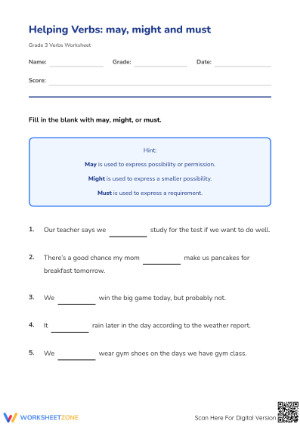
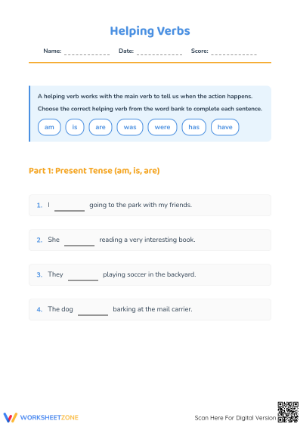
These helping verbs printable worksheets for 3rd grade target a grammar concept that looks simple until students actually sit down with sentences. Each worksheet isolates one piece of the verb phrase—the auxiliary—so students practice identifying, distinguishing, and using helpers before those skills get buried inside longer writing tasks.
The Specific Skills Each Worksheet Targets
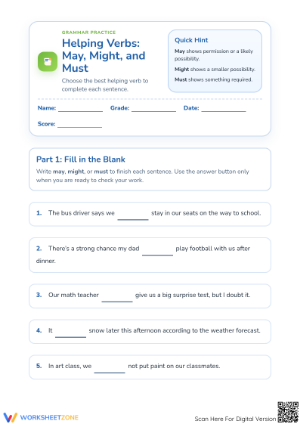
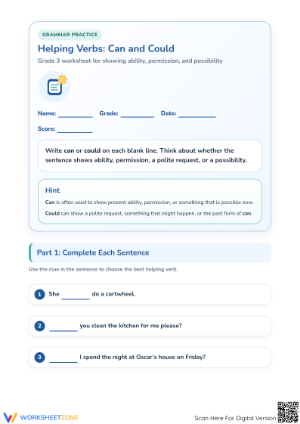
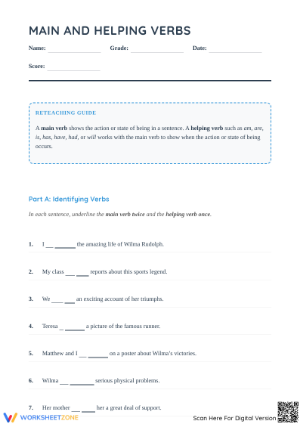
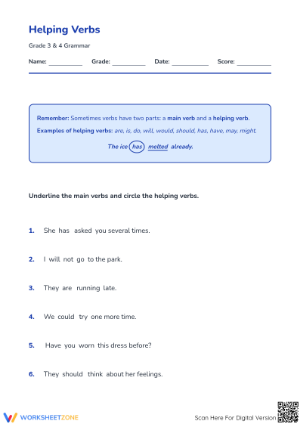
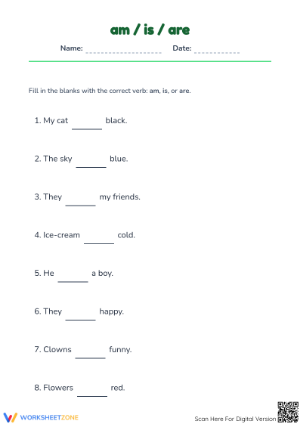
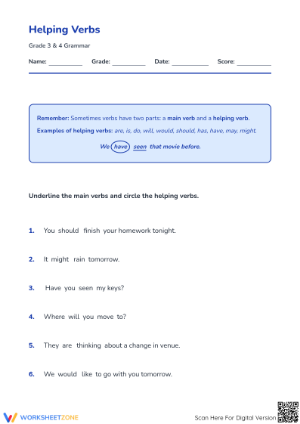
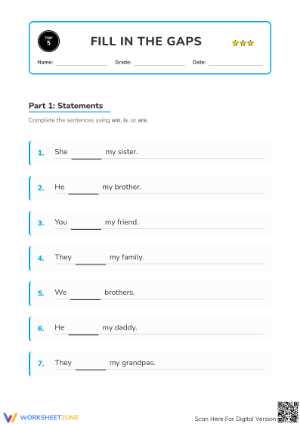
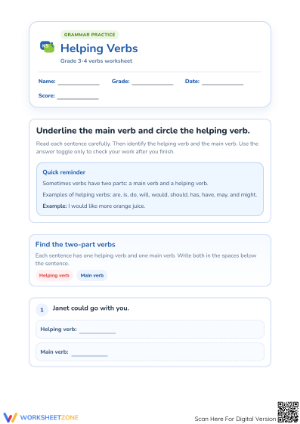
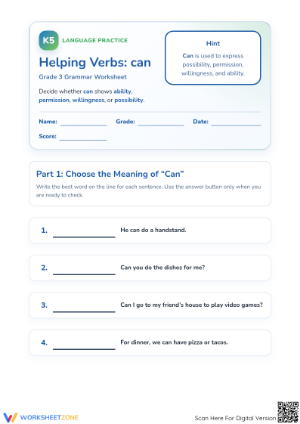
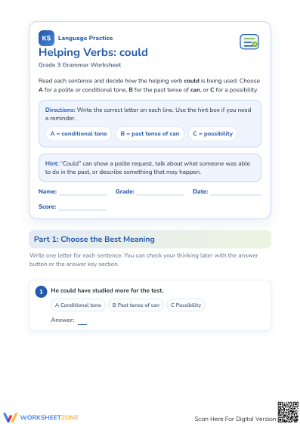
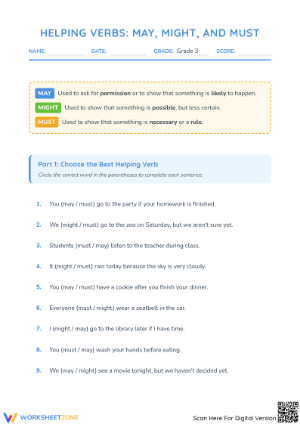
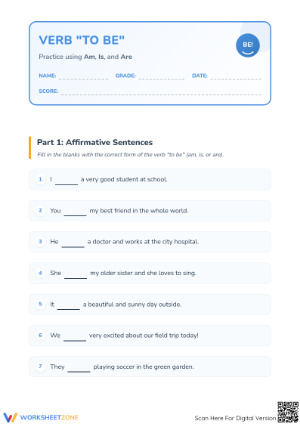
The set works through three auxiliary categories in sequence. Primary helpers—forms of be (am, is, are, was, were, be, being, been), forms of have (have, has, had), and forms of do (do, does, did)—appear in the opening worksheets alongside high-frequency example sentences. Modal auxiliaries (can, could, will, would, shall, should, may, might, must) get their own worksheet, with contextual sentences that establish each modal's meaning before asking students to identify it as the helper.
Tasks across the set include:
- underlining the helping verb and circling the main verb in printed sentences
- sorting verb phrases by auxiliary type
- rewriting sentences in a different tense by changing only the helper
- choosing the correct modal to complete a sentence based on the context given
- determining whether a word like is or was is functioning as a helper or a linking verb in a specific sentence
That last task is the hardest in the set and deserves direct instruction before students attempt it independently.
Student Errors Worth Anticipating Before the Lesson
The linking-verb versus helping-verb confusion is the most persistent problem at this grade. "She is tired" and "She is running" use the same word in the same position, and students who have memorized a list of helping verbs will mark is as a helper in every sentence without checking what follows. Worksheets that place both sentence types side by side—and ask students to name what kind of word comes after the verb—interrupt that automatic response more reliably than re-explaining the definition does.
A second error shows up with separated verb phrases. In "He did not finish," the word not draws students' attention, and many will mark it as the helper or skip over did entirely. Teaching students to physically cross out the negative word before marking the verb phrase is a small procedural move that consistently reduces this error across the class.
Modal verbs present a third difficulty. Words like must, shall, and might are low-frequency for most eight-year-olds, and students sometimes read past them or misidentify them as adjectives. Helping verbs printable worksheets for 3rd grade that pair modal sentences with brief story context give students a concrete situation to reason from before they commit to marking the helper.
Building These Worksheets Into a Weekly Grammar Block
A two-day sequence works well for most classes. On the first day, use the be/have/do worksheet for guided practice after a short introduction—circulate while students underline helpers and note who is already flipping to linking verbs. On the second day, introduce the modal worksheet and draw explicit comparisons to the prior day's work. About fifteen minutes per worksheet is enough time for most students; the follow-up discussion where disagreements surface does as much instructional work as the silent marking does.
Friday review blocks are a strong fit for helping verbs printable worksheets for 3rd grade. Reading sentences aloud as a class before anyone marks an answer slows down the impulsive circling that produces most of the errors described above, and the genuine disputes over is and was generate clarifying conversation that sticks. These worksheets also transfer cleanly to homework—the task is self-explanatory, and a simple answer key lets parents check along without any background instruction.
Standard Alignment
CCSS.ELA-LITERACY.L.3.1.A requires students to explain the function of nouns, pronouns, verbs, adjectives, and adverbs in general and their functions in particular sentences. Identifying helping verbs and distinguishing them from action verbs and linking verbs is the grammar target that most third-grade curriculum maps place in the second quarter—after students have reviewed simple past and present tenses from second grade but before the shift toward compound and complex sentences. Each worksheet in the set follows that same sequence: primary auxiliaries before modals, identification before production, so teachers can drop these resources into an existing pacing guide without reordering anything.
Adjusting the Worksheets for Different Student Levels
Students who struggle with verb identification work better with a printed reference list of the 23 helping verbs kept visible during the task. The learning target at this stage is application—finding the helper in context—not cold retrieval from memory. Keeping the list available shifts the cognitive demand to where it belongs. Remove it gradually over successive sessions as recognition becomes more automatic.
Students who move through the identification exercises quickly are ready for a production challenge: take three completed sentences, substitute a different modal in each one, and write a sentence explaining how the meaning changed. "She must leave" versus "She might leave" is a real semantic difference, and students at that level engage with it seriously. Students who process language more slowly often benefit from hearing sentences read aloud before marking anything—spoken verb phrases cluster naturally in a way that printed text does not always reproduce for word-by-word readers.
Frequently Asked Questions
What is the difference between a helping verb and a linking verb?
A helping verb comes before a main action verb and forms a verb phrase: "He was running." A linking verb connects the subject to a description with no action verb following it: "He was tired." Because the same word can do either job depending on what follows it, this distinction is worth practicing in context rather than in definitions—and several worksheets in the set are built specifically for that comparison.
When do most third-grade teachers introduce this topic?
Second quarter is standard across most pacing guides, after reviewing simple tenses and before moving into compound sentences. Introducing it earlier works if students are already confident with basic action verbs; waiting until the fourth quarter leaves too little time to reinforce the concept through actual writing assignments.
Does the set cover all 23 helping verbs?
Yes. Primary auxiliaries appear in the earlier worksheets, and modal auxiliaries—including lower-frequency words like shall and must—appear in later worksheets with more contextual support built in. No single worksheet tries to address all 23 at once; the grouping keeps each task manageable and allows students to build recognition category by category.
Can these resources serve as formative assessment?
The identification exercises work cleanly as formative checks. Scanning a completed worksheet takes about two minutes and immediately reveals whether a student is missing modals consistently, confusing linking and helping verbs, or struggling only with separated verb phrases. Helping verbs printable worksheets for 3rd grade used this way produce more specific diagnostic information than a single exit-ticket question does, because the error pattern shows up across multiple sentence types at once rather than on a single item.












 Interactive Worksheet Maker
 Quiz Maker
 Word Search Maker
 Crossword Puzzle Maker
 Word Scramble Generator
 Sentence Scramble Generator
 Handwriting Worksheet Generator
 Name Tracing Generator
 Fill In The Blank Generator