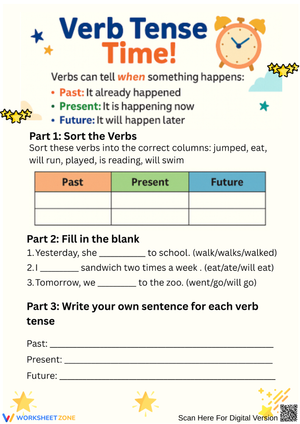
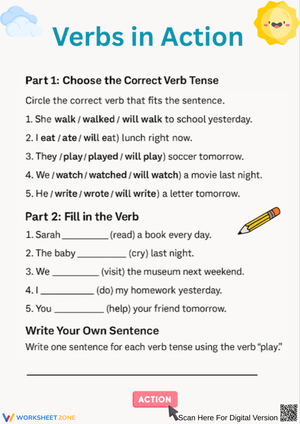
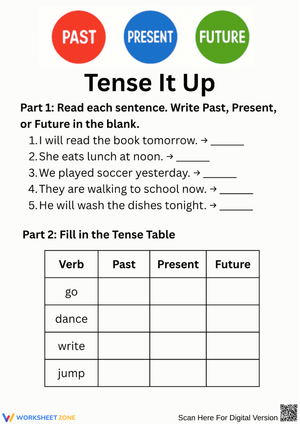
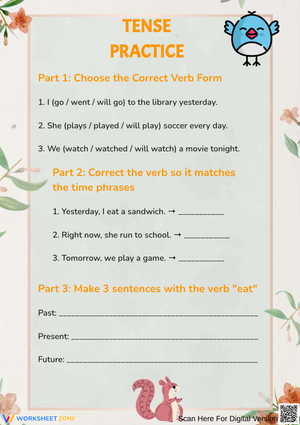
These 3rd grade future tense verbs worksheets resources give teachers targeted, print-ready grammar practice built around the errors Grade 3 students actually make. The core pattern students work with at this level — will + base verb — looks deceptively simple, but applying it consistently in their own sentences takes repeated exposure across different task formats. Each worksheet in the set focuses that exposure in one clear direction, so teachers have flexible materials that fit morning warm-ups, small groups, homework, and quick Friday review blocks without any extra setup.
What's Inside the Set
Future tense instruction at Grade 3 follows a natural arc: students need to recognize the pattern before they can produce it, and they need to produce it in guided conditions before they can use it independently. The worksheets in this set move through that arc deliberately.
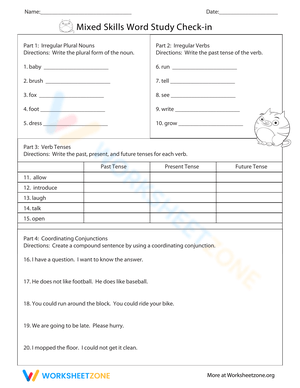
- Identifying future tense verbs in written sentences
- Selecting the correct verb form from two or three options
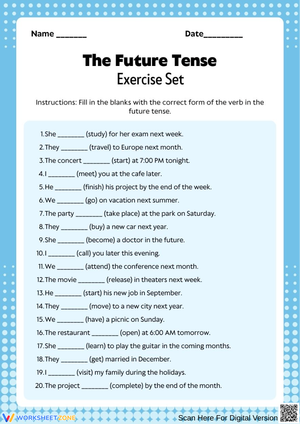
- Completing sentences by supplying will + a base verb
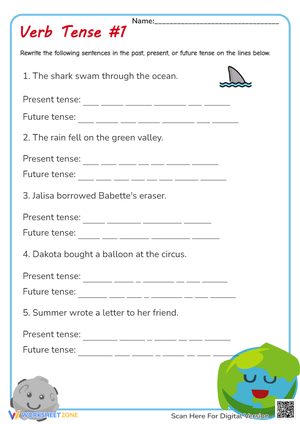
- Rewriting present-tense sentences in future tense
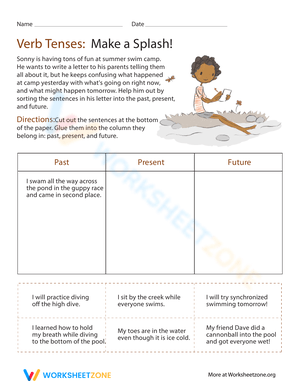
- Writing original sentences about events that have not yet happened
The sentence-rewriting tasks carry more instructional weight than they might appear to. Circling will play in a multiple-choice item and converting She runs every morning into She will run every morning are not the same cognitive task. Rewriting requires students to hold the original sentence structure, isolate the verb, and apply the future tense rule simultaneously. Teachers who push past recognition work into rewriting too fast often find that students can select the correct answer from a list but still write She play tomorrow in their journals the same afternoon.
Mistakes Students Make That These Worksheets Surface
The most common error is dropping will entirely. A student who writes We go to the park tomorrow is not ignoring the rule — they often believe the time word does the grammatical work on its own, and in spoken language, that reasoning is not entirely off. The problem is that written grammar at Grade 3 requires the helping verb to appear explicitly, and students have to internalize that expectation through enough written practice to make it automatic.
A second error shows up less often but matters: will paired with an inflected verb, as in She will runs to the bus. This tells you the student remembered to include will but has not understood that only the base form follows it. Adults register the awkwardness immediately, but third graders often read right past it. Worksheets that ask students to underline only the verb phrase — not the full sentence — help isolate this error faster than tasks where students mark the whole line.
Overcorrection appears too. Some students begin inserting will into sentences that already carry future meaning through a different structure, or they write will + -ing because they are pattern-matching without full understanding. Catching that early — before it solidifies — is one reason item variety across the set matters.
Fitting These Worksheets Into the Lesson
The most reliable opening for a future tense lesson is two minutes of oral modeling before students touch any worksheet at all. Write a present-tense sentence on the board — I eat lunch at noon — and talk through the change aloud: what the sentence says now, which word in the revised version signals a future event, and why the verb form has to shift. Work through two or three examples with the class before distributing anything.
That oral step earns its time. Third graders often catch the pattern in speech before their hands can apply it reliably on paper. Moving straight to independent written practice asks students to understand the rule and execute it simultaneously — a significant cognitive load for a student still building fluency. A two-minute oral bridge reduces that pressure without slowing the lesson.
In literacy centers, pairing a worksheet with sentence strips works well: students read a present-tense strip, say the future version aloud, then write it. The physical manipulation gives another pass at the rule before any pencil hits paper. For small-group intervention, reading items aloud together before writing catches students who follow the concept aurally but lose it when decoding silently. Across all these settings, these 3rd grade future tense verbs worksheets fit without requiring special materials, room rearrangement, or meaningful extra prep time.
Standard Alignment
These worksheets address CCSS.ELA-Literacy.L.3.1.e, which requires students to form and use simple verb tenses, future included. That standard sits within a cluster that also covers irregular past-tense verbs and subject-verb agreement. In most classroom sequences, future tense arrives after students have worked through irregular past forms — because the will + base verb pattern is more rule-consistent and easier to apply reliably once the helping-verb concept is established. Teachers running a three- to four-week verb tense unit will find these worksheets fit most naturally in weeks three or four, after irregular past-tense accuracy has reached a workable level.
Adjusting the Worksheets Across Ability Levels
For students who need more support, sentence frames remove the production barrier while keeping the grammar target intact. Frames like Tomorrow I will ____ or After school, we will ____ let students focus entirely on selecting a correct base verb without also having to construct a full sentence from scratch. Reading each prompt aloud before writing cuts the dual burden of decoding and composing at the same time — a practical move for any student working near fluency threshold.
Students who have the pattern under control benefit from a higher language demand rather than more items of the same type. Ask them to rewrite a short paragraph — three to five sentences — converting every present-tense verb to future tense while leaving the rest of the sentence intact. Or have them draft four sentences about an upcoming school event, using a different future-tense verb in each. Both tasks hold the grammatical target steady while stretching the writing load.
Because 3rd grade future tense verbs worksheets materials vary in writing demand from worksheet to worksheet, teachers can also assign each worksheet to a group directly — identification and completion tasks for students still building recognition, sentence-rewriting and original-writing tasks for students ready to produce independently.
Frequently Asked Questions
What future tense pattern do Grade 3 students focus on?
At this grade level, instruction centers on will + base verb — for example, will run, will read, will build. Students do not typically work with going to constructions or modal nuance at Grade 3. The goal is to form and use the simple future reliably across a range of sentence types.
How long does each worksheet take to complete?
Most students finish each worksheet in 10 to 15 minutes during independent work time. Sentence-writing tasks run a few minutes longer than identification or fill-in items, so the actual time depends on which worksheet in the set students are completing that day.
Can these worksheets function as formative assessments?
Each worksheet works well as an informal check on understanding. The sentence-rewriting and original-writing items are the most informative for a quick assessment look because they show production rather than recognition. After collection, teachers can scan for missing will and for will + inflected-verb errors in a matter of minutes.
Do these worksheets work for homework?
The identification and fill-in-the-blank worksheets travel home well because students can complete them without adult explanation. Rewriting tasks are better assigned after students have practiced the pattern in class first. Sending home 3rd grade future tense verbs worksheets materials that students have already worked through in a guided setting avoids the risk of students rehearsing incorrect forms on their own and reinforcing errors before the next lesson.












 Interactive Worksheet Maker
 Quiz Maker
 Word Search Maker
 Crossword Puzzle Maker
 Word Scramble Generator
 Sentence Scramble Generator
 Handwriting Worksheet Generator
 Name Tracing Generator
 Fill In The Blank Generator