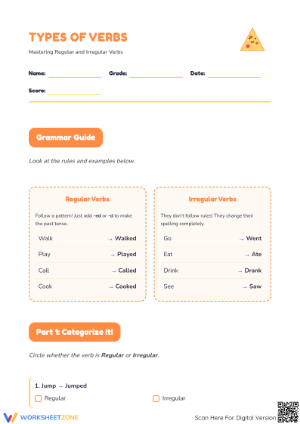
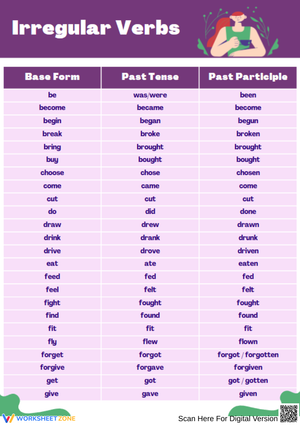
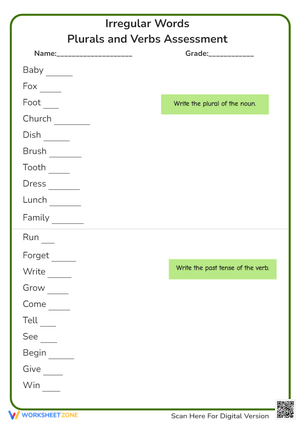
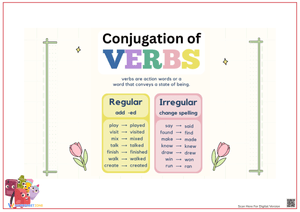
These 3rd grade irregular verbs worksheets give teachers a focused, print-ready set targeting the past tense forms that cause the most persistent errors in third-grade writing. Each worksheet works around a distinct cluster of verbs — vowel-shift families like sing/sang and drink/drank, complete stem changes like go/went, and the handful of forms that stay identical in both tenses — so students build recognition through pattern rather than raw memorization alone.
What Students Practice Across the Set
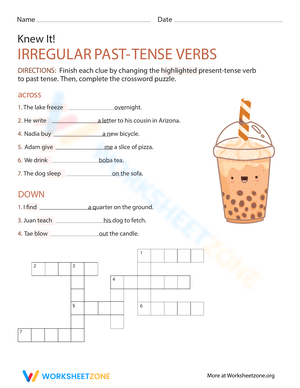
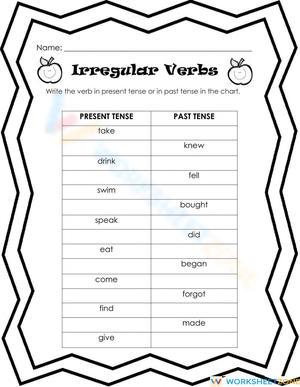
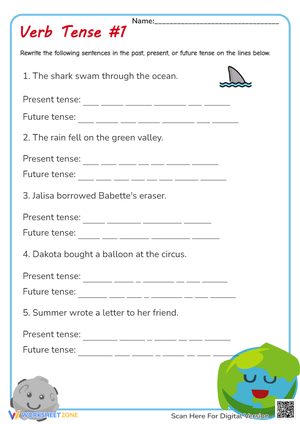
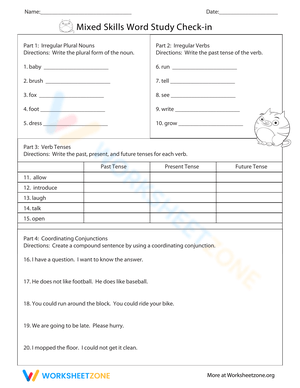
The exercises move students through three levels of demand. First, they identify and match: students draw lines connecting present-tense verbs to their irregular past forms, which establishes basic recall before any production is required. Then they fill in blanks inside short narrative sentences, where context forces them to choose the correct form rather than simply recognize it in a list. The most demanding task on each worksheet asks students to rewrite a flawed passage — a short paragraph where every irregular verb has been wrongly regularized ("She runned to the bus, and he catched her backpack") — correct the errors, then read the passage aloud to confirm it sounds right.
The verb groupings within each worksheet are deliberate. Verbs that share an internal vowel shift (blow/blew, grow/grew, know/knew, throw/threw) appear together so students notice the family resemblance. Treating these as a word family rather than a list of unrelated exceptions gives students a cognitive foothold — they begin to hear the pattern instead of treating every verb as its own isolated problem to memorize.
Standard Alignment
CCSS.ELA-LITERACY.L.3.1.D requires students to "form and use regular and irregular verbs." That phrasing — form and use — is the key instructional distinction. Forming means producing the correct past tense from memory; using means applying it accurately inside a sentence where other grammatical and meaning decisions are happening simultaneously. Teachers who find students meeting this standard on isolated matching tasks but failing it on writing assessments almost always locate the gap in that second demand. The worksheets address both: identification and matching tasks cover formation, while sentence completion and rewrite tasks require accurate use in context, so the gap doesn't quietly develop between the two.
Frequent Student Errors Worth Watching For and Correcting
The most predictable mistake is over-regularization: students write "goed," "runned," "catched," and "eated" because the -ed rule is the most recently drilled pattern in their grammar toolkit. It's reliable for regular verbs, so third graders apply it everywhere by default. What makes this error genuinely tricky to address is that it doesn't signal confusion — it signals exactly the kind of rule application we want students to do. The teaching work is redirecting that instinct for a specific set of high-frequency exceptions.
A subtler problem appears with verbs where the past tense form already sounds familiar in speech but feels uncertain in writing. Many third graders say "saw" correctly in conversation but write "seen" in a story — "We seen the movie Friday night" — because "seen" sounds like a past form and they have heard it used that way in informal speech. These students need writing practice with the correct form, not just oral reinforcement, because their auditory memory is working from a mixed signal. The error-correction exercises on each worksheet pull both types of mistakes into view in the same sitting, which is useful for identifying which students have which gap.
Working These Worksheets Into Your Lesson Plans
The most reliable placement is the first five to seven minutes of language arts — the quiet independent stretch after morning meeting settles but before whole-group instruction begins. Students pick up the worksheet, work through it, and it functions as both cumulative review and a low-stakes preview when you're introducing a new verb family that day. Following completion with a two-minute partner read-aloud, where each student reads their corrected sentences to the other, adds an oral check that silent written practice alone can't provide.
These 3rd grade irregular verbs worksheets also work well as a fast formative check after a direct-instruction lesson. Hand out the matching and fill-in worksheet after a fifteen-minute lesson on vowel-shift verbs, then scan the papers during the transition to reading. Within two minutes you know which students internalized the pattern and which need a small-group pull the next morning — more actionable than a unit quiz that arrives too late to adjust instruction.
Spacing matters more than massing for this content. Introducing five to eight verbs per week and using a worksheet from a previous week as Monday review — rather than spending one dense instructional block on all irregular verbs at once — produces more durable retention. Because each worksheet covers a tight, coherent verb cluster rather than a scrambled mix, planning cumulative review across weeks is straightforward.
Adjusting the Worksheets Across Ability Levels
For students early in the learning curve, a reference card listing the twenty most common irregular verb pairs taped to their desk turns each worksheet into a supported recognition task rather than a cold-recall test. The key is removing that reference card gradually — one verb family at a time as fluency builds — rather than pulling it all at once and watching error rates spike back to the starting point.
These 3rd grade irregular verbs worksheets present a different kind of challenge for students who have already internalized the target forms: ask them to write an original paragraph using five of the week's verbs correctly, then exchange papers with a partner to audit each other's forms. That production task is more demanding than completion of a structured exercise and keeps students who already have the basics working on genuine application rather than coasting through familiar material.
For English Language Learners, the rewrite exercises carry an extra layer of difficulty because regularized forms like "runned" or "catched" may not sound wrong to a student whose home language doesn't share English's irregular patterns. Consistent oral reading alongside the written work helps here — doing the first rewrite exercise as a class read-aloud before students attempt it independently gives ELL students an auditory model they can use to self-monitor their corrections.
Frequently Asked Questions
Which irregular verbs are typically covered at this grade level?
Third-grade instruction concentrates on the highest-frequency forms students encounter in reading and use in writing: go/went, see/saw, eat/ate, run/ran, come/came, give/gave, bring/brought, think/thought, buy/bought, catch/caught, and the vowel-shift families (sing/sang, ring/rang, drink/drank; blow/blew, grow/grew, know/knew). These forms account for a large share of all past-tense use in third-grade narrative writing, which is why they anchor both CCSS.ELA-LITERACY.L.3.1.D and most state-level equivalents.
How does this set differ from a general grammar worksheet?
Each worksheet focuses on a single verb cluster rather than mixing every grammar rule on the same page. That narrower focus reduces cognitive load — students aren't toggling between capitalization rules, comma placement, and verb forms all at once. Most students complete a worksheet in eight to twelve minutes, which leaves time for the partner read-aloud step that reinforces written practice with an oral check.
Do these work for ESL students and Tier 2 or Tier 3 intervention groups?
The structured three-step format — match, fill in, rewrite — gives students who struggle with open-ended tasks a clear procedural path through each worksheet. For ESL students specifically, the rewrite exercises are often the most valuable task because they require students to hear and correct a form they may have previously accepted as standard. Pairing the written work with a verb-pair reference list, then using the corrected sentences as read-aloud material after completion, gives both visual and auditory reinforcement in the same session without requiring separate materials.
Can these be sent home as homework?
The matching and fill-in worksheets travel home well because they don't require additional context or teacher explanation to complete. The rewrite exercises are better kept in class, where you can confirm students are reading the corrected version aloud — that oral check is part of what makes the rewrite task effective, and it reliably gets skipped at home. A practical middle path: send home a fill-in worksheet from the current week's verb family as weekend review, once that cluster has already been introduced and practiced in class.












 Interactive Worksheet Maker
 Quiz Maker
 Word Search Maker
 Crossword Puzzle Maker
 Word Scramble Generator
 Sentence Scramble Generator
 Handwriting Worksheet Generator
 Name Tracing Generator
 Fill In The Blank Generator