


























Views
Downloads

Helping Verbs Worksheet: May, Might, Must | Essential
Paste this activity's link or code into your existing LMS (Google Classroom, Canvas, Teams, Schoology, Moodle, etc.).
Students can open and work on the activity right away, with no student login required.
You'll still be able to track student progress and results from your teacher account.
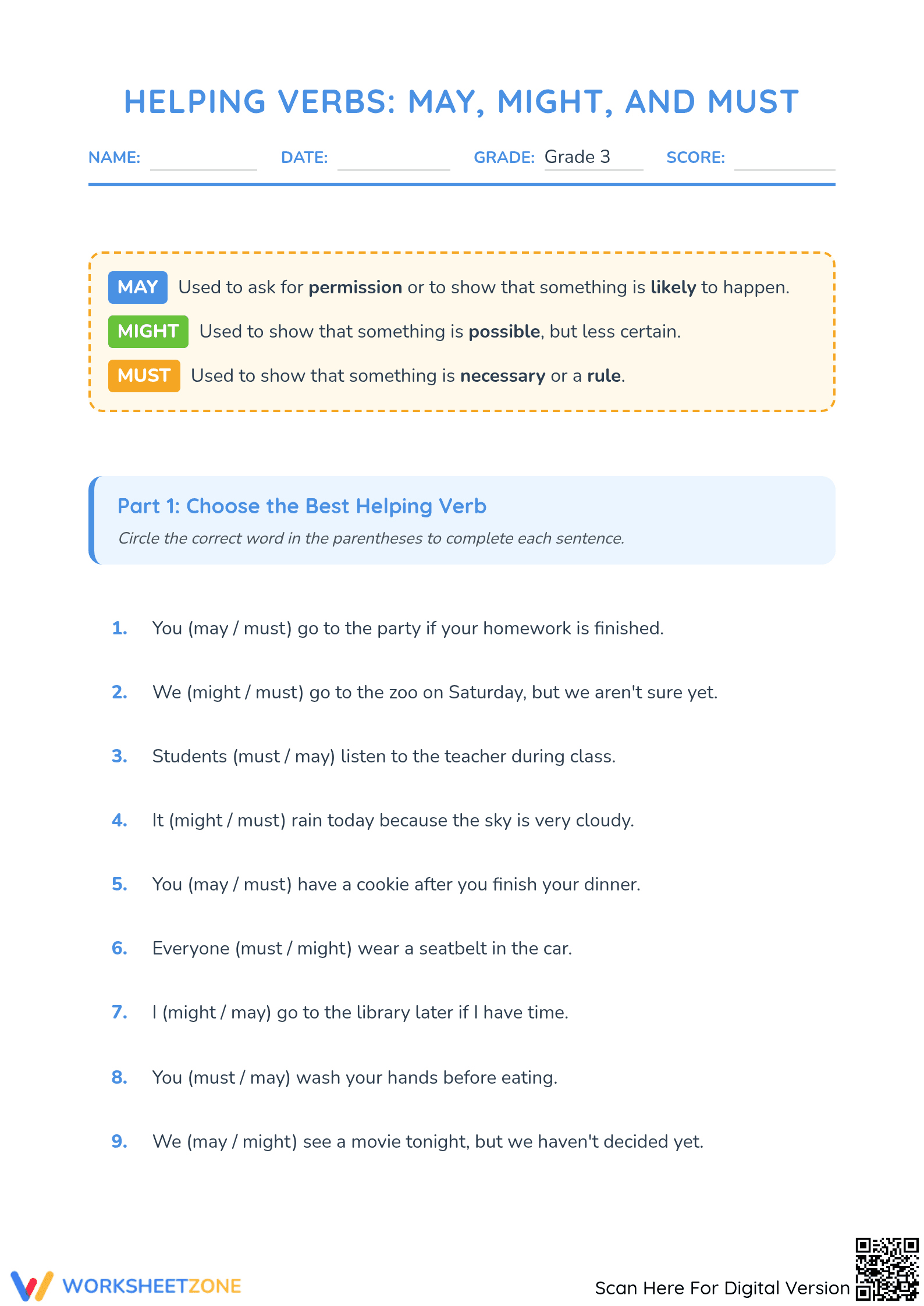
Helping verbs provide critical nuance to English sentences, allowing writers to express varying degrees of certainty and obligation. This comprehensive Grade 3 worksheet focuses on the specific modal helping verbs 'may', 'might', and 'must'. By completing these exercises, students learn to distinguish between asking for permission, expressing a possibility, and stating a requirement.
At a Glance
- Grade: 3 · Subject: ELA
- Standard:
CCSS.ELA-LITERACY.L.3.1— Demonstrate command of the conventions of standard English grammar and usage when writing- Skill Focus: Helping verbs (may, might, must)
- Format: 4 pages · 30 problems · Answer key included · PDF
- Best For: Independent practice and grammar reinforcement
- Time: 25–35 minutes
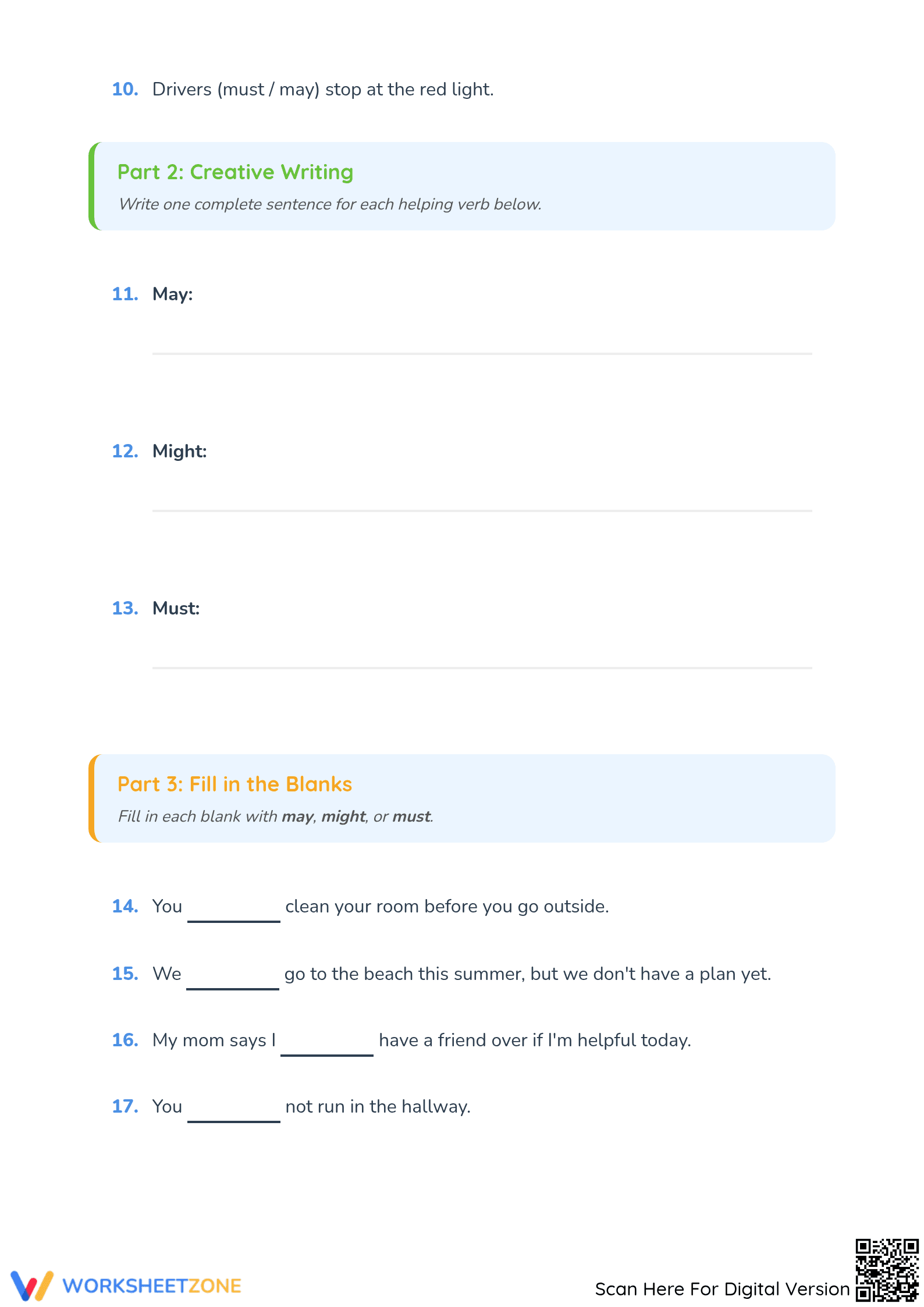
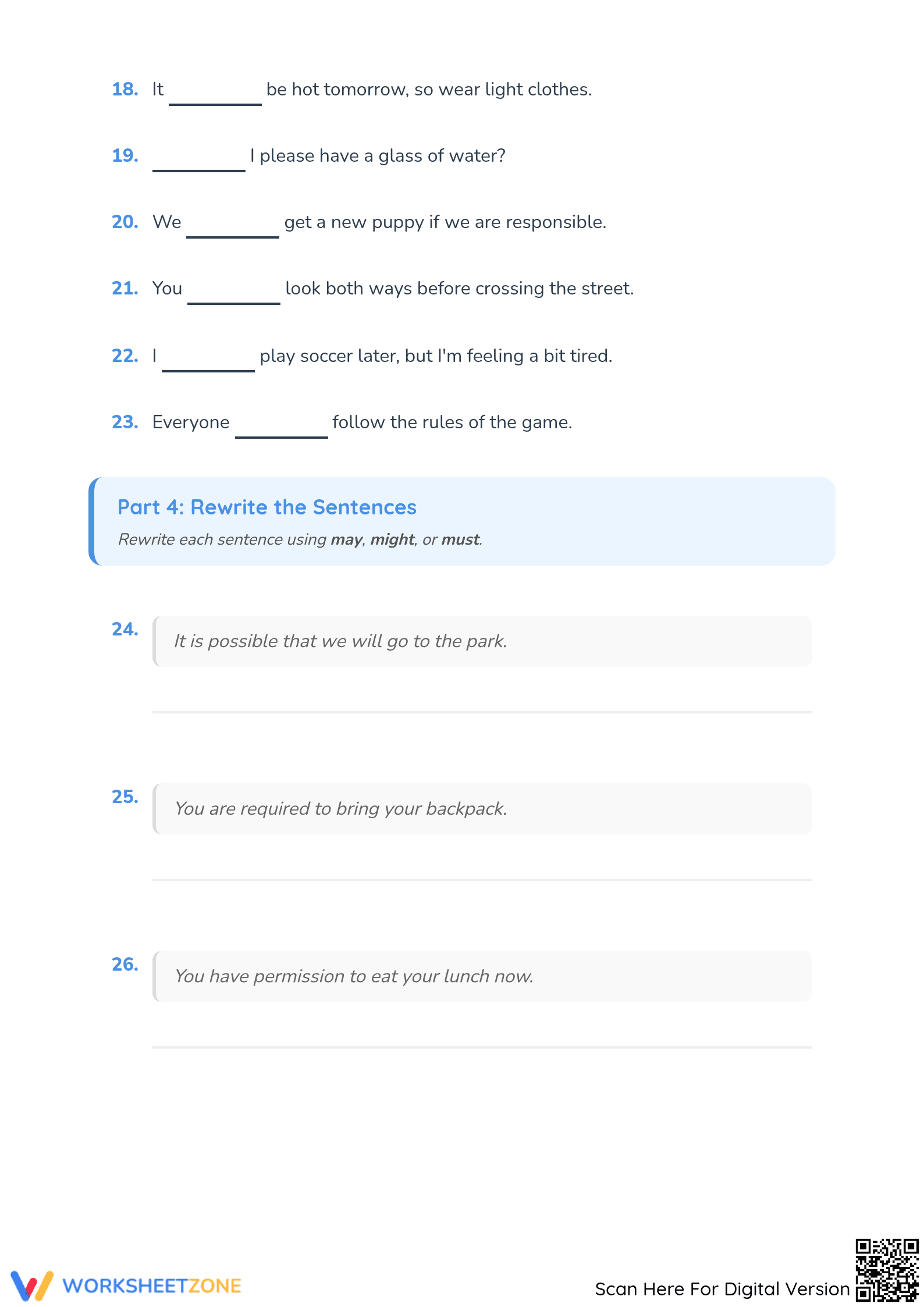
What's Inside: This 4-page instructional packet begins with a clear reference box defining each helping verb with its primary function. The worksheet contains 30 total tasks across five distinct sections, including multiple-choice selection, creative sentence generation, fill-in-the-blank exercises, and sentence rewriting. A complete 4-page answer key is provided to facilitate quick grading or student self-correction.
Skill Progression
- Guided Practice: Part 1 features 10 circling tasks where students choose between two options, allowing them to recognize the correct context for each verb with immediate support.
- Supported Practice: Part 3 provides 10 fill-in-the-blank sentences where students must recall the definitions to select the appropriate verb without a provided word bank for each specific item.
- Independent Practice: Parts 2 and 4 require students to generate original sentences and rewrite existing ones, moving from recognition to active application of grammatical rules.
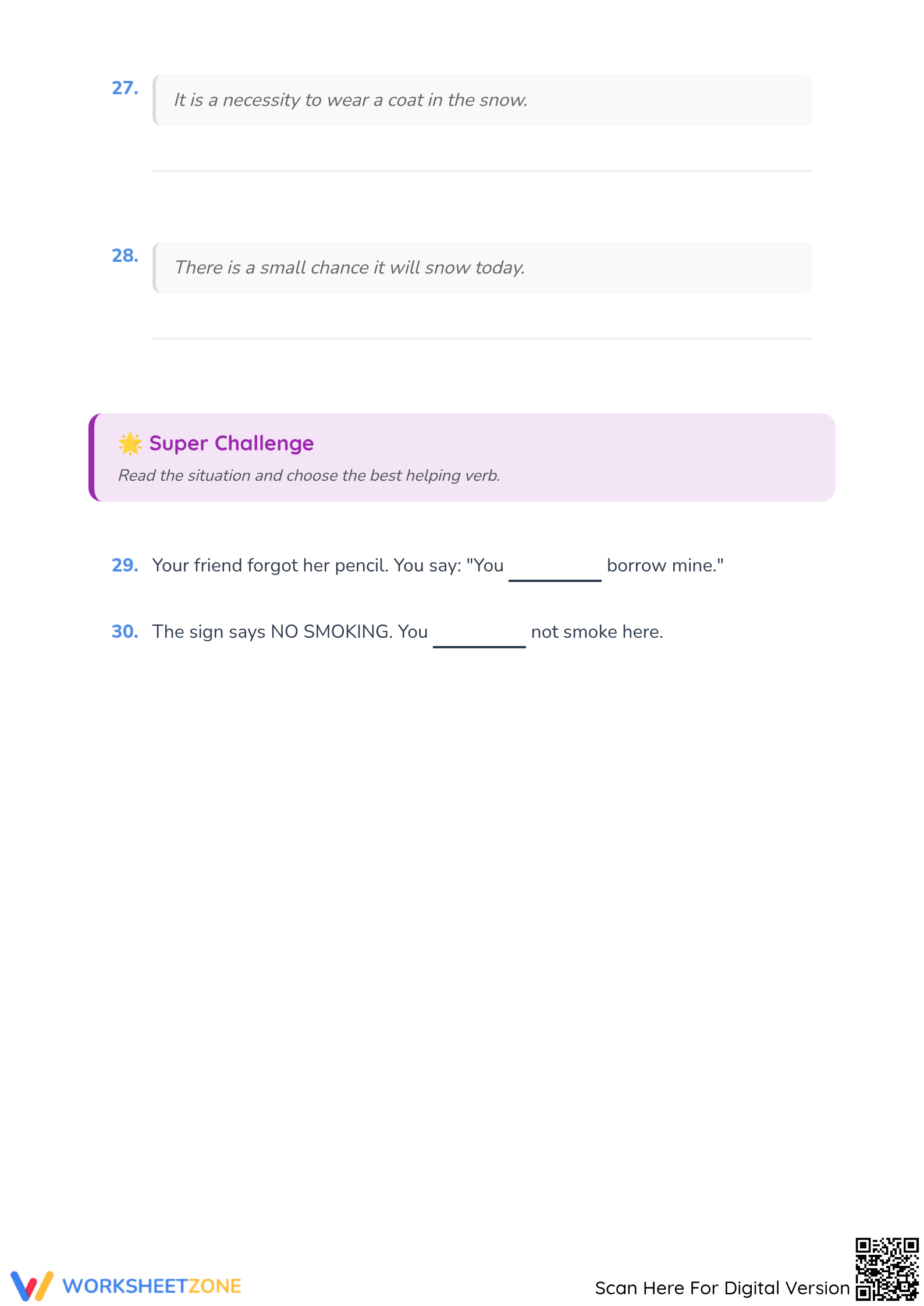
This structure follows a gradual-release model, ensuring students build confidence before tackling the higher-order thinking required in the final "Super Challenge" section.
Standards Alignment
This resource is aligned to `CCSS.ELA-LITERACY.L.3.1`, which requires students to demonstrate command of the conventions of standard English grammar and usage. Specifically, it addresses the use of modal auxiliaries to convey various conditions. Both standard codes can be copied directly into lesson plans, IEP goals, or district curriculum mapping tools.
How to Use It
This worksheet is ideal for use during the "You Do" phase of a grammar lesson. After introducing the concepts of permission and necessity, assign the first two pages as independent practice. Use the "Super Challenge" on the final page as a formative assessment to identify which students have mastered the subtle differences between 'may' and 'might'. Expected completion time ranges from 25 to 35 minutes depending on student writing speed.
Who It's For
While designed for Grade 3 students, this resource is also highly effective for English Language Learners (ELL) who struggle with the nuances of modal verbs. It serves as an excellent intervention tool for older students or a rigorous extension for second graders. Pair this with a mentor text that features dialogue to see these verbs in a natural narrative context.
According to the Fisher & Frey (2014) framework for productive group work and independent learning, the transition from scaffolded choice to independent sentence construction is vital for long-term retention of grammatical structures. This worksheet applies those principles by requiring students to not only identify 'may', 'might', and 'must' but also to transform sentences to reflect specific meanings. By engaging with 30 distinct items, students receive the repetitive exposure necessary to move these rules into their permanent writing repertoire. The inclusion of a standalone citation capsule ensures that educators can verify the instructional validity of the resource against current CCSS.ELA-LITERACY.L.3.1 benchmarks for third-grade linguistic development and modal verb usage.


