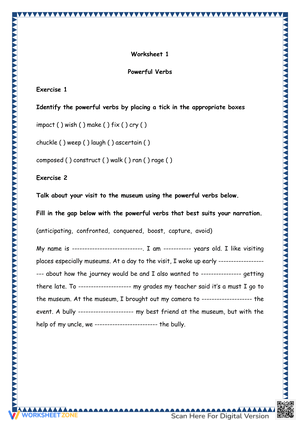
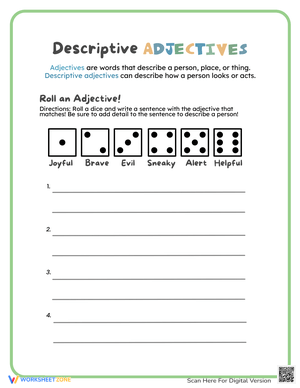
These descriptive verbs worksheets for 3rd grade give students repeated, structured practice replacing weak, overused action words with precise alternatives — the kind of work that actually moves vocabulary from a word wall into student drafts. The set targets the gap between knowing a word exists and reaching for it independently during writing. Six distinct activity formats keep that practice from going stale across a unit.
What's Inside the Set
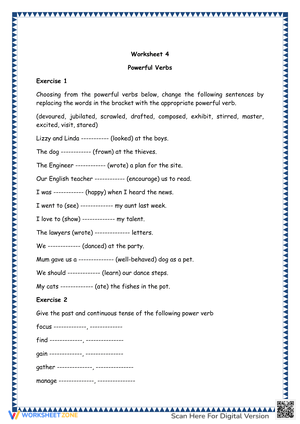
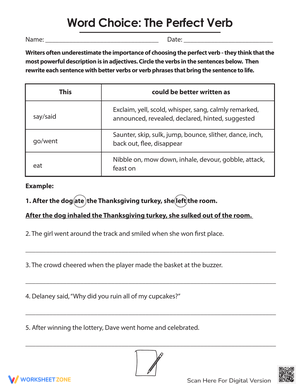
Each worksheet in the descriptive verbs worksheets for 3rd grade set focuses on a specific aspect of verb precision. Verb swap exercises ask students to replace a highlighted weak verb — went, got, said, looked — with a stronger choice drawn from a word bank or from memory. Fill-in-the-blank items emphasize context: two sentences might share the same blank, but the surrounding details make clear that trudged fits one and strolled fits the other. Students learn quickly that word choice is not only about intensity but about fit.
Matching worksheets pair a base verb with a cluster of vivid synonyms, giving students a map of the vocabulary territory around a single action. Word sorts ask students to arrange verbs along a spectrum — from least to most forceful — which requires comparative judgment rather than simple recall. Picture-prompt worksheets present an illustration and ask for a single strong-verb sentence describing the action; these are particularly useful for students who freeze when asked to write from nothing. Sentence-rewriting tasks close the loop by asking students to revise a flat sentence end-to-end, incorporating a stronger verb and at least one supporting detail.
Errors Worth Watching For and Correcting Early
The most persistent error at this level is not picking the wrong strong verb — it's keeping the weak one. When students work through a verb swap exercise, a significant portion will underline the target word correctly, write sprinted or stomped in the margin, and then copy the original weak verb back into the rewritten sentence anyway. The pull of the familiar word is stronger than a single exposure to an alternative. These worksheets address that by requiring students to write the new sentence in full, not just name a synonym, which creates a genuine writing act rather than a labeling exercise.
A second pattern shows up in the picture-prompt and sentence-rewriting tasks: students who are genuinely reaching for stronger verbs often overcorrect toward dramatic words regardless of tone. A child describing a character sitting down to read might write collapsed or plunged because those feel vivid, without noticing the mismatch with the calm scene. That misjudgment is actually a sign of growth — the student is trying — but it needs direct feedback. The word-sort format helps here, because placing verbs along an intensity spectrum forces students to confront the idea that strength is not always what a sentence needs.
How to Work These Worksheets Into Your Lesson Plans
The most reliable entry point is the five to eight minutes at the start of a writing workshop block. A verb swap exercise, projected on the board and completed in journals, takes less than ten minutes and gives students a vocabulary anchor before they move into drafting. Because the task is brief and the goal is clear, it does not eat into writing time — it primes it. Teachers who use these at the start of the week consistently see stronger verb choices appearing in Friday drafts without any additional prompting.
The descriptive verbs worksheets for 3rd grade also work well as literacy center rotations. The matching and fill-in-the-blank formats require no oral explanation and produce clear, self-checking results — a student either matched the word correctly or did not. That independence matters when the teacher is pulling a small guided group. The picture-prompt and sentence-rewriting tasks are better used during whole-class or partner work, where the teacher can hear the reasoning behind a word choice in real time. One practical rhythm: place the self-directed formats in a center folder on Monday and cycle in the discussion-dependent formats during whole-class time mid-week.
One classroom strategy worth building around this set is a "Verb Graveyard" bulletin board where students ceremonially retire overused words — said, went, got written on paper tombstones. When a student uses a vivid replacement in a final draft, that word goes on a "Living Verbs" tree posted alongside the graveyard. The visual contrast makes the vocabulary work public and concrete, and students start checking their own drafts against the board rather than waiting for a teacher note.
Adjusting the Worksheets for a Range of Learners
Students who need more support do well when the word bank options are narrowed. Instead of ten choices for a fill-in-the-blank item, cut the list to three or four words that differ clearly enough to make the decision manageable without being obvious. For word sort tasks, providing a labeled anchor at each end of the spectrum — "least forceful" on one end, "most forceful" on the other — reduces the cognitive demand of figuring out the sorting criteria on top of evaluating the words themselves.
For students who are ready for more challenge, the most effective adjustment is removing the word bank entirely and asking them to generate replacements before consulting any list. That production demand — recalling a word rather than recognizing one — is a meaningfully harder cognitive task. Another strong option is asking these students to write two versions of the same sentence using different strong verbs, then explain in one sentence why the two versions feel different. That metacognitive layer pushes toward the kind of intentional word choice that shows up in strong independent writing.
Standard Alignment
These worksheets align to CCSS.ELA-LITERACY.L.3.3.A, which asks third graders to choose words and phrases for effect. In classroom terms, this standard sits at the intersection of vocabulary instruction and writing craft — it is not enough for students to know that sprint means fast running; the standard asks them to make that choice intentionally because it serves the sentence. The verb swap and sentence-rewriting formats directly address that expectation by requiring students to evaluate effect, not just identify a synonym. The word sort format builds the underlying knowledge of gradation that makes intentional choice possible in the first place.
Frequently Asked Questions
These worksheets look like vocabulary work. What makes them different?
Vocabulary activities typically ask students to match words to definitions or use new terms in isolated sentences. These activities ask students to evaluate which word best serves a specific sentence in context — a different cognitive task entirely. The emphasis is on judgment and fit, not recall. A student completing these exercises is practicing the decision that writers make, not just building a word list.
How long does each worksheet take?
The descriptive verbs worksheets for 3rd grade are sized for realistic classroom use. Most take between eight and fifteen minutes in a focused session. The sentence-rewriting and picture-prompt formats run a few minutes longer because they require original writing rather than selecting from given options — both are better suited for a full center rotation or a partner-work block than for a quick warm-up slot.
Can these be used with students who are below grade level in vocabulary?
Yes, with the adjustments described in the differentiation section above. The key is narrowing choices rather than removing the reasoning task. Students below grade level in vocabulary still benefit from evaluating words in context — that evaluation is how vocabulary grows. Start these students with the matching and fill-in-the-blank formats before moving them to the open-ended rewriting tasks.












 Interactive Worksheet Maker
 Quiz Maker
 Word Search Maker
 Crossword Puzzle Maker
 Word Scramble Generator
 Sentence Scramble Generator
 Handwriting Worksheet Generator
 Name Tracing Generator
 Fill In The Blank Generator