


























Views
Downloads

Helping Verbs Can and Could Worksheet | Grade 3 Printable
Paste this activity's link or code into your existing LMS (Google Classroom, Canvas, Teams, Schoology, Moodle, etc.).
Students can open and work on the activity right away, with no student login required.
You'll still be able to track student progress and results from your teacher account.
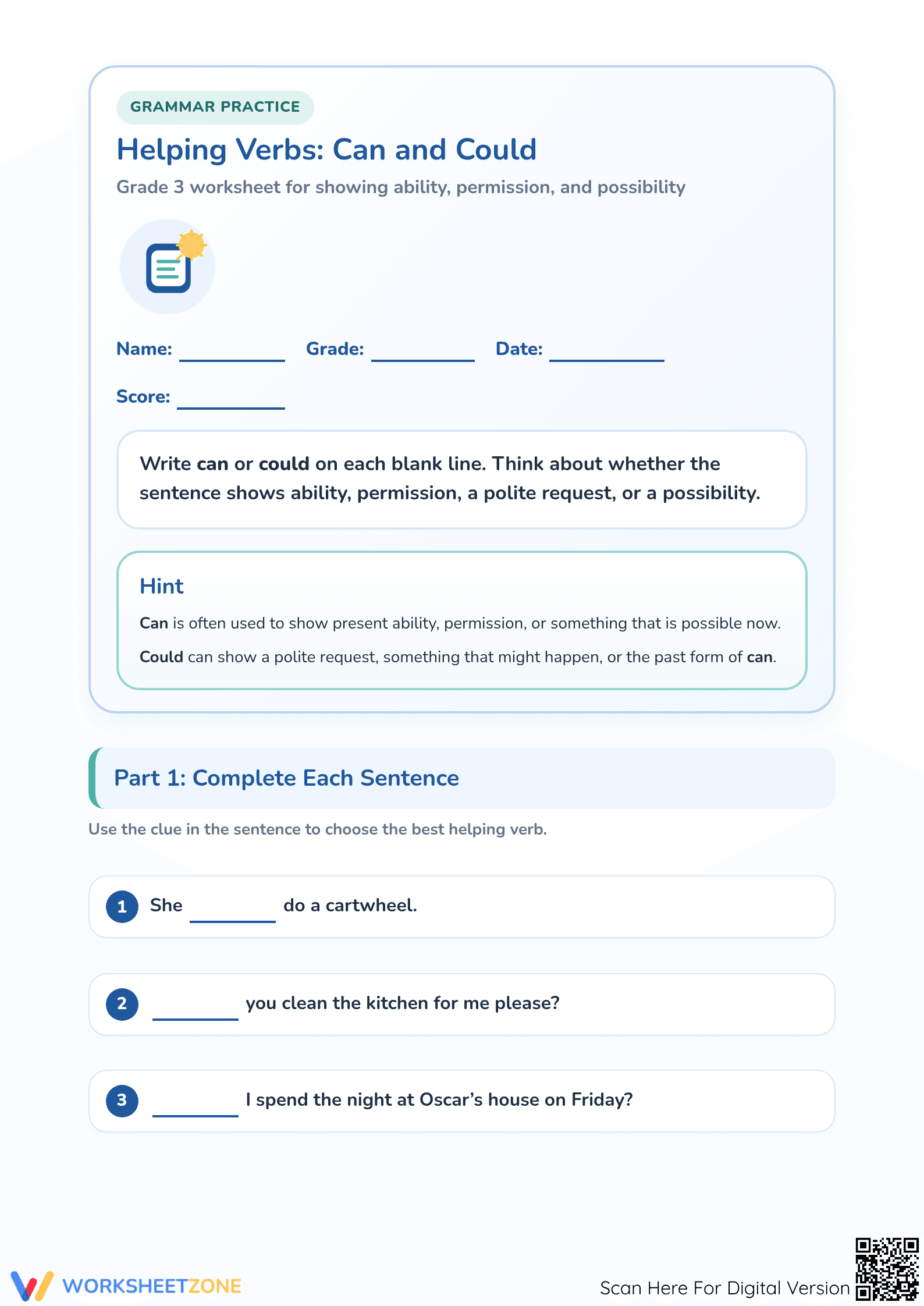
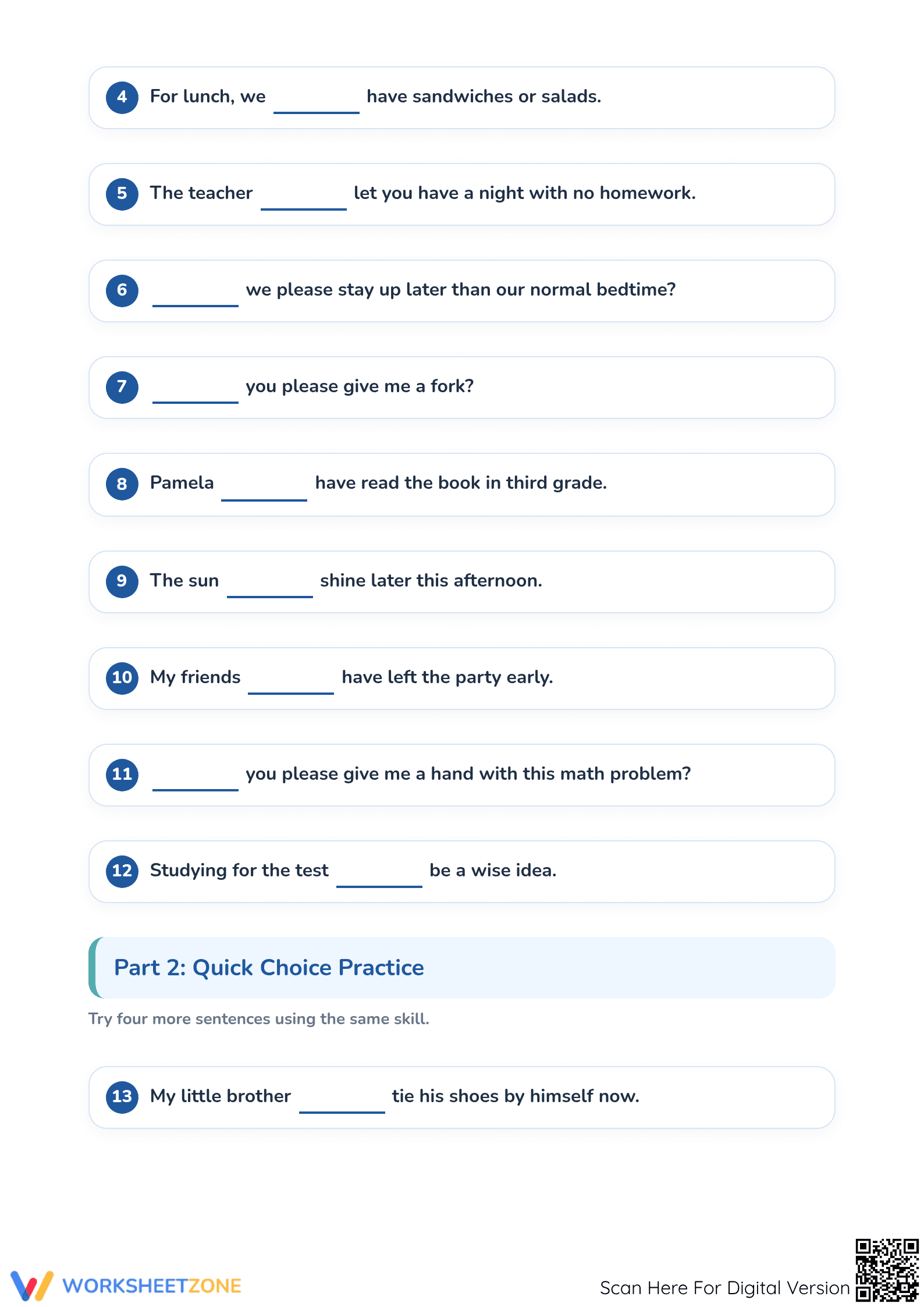
This Grade 3 helping verbs worksheet provides students with 16 targeted practice sentences to master the distinction between "can" and "could." By analyzing context clues related to ability, permission, and possibility, learners develop the grammatical precision necessary for clear communication. Students will successfully identify the correct modal auxiliary to complete each sentence accurately.
At a Glance
- Grade: 3 · Subject: ELA
- Standard:
CCSS.ELA-LITERACY.L.3.1— Demonstrate command of the conventions of standard English grammar and usage- Skill Focus: Helping Verbs (Can/Could)
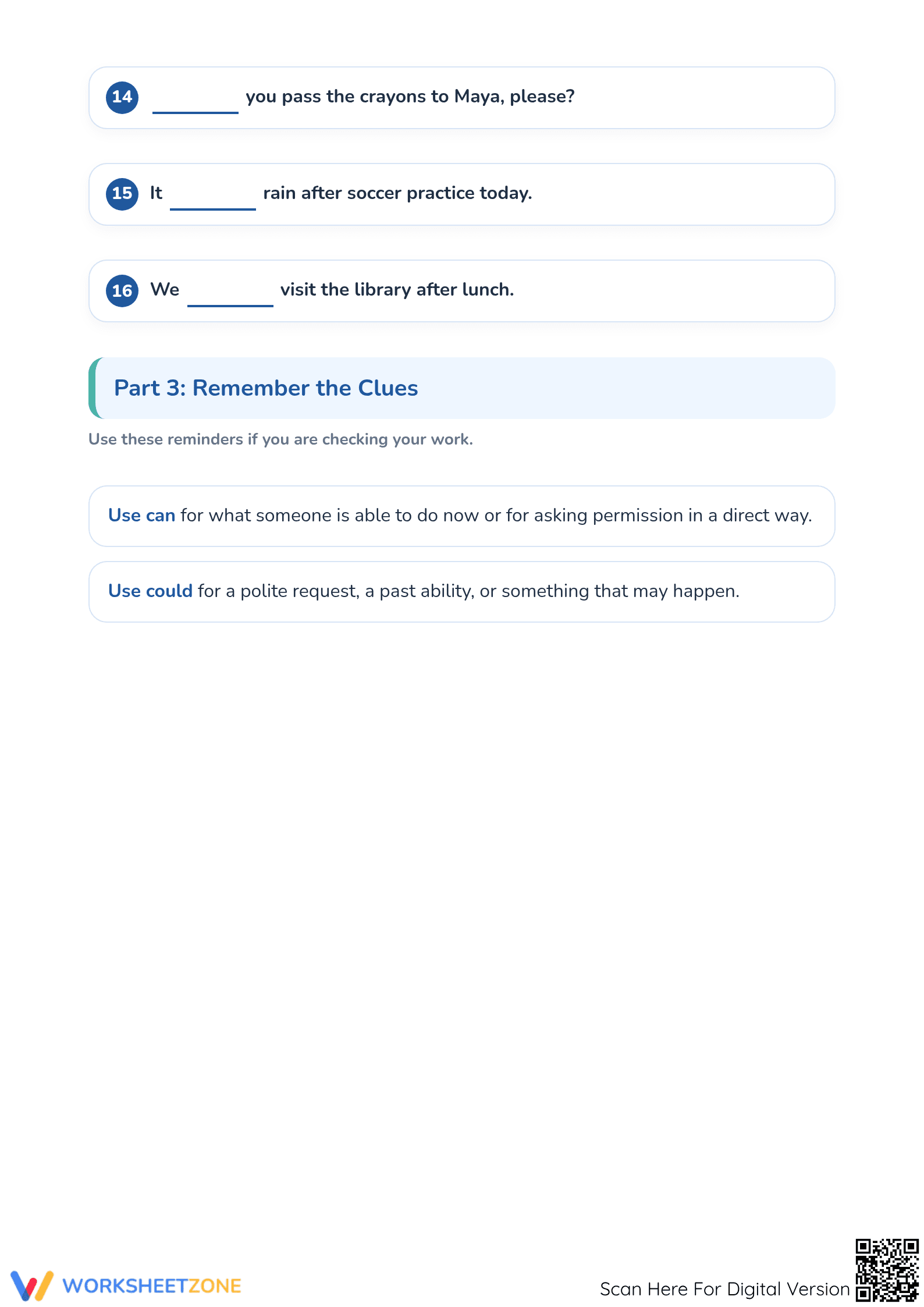
- Format: 3 pages · 16 problems · Answer key included · PDF
- Best For: Grammar centers and independent practice
- Time: 15–20 minutes
What's Inside: This 3-page PDF includes a comprehensive instructional header with "Hint" boxes that define the usage of each helping verb. The worksheet features 16 fill-in-the-blank sentences divided into two practice parts, followed by a "Remember the Clues" summary section. A full answer key is provided to facilitate quick grading or student self-correction.
Skill Progression
- Guided Practice: The first 3 problems include explicit context clues to help students choose between present ability and polite requests.
- Supported Practice: Problems 4 through 12 require students to distinguish between possibility and permission with decreasing scaffolding.
- Independent Practice: The final "Quick Choice" section challenges students to apply their knowledge to new sentences without immediate hints.
This gradual-release approach ensures students move from basic identification to confident application using the I Do, We Do, You Do model.
Standards Alignment: The primary focus is CCSS.ELA-LITERACY.L.3.1, which requires students to "Demonstrate command of the conventions of standard English grammar and usage when writing or speaking." This worksheet specifically targets the nuanced use of modal auxiliaries to express different moods and conditions. This standard code can be copied directly into lesson plans, IEP goals, or district curriculum mapping tools.
How to Use It: Use this worksheet as a formative assessment after an introductory lesson on modal verbs. It is ideal for a "You Do" independent practice phase where students work quietly to demonstrate their understanding of ability versus possibility. Teachers can observe student choices during the "polite request" items to gauge social-linguistic awareness. Completion typically takes 15 to 20 minutes.
Who It's For: This resource is designed for third-grade students but serves as an excellent review for fourth graders or a challenge for advanced second graders. It is particularly helpful for English Language Learners (ELLs) who may struggle with the subtle differences between "can" and "could." Pair this with a modal verb anchor chart for maximum instructional impact.
According to the RAND AIRS 2024 report on literacy instruction, targeted grammar practice that isolates specific word classes, such as modal auxiliaries, significantly improves student writing clarity and syntactic variety. This worksheet aligns with these findings by focusing exclusively on the helping verbs "can" and "could" within the CCSS.ELA-LITERACY.L.3.1 framework. By providing 16 distinct contextual applications, the resource ensures that students move beyond rote memorization toward a functional understanding of how these verbs signal ability, permission, and possibility. Research from Fisher & Frey (2014) supports this type of scaffolded practice as essential for the gradual release of responsibility. Educators can rely on this structured approach to bridge the gap between isolated grammar rules and fluent, expressive writing in the elementary classroom.


