


























Views
Downloads




Helping Verbs: Could Worksheet | Grade 3 Essential
Paste this activity's link or code into your existing LMS (Google Classroom, Canvas, Teams, Schoology, Moodle, etc.).
Students can open and work on the activity right away, with no student login required.
You'll still be able to track student progress and results from your teacher account.
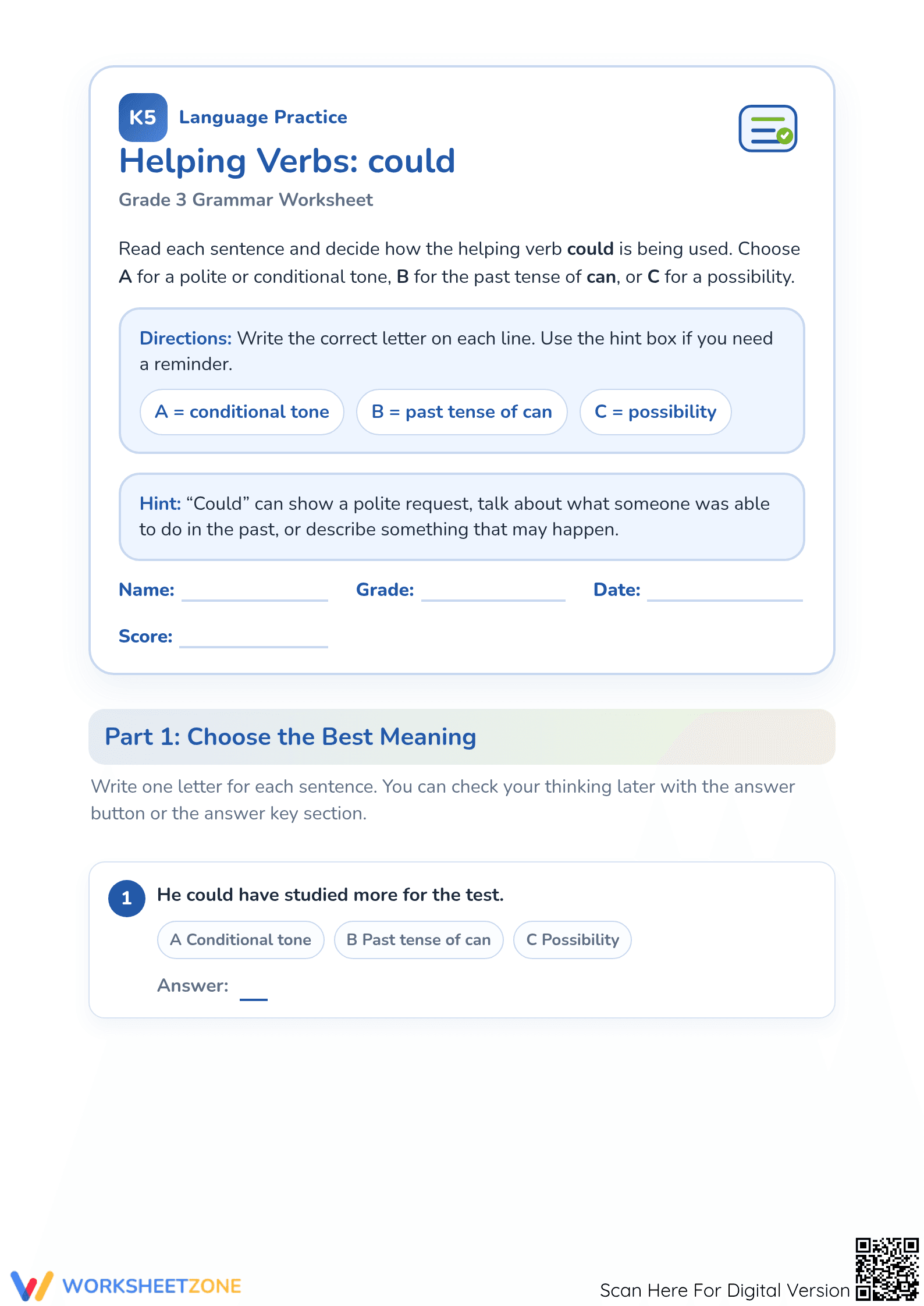
This Grade 3 grammar worksheet helps students master the nuances of the helping verb "could." By analyzing 12 distinct sentences, learners identify whether the verb indicates a polite request, a past ability, or a future possibility. This targeted practice ensures students understand how modal auxiliaries change the tone and meaning of a sentence.
At a Glance
- Grade: 3 · Subject: ELA
- Standard:
CCSS.ELA-LITERACY.L.3.1— Demonstrate command of the conventions of standard English grammar and usage when writing- Skill Focus: Modal Helping Verbs (Could)
- Format: 5 pages · 12 problems · Answer key included · PDF
- Best For: Independent grammar practice or homework
- Time: 15–20 minutes
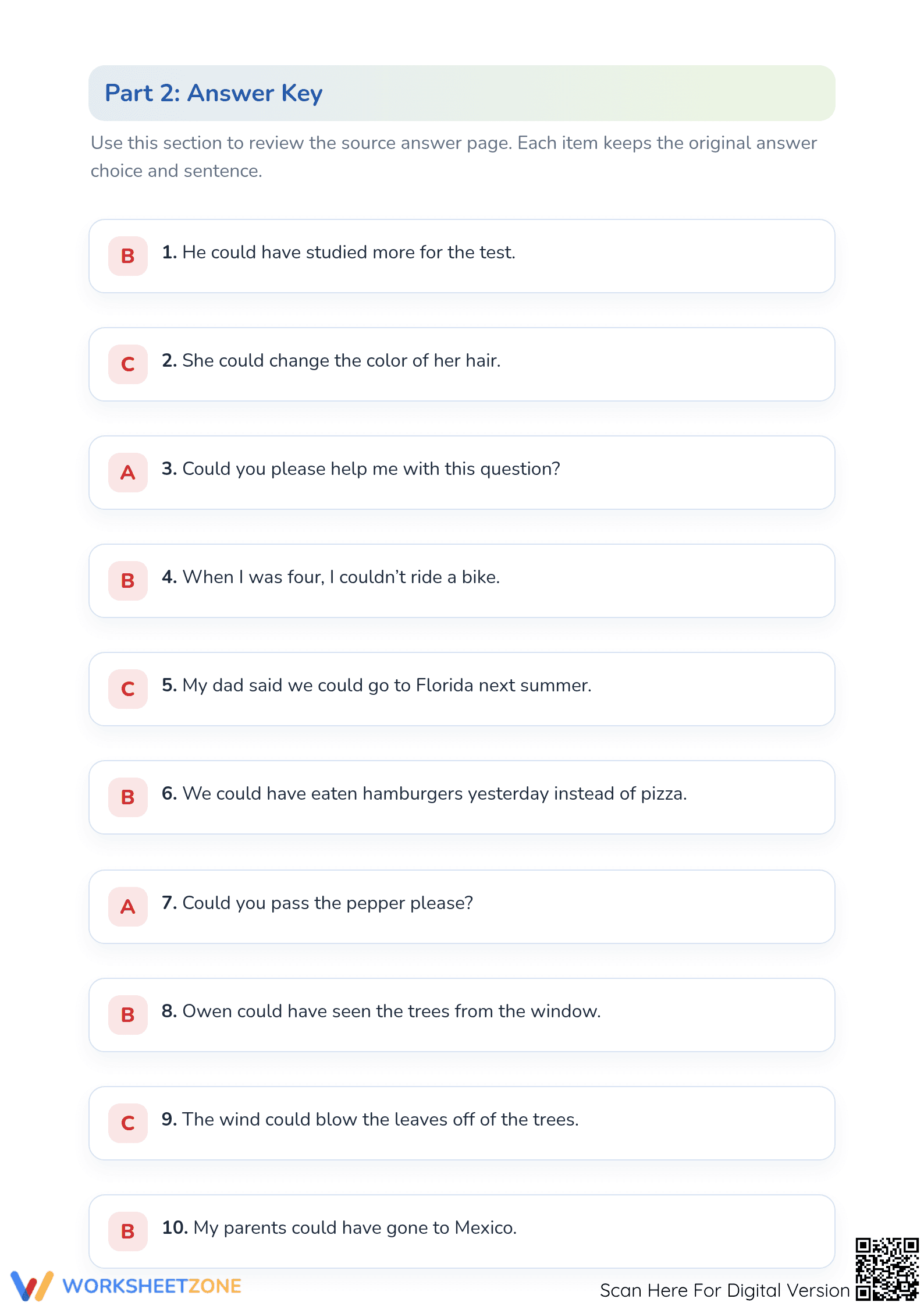
The resource contains three pages of student tasks and a comprehensive two-page answer key. Each of the 12 problems presents a complete sentence featuring the word "could." Students use a multiple-choice format (A, B, or C) to categorize the verb's function. A helpful "Hint Box" at the top provides clear definitions for conditional tones, past tense usage, and possibility to support independent work.
Skill Progression
- Guided practice: The worksheet begins with a hint box that defines the three primary uses of the verb, providing a clear reference point for students.
- Supported practice: Students evaluate sentences with clear contextual clues, such as "When I was four," to help them distinguish between past tense and possibility.
- Independent practice: 12 unique tasks require students to apply their knowledge to various sentence structures without direct teacher intervention.
This gradual-release approach builds student confidence in identifying modal functions through repetitive, successful application.
Standards Alignment
This worksheet is aligned with `CCSS.ELA-LITERACY.L.3.1`, which requires students to demonstrate command of the conventions of standard English grammar and usage. Specifically, it introduces the concept of modal auxiliaries, a skill that bridges Grade 3 foundational grammar with Grade 4 requirements for modal verbs. Both standard codes can be copied directly into lesson plans, IEP goals, or district curriculum mapping tools.
How to Use It
Use this worksheet as a formative assessment after a direct instruction lesson on helping verbs. It is particularly effective during the "independent practice" phase of a lesson. Teachers can observe students as they work; if a student consistently confuses "possibility" with "conditional tone," it indicates a need for small-group re-teaching. Expect students to complete the 12 items in approximately 15 to 20 minutes.
Who It's For
This resource is designed for third-grade students but is also suitable for fourth-grade review or English Language Learners (ELL) who are mastering English verb nuances. It pairs naturally with a classroom anchor chart on modal verbs or a short reading passage where students can highlight helping verbs in context.
According to research from Fisher & Frey (2014) on the gradual release of responsibility, providing students with clear categorical frameworks—like the three-part function of "could" used here—significantly improves the retention of complex grammatical rules. This worksheet addresses CCSS.ELA-LITERACY.L.3.1 by isolating the specific lexical function of modal auxiliaries, allowing students to move beyond simple identification toward functional understanding. By categorizing 12 unique sentence examples, learners develop the linguistic sensitivity required for standard English proficiency. Such targeted practice is essential for Grade 3 students as they transition from basic sentence construction to more nuanced writing. The inclusion of a clear answer key and a hint box aligns with best practices for self-regulated learning, ensuring that students receive immediate feedback on their mastery of helping verbs.


