


























Views
Downloads


Helping Verbs: Can Worksheet | Grade 3 Essential
Paste this activity's link or code into your existing LMS (Google Classroom, Canvas, Teams, Schoology, Moodle, etc.).
Students can open and work on the activity right away, with no student login required.
You'll still be able to track student progress and results from your teacher account.
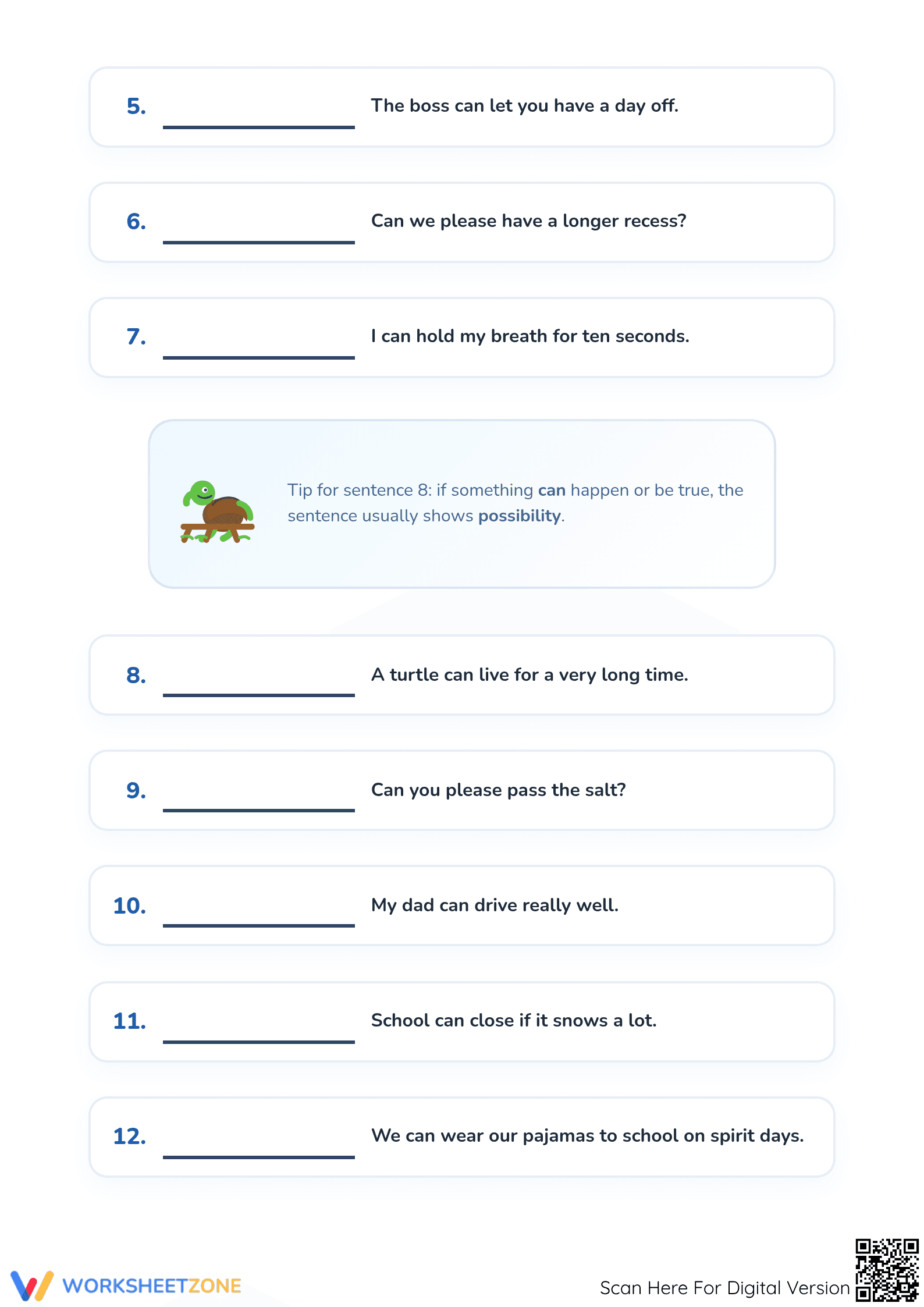
This Grade 3 grammar worksheet helps students master the nuances of the helping verb "can." By analyzing 12 distinct sentences, learners determine if the verb expresses ability, permission, willingness, or possibility. This targeted practice ensures students understand how modal verbs function to change the meaning of a main verb in context.
At a Glance
- Grade: 3 · Subject: ELA
- Standard:
CCSS.ELA-LITERACY.L.3.1— Explain the function of verbs and their specific roles in sentences- Skill Focus: Modal Helping Verbs (Can)
- Format: 4 pages · 12 problems · Answer key included · PDF
- Best For: Independent grammar practice and assessment
- Time: 15–20 minutes
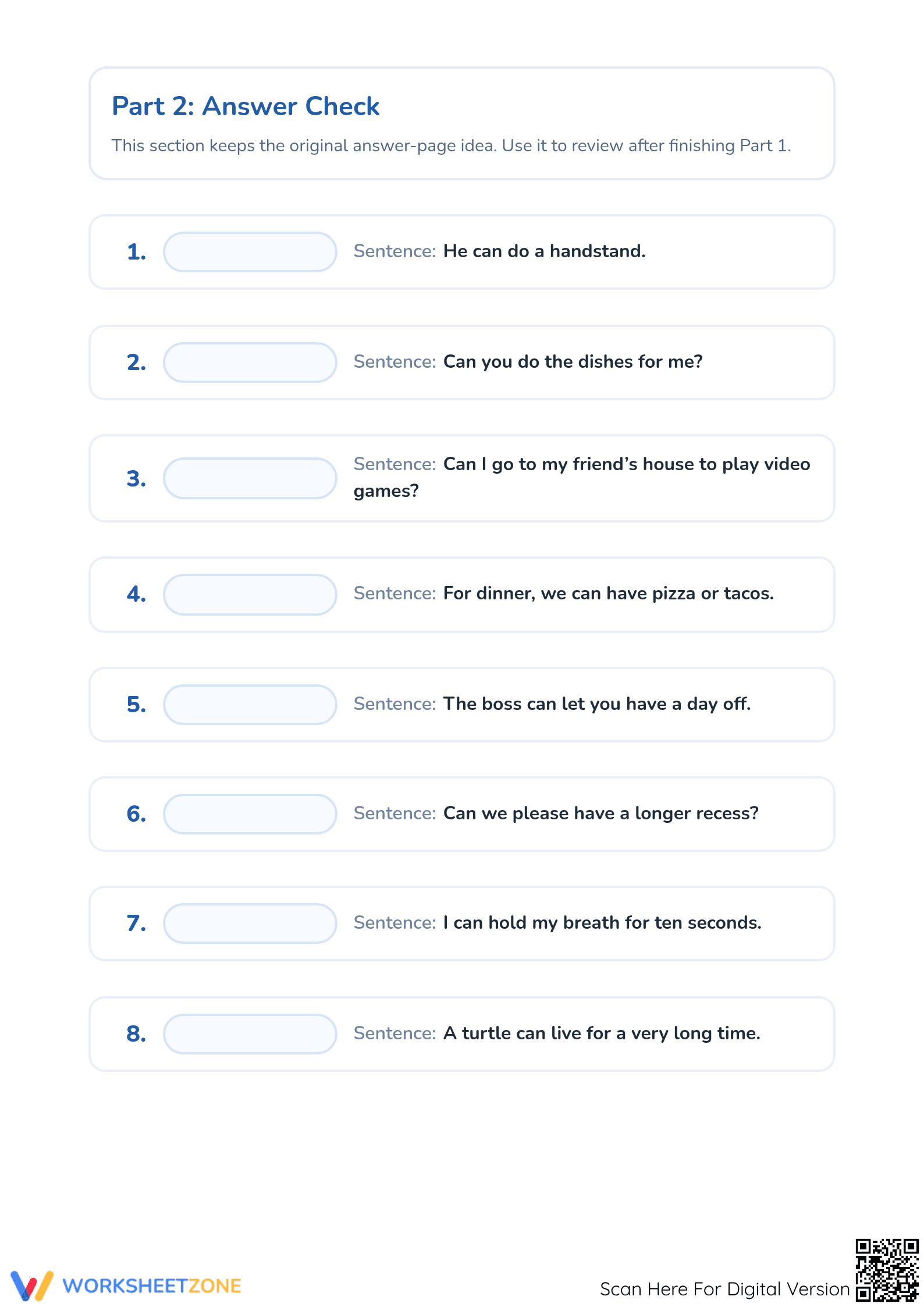
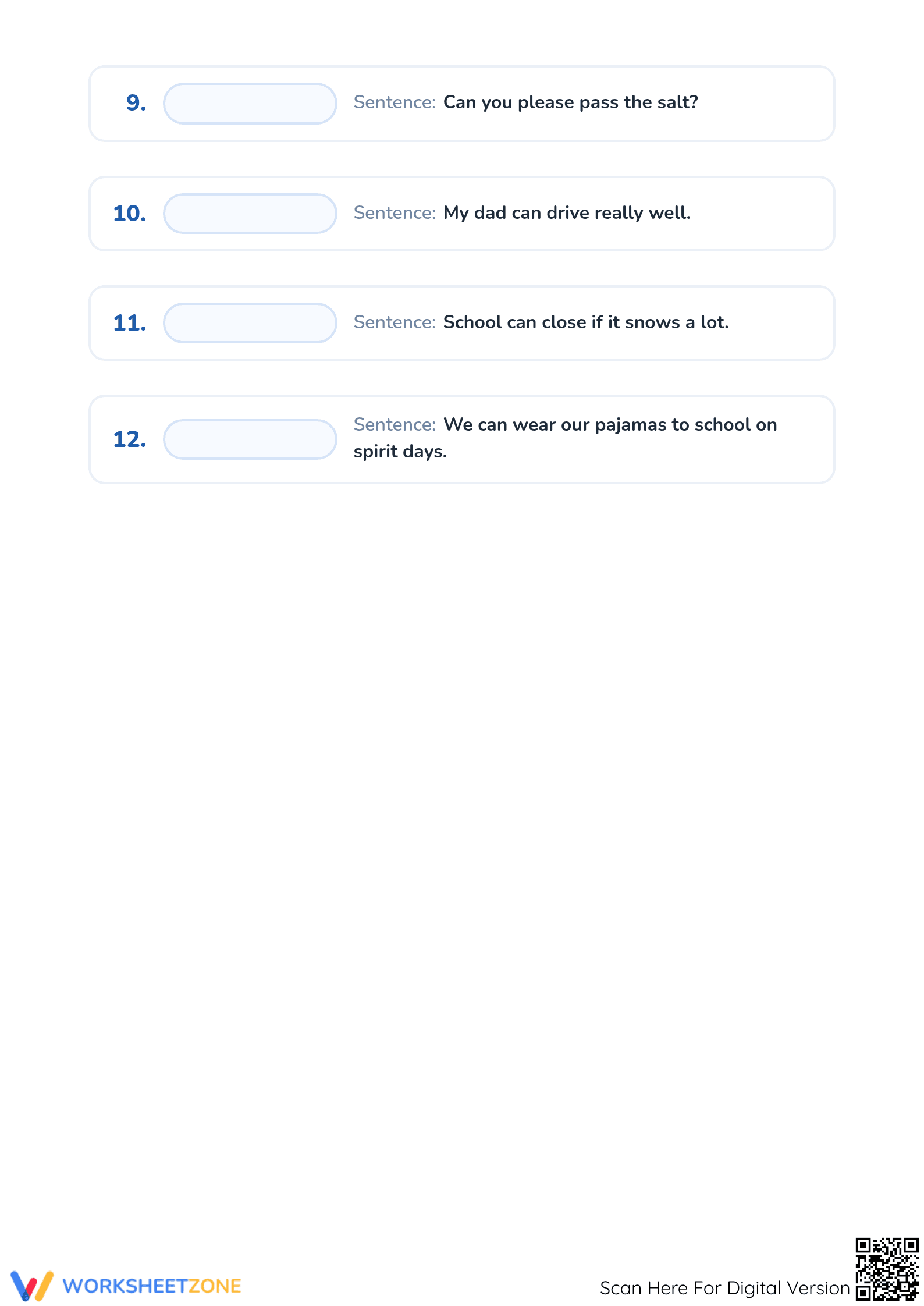
The resource contains a structured 12-item practice set where students categorize the usage of "can." It includes a helpful "Hint" box that defines the four primary uses of the verb. The layout features clear spacing for handwriting and a dedicated "Answer Check" section for immediate feedback or teacher-led review.
The zero-prep workflow is designed for busy classrooms. First, print the 4-page PDF (1 minute). Second, distribute the practice sheets to students for independent work (10-15 minutes). Finally, use the integrated Answer Check pages to review responses as a whole group or for self-grading (5 minutes). This makes it an ideal resource for emergency sub plans or morning work.
Standards Alignment
This worksheet aligns with CCSS.ELA-LITERACY.L.3.1, which requires students to demonstrate command of standard English grammar. Specifically, it addresses the function of verbs in particular sentences. By identifying the intent behind "can," students build the foundational knowledge required for more complex modal auxiliary verbs in later grades. Both standard codes can be copied directly into lesson plans, IEP goals, or district curriculum mapping tools.
How to Use It
Use this worksheet during the "You Do" phase of a gradual release lesson on helping verbs. It serves as an excellent formative assessment tool; observe if students struggle to distinguish between "permission" and "possibility" to identify who needs small-group intervention. Expected completion typically takes 15 to 20 minutes depending on reading speed.
Who It's For
This resource is tailored for third-grade students but is also highly effective for older ELL learners who are mastering English modal verbs. It pairs naturally with a classroom anchor chart on helping verbs or a direct instruction lesson on sentence structure.
The mastery of modal verbs like "can" is a critical component of syntactic development in middle childhood. According to Fisher & Frey (2014), providing students with structured opportunities to analyze word functions within varied sentence contexts facilitates the transition from basic decoding to sophisticated language use. This worksheet targets CCSS.ELA-LITERACY.L.3.1 by requiring students to evaluate the semantic intent of helping verbs across 12 unique scenarios. Research indicates that explicit grammar instruction, when paired with immediate feedback mechanisms like the included answer key, significantly improves a student's ability to apply these rules in their own writing. By distinguishing between ability, permission, willingness, and possibility, learners develop the linguistic precision necessary for meeting Grade 3 literacy benchmarks. This resource provides the high-repetition, low-stakes practice environment recommended by the NAEP for reinforcing core grammatical conventions in the elementary classroom.


