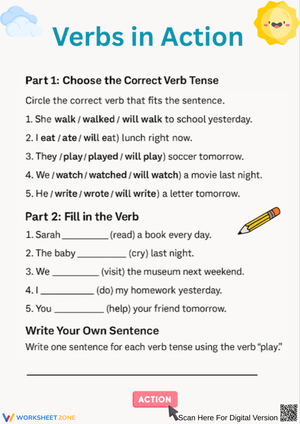
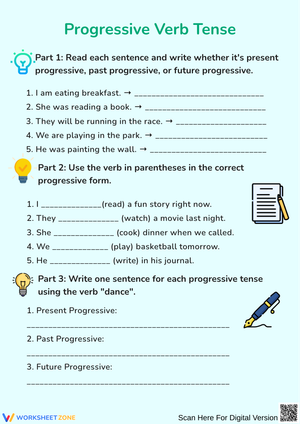
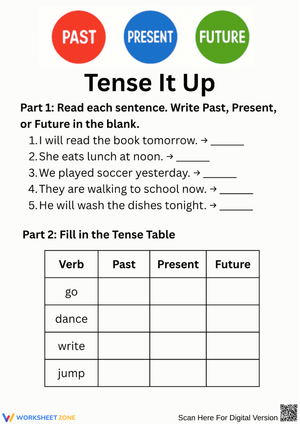
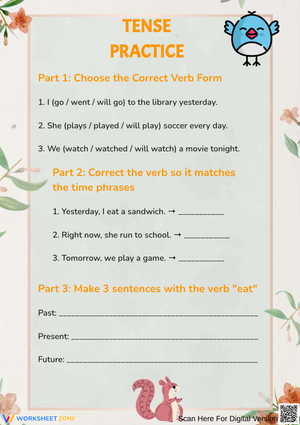
These present tense verbs pdf worksheets for 3rd grade give teachers a targeted grammar set covering subject-verb agreement, verb spelling patterns, and irregular forms — the three areas where third graders most reliably need focused practice before those skills transfer into their own drafts.
What Each Worksheet Builds
The set targets the skill progression third graders move through during a verb unit. The skills are sequenced so that simpler pattern work comes before the more cognitively demanding tasks like editing in context.
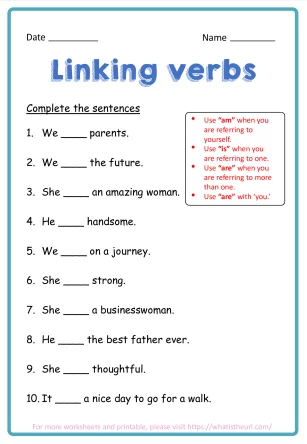
- Basic subject-verb agreement — students identify the subject, determine singular or plural, then write or select the matching verb form.
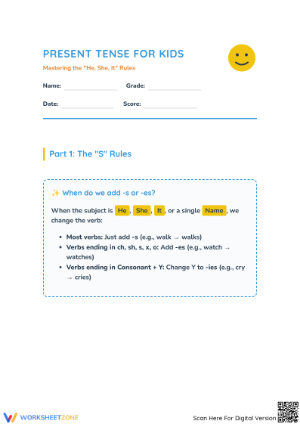
- -s vs. -es endings — verbs ending in consonant clusters (-ch, -sh, -x, -ss, -z) get sorted and completed, making the pronunciation-driven spelling rule explicit.
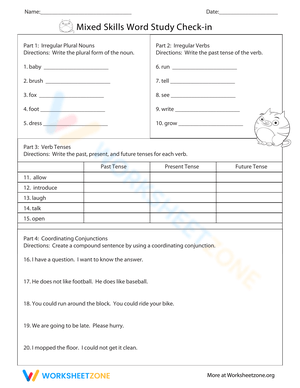
- The -y to -ies change — students practice the spelling shift for verbs like carry → carries and try → tries, where the pattern differs from the noun plural equivalent.
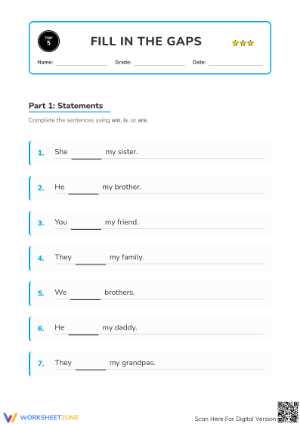
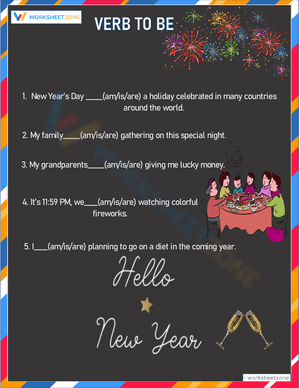
- Irregular present tense forms — focused work on to be (am, is, are), to have (have, has), and to do (do, does), the verbs students use daily in writing but misuse at a high rate.
- Paragraph editing — students read a short passage and mark every agreement error, connecting isolated rule knowledge to real text revision.
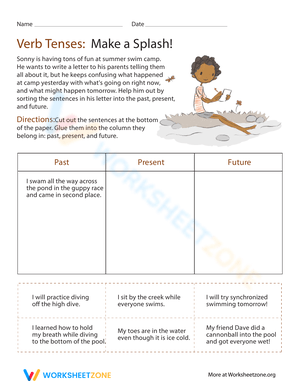
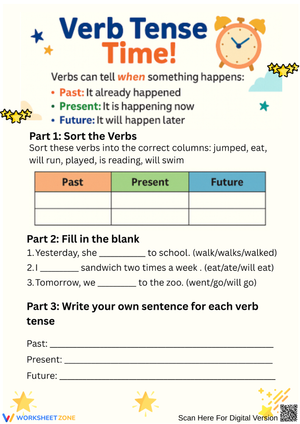
Having the present tense verbs pdf worksheets for 3rd grade span multiple task types — fill-in-the-blank, sorting, sentence transformation, and paragraph editing — matters because performance varies sharply by format. A student who breezes through isolated sentences will often make agreement errors the moment the same verb appears embedded in a paragraph. Seeing exactly where the breakdown happens tells you more than a single score does.
Where Third Graders Consistently Go Wrong
The most persistent mistake involves a genuine cognitive reversal. Adding -s to a noun signals plural: dog → dogs. But adding -s to a present-tense verb signals singular: he runs. Third graders who have spent two years learning that -s means "more than one" find it counterintuitive that the boys run has no -s on the verb while he runs does. The error isn't carelessness — it's the noun rule being applied where the verb rule belongs. Students write "the boys runs together" just as often as they write "he run fast," and both errors come from the same underlying confusion.
A second consistent pattern: students who correctly spell flies as a noun (the insect) revert to flys when they need the verb form. The noun plural and the verb conjugation feel like separate, unrelated words to them, which means recognizing the form isn't the same as applying the rule. Error correction worksheets make this visible fast. When a student marks "The bird flys south" as correct, you know exactly what still needs direct attention.
Standard Alignment
CCSS.ELA-LITERACY.L.3.1.D requires third graders to form and use regular and irregular verbs. In most classroom sequences this standard follows noun and pronoun function work (L.3.1.A) and lands in the grammar block between October and January. Its placement in the calendar matters: subject-verb agreement in present tense is the bridge skill between sentence-level grammar and meaningful revision. Students who haven't solidified it find themselves correcting agreement and generating ideas simultaneously during writing workshop, which overloads both tasks. Handling the agreement mechanics in focused grammar practice first lets writing time stay focused on writing.
How to Work These Worksheets Into Your Lesson Planning
The fill-in-the-blank and sorting worksheets fit naturally as a 10-minute warm-up before a writing block. Four or five sentences of agreement practice keeps the concept active during a unit without consuming instructional time. Error correction worksheets work differently — those belong at the end of a lesson, especially the last 8 minutes before transition. Display the paragraph on the board first, work through one sentence with the class, then release students to complete the rest independently. That gradual release keeps the cognitive load manageable for students who find editing in context harder than isolated sentence work.
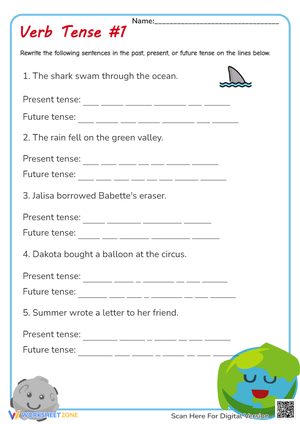
The present tense verbs pdf worksheets for 3rd grade focused on sentence transformation — where students rewrite a sentence by switching the subject from singular to plural or vice versa — are worth pulling for small-group instruction. When you're sitting with three or four students who are still writing "she have" or "they runs" in their drafts, those transformation exercises make the agreement shift explicit in a way that circling errors on a returned draft alone never does.
Adjusting the Work for Different Learners in the Room
For students who need more support — including English language learners whose home language doesn't mark singular agreement with a verb suffix — add a reference strip at the top of each worksheet showing the three spelling rules with one example of each. This isn't simplifying the task. It reduces the memory demand so students can practice applying the rule rather than trying to reconstruct it from scratch on every item. Students who are guessing don't build the pattern; students who can reference it while working do.
Advanced students who have mastered basic agreement move directly to the paragraph editing worksheets, which require holding multiple rules active while processing continuous text. A strong extension: after completing an error correction worksheet, ask those students to rewrite two of the corrected sentences using a different subject, forcing them to apply the rule in both directions. Some teachers also use this group to write short paragraphs with planted errors for classmates to find — a task that requires considerably deeper rule understanding than correcting someone else's mistakes.
Frequently Asked Questions
Do the worksheets address both regular and irregular present tense verbs?
Yes. Regular verb endings (-s, -es, -ies) and irregular forms are handled in separate worksheets so students build automatic recognition of irregular forms before encountering them alongside spelling pattern rules. The irregular focus is primarily on to be, to have, and to do — the verbs that appear most frequently in third-grade writing and that generate the highest rate of agreement errors in student work.
Are these appropriate for students who are still shaky on identifying sentence subjects?
Students who can't reliably identify the subject of a sentence will find agreement practice frustrating rather than useful. A 10-minute anchor lesson on what a subject is, with three or four worked examples, makes the worksheets productive. The fill-in-the-blank format with a word bank is accessible for students who need structured support after that initial instruction; the paragraph editing format is not the right starting point for those students.
When in the year do most third-grade teachers use these?
Subject-verb agreement in present tense typically appears in the grammar sequence mid-fall through early winter, after basic sentence parts have been covered. That timing places it right when students are producing their first longer writing pieces, so agreement accuracy becomes immediately applicable — not just a grammar exercise but something students can look for in their own work. Using present tense verbs pdf worksheets for 3rd grade as a review set in late winter also aligns with state assessment preparation, since verb usage in context appears across third-grade writing prompts and on-demand tasks.












 Interactive Worksheet Maker
 Quiz Maker
 Word Search Maker
 Crossword Puzzle Maker
 Word Scramble Generator
 Sentence Scramble Generator
 Handwriting Worksheet Generator
 Name Tracing Generator
 Fill In The Blank Generator