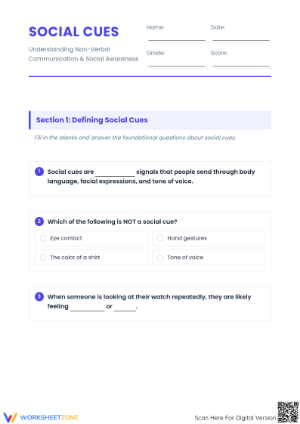
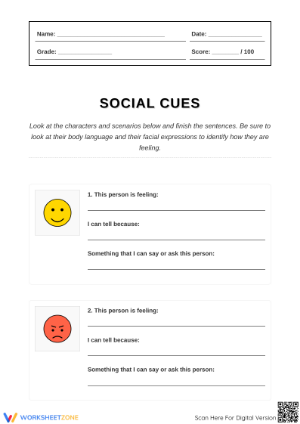
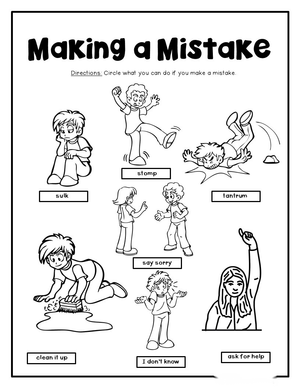
Social Skills for Autism Printable Worksheets for 11th Grade
Social skills for autism printable worksheets for 11th grade address a specific instructional gap that surfaces in junior year: IEP transition planning has moved from goal-setting to preparation for actual post-secondary environments, and the social demands students face are increasingly adult in character. A 17-year-old on the spectrum needs practice with a job interview, not a lesson on taking turns in conversation. These worksheets give transition coordinators and special education teachers printable, scenario-based tools for that work — adult-context interactions broken into steps students can analyze, rewrite, and carry into real situations.
What Each Worksheet Covers
The set spans five skill domains that appear consistently in transition plans for high school juniors on the spectrum. Each worksheet targets one domain rather than bundling multiple concepts together, which makes it straightforward to match materials directly to the objectives in a student's current IEP.
- Workplace communication: Students read job interview transcripts and mark responses as effective or ineffective, then rewrite the weak ones. Separate worksheets cover how to receive critical feedback from a manager without shutting down, how to ask a clarifying question without seeming difficult, and the unspoken norms of break-room conversation — which is its own distinct register, separate from both formal and casual peer interaction.
- Self-advocacy: Students practice the exact language of requesting accommodations — at a college disability services office, during a professor's office hours, and with a workplace supervisor. Each worksheet presents multiple versions of the same request and asks students to identify which phrasing is most likely to succeed and explain why.
- Language register: Students compare two versions of the same message — one casual, one professional — and identify the specific markers that distinguish them. This is harder than it sounds for students who have learned social behavior rules but have not yet internalized that register is situational, not a reflection of character.
- Digital communication: Worksheets present email drafts with embedded tone errors and ask students to identify and revise them. One worksheet focuses specifically on the difference between a private message and a public social media post in terms of permanence and what a future employer can see.
- Community navigation: Scenario-based practice for interactions at the bank, pharmacy, and transit information desk. Students map out the conversation before it happens — who to approach, what to say first, how to handle a response that doesn't match the expected script.
Frequent Errors Worth Catching Before They Become Habits
The most persistent pattern in this skill area is over-literalism with learned rules. A student who has been taught "maintain eye contact" will often interpret that as sustained, unblinking focus — which reads as unsettling or aggressive to an interviewer, not confident. The rule was learned correctly in isolation; the problem is that it gets applied too rigidly in a new context. A worksheet that shows two versions of the same interview — one with natural intermittent eye contact, one with unbroken staring — and asks students to consider how the interviewer likely experienced each version redirects the goal from rule compliance to actual connection.
In self-advocacy tasks, two opposite errors appear with roughly equal frequency. Some students refuse to disclose any need at all, having absorbed the message that asking for help is an imposition. Others overcorrect and phrase requests as demands: "You need to give me more time" instead of "I'd like to request extended time because of a documented disability." Worksheets that present three different phrasings of the same accommodation request and ask students to rate how each is likely to land — then explain their reasoning — surface this pattern quickly. That "explain your reasoning" step is what makes the exercise instructionally useful; it shows the teacher not just what the student chose but how they're thinking about perspective-taking.
Digital communication produces a third, entirely predictable error: students write professional emails in text-message register. Sentences like "hey can you send me the info again" appear in real emails from students who have no functional framework for register-switching in written form. A worksheet that places five email openers on a spectrum from casual to formal, asks students to sort them, and then asks them to write a professional version of the most casual one addresses this directly — and usually triggers a class conversation about why the distinction matters, which is where the actual learning happens.
Building These Worksheets Into the Weekly Schedule
Advisory periods — typically 20 to 25 minutes — are the most workable slot for most 11th-grade schedules that don't include a dedicated transition or life skills block. The community navigation worksheets complete comfortably in about 15 minutes, leaving time for a brief debrief. The language register comparisons tend to run longer when students connect the examples to their own experience, which is worth letting happen — that connection is the point.
The most effective use pattern pairs worksheet analysis with a short role-play immediately after. Once a student has worked through a job interview scenario on paper and written a revised response, acting out that same scenario uses the written work as a rehearsal map rather than starting the role-play cold. Students who resist role-play still gain from the written analysis alone; the "what would you do and why" reasoning is what transfers to new situations, not the performance itself.
Social skills for autism printable worksheets for 11th grade also generate documentation that transition teams can use directly. When a student completes worksheets across six to eight weeks on self-advocacy, the teacher has a concrete record of how that student phrases accommodation requests, where the language breaks down, and how their reasoning has shifted over time. That's more useful in an IEP meeting than a general anecdotal note — it gives the team specific evidence of where the student is and what instruction should come next.
Standard Alignment
These worksheets align with IDEA 2004's transition services mandate, which requires that IEPs for students aged 16 and older include measurable postsecondary goals and coordinated transition services in the areas of education, employment, and independent living. The workplace communication and self-advocacy worksheets map directly to those employment and independent living goal areas. The language register and digital communication worksheets address CCSS.ELA-LITERACY.W.11-12.4 — producing writing appropriate to task, purpose, and audience — in a context with immediate practical relevance rather than purely academic application. For teachers in states that maintain their own transition competency frameworks, the five skill domains covered here correspond to what most state frameworks classify as "employment readiness" and "self-determination" competencies.
Adjusting the Set for a Range of Learners
For students with limited written expression, the scenario-based worksheets adapt easily to a structured-choice format: present three possible responses to a job interview question and ask the student to select the strongest one, then explain orally why. The oral explanation is the non-negotiable part. Selecting a correct answer without articulating the reasoning doesn't transfer to real situations — and it doesn't give the teacher anything useful to work from.
For students who are already competent in a given domain, social skills for autism printable worksheets for 11th grade work differently — not as remediation but as a prompt for more complex reasoning. The most productive modification at this end of the ability range is increasing ambiguity: present a scenario where the right social choice is genuinely unclear, and ask the student to reason through two or three possibilities rather than identify one correct answer. Building that cognitive flexibility is harder to find in off-the-shelf materials, and it is exactly what higher-functioning students at this level need most before they enter environments that won't give them obvious signals.
Frequently Asked Questions
How do these worksheets connect to IEP transition goals?
Each worksheet targets a skill area that maps to the goal categories IDEA recognizes in transition planning — employment, postsecondary education, and independent living. Teachers can select worksheets that correspond directly to the objectives in a student's current transition plan and use completed worksheets as written progress documentation. If a goal reads "student will practice requesting accommodations in at least two simulated post-secondary settings," the self-advocacy worksheets provide exactly that simulation and generate a written record of each attempt — the kind of evidence that's straightforward to reference during progress reporting and IEP meetings.
Are these worksheets appropriate for students with limited written expression?
Yes, with adjustment. Students who struggle to produce extended written responses can answer scenario prompts orally while the teacher records key points, or the worksheets can be modified to offer structured response options rather than open-ended writing. The core task — reading a scenario, identifying effective versus ineffective social choices, and reasoning through likely outcomes — stays intact even when the output format changes.
Do these materials work in an inclusive general education classroom?
They do. Professional communication, self-advocacy, and digital etiquette are relevant to all 11th graders, and using social skills for autism printable worksheets for 11th grade in a mixed classroom creates peer discussion that a self-contained setting can't replicate. Neurotypical students frequently surface their own gaps in professional register and email tone during those conversations — they've often never had explicit instruction in these areas either. The main adjustment in an inclusive setting is framing the material around transition readiness broadly, rather than positioning it as intervention.
How often should these worksheets be used to see measurable progress?
Weekly practice is the minimum for building real fluency in these skills. Monthly use isn't frequent enough — these are behaviors that require repeated rehearsal across varied scenarios, not periodic review. A once-per-week rotation, one worksheet per session followed by brief discussion or a short role-play, gives teachers enough data across a semester to document movement on IEP goals and gives students enough repetition to start applying the reasoning on their own rather than simply completing the task and moving on.
Clear All