Social Skills for Teens Worksheets for 11th Grade
Social skills for teens worksheets for 11th grade give teachers something concrete to work with when the curriculum expectation is "build communication skills" but the structure to actually do it is missing. By junior year, students are navigating group projects, part-time jobs, internships, and early postsecondary conversations — contexts that demand real communication skill, not just good intentions. These worksheets make the demands of those situations visible and give students a chance to think through their responses before they're in the middle of something difficult.
The Specific Skills Targeted Across This Set
Each worksheet focuses on one skill area rather than trying to cover everything at once. That specificity matters because 11th graders have short patience for activities that feel vague or catch-all. The skills covered include:
- Active listening: distinguishing between listening to reply and listening to understand, noticing body language signals, and responding to what the other person actually said
- Conflict resolution: separating facts from assumptions, identifying what someone wants versus what they said, and choosing a next step that doesn't escalate the situation
- Self-advocacy: asking for clarification, requesting accommodations, and speaking up to teachers, supervisors, and peers using direct but respectful language
- Digital communication: interpreting tone in short messages, recognizing when a text could read as aggressive even if it wasn't meant that way, and revising messages for professionalism
- Teamwork and group dynamics: naming what's happening when a group stalls, giving feedback without creating defensiveness, and recognizing one's own role in a problem
- Boundary-setting: using language that says no or not yet without sounding dismissive, and understanding the difference between setting a limit and refusing to cooperate
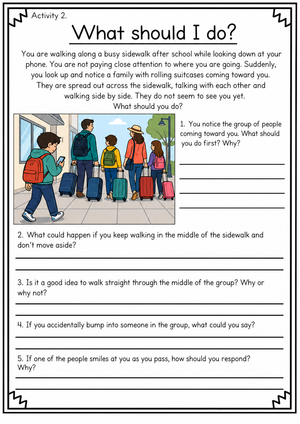
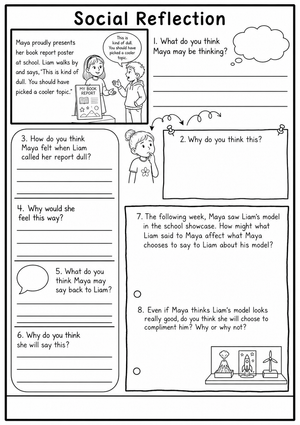
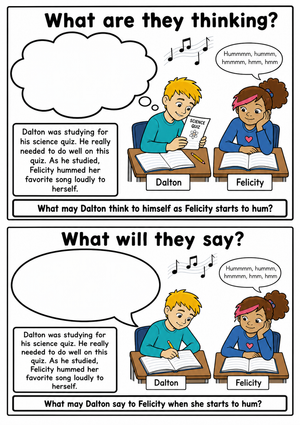
Most exercises follow a consistent format: a short realistic scenario, response options or open-ended prompts, and a reflection question that asks students to explain their reasoning rather than just pick an answer. The emphasis is on judgment and communication — not on identifying the "right" feeling.
Student Errors Worth Anticipating Before the Lesson
The most consistent pattern in 11th-grade social skills work is that students understand the general principle but cannot produce the actual language. A student will write "I would just talk to them" or "I'd tell them how I feel" without being able to fill in what, specifically, they would say. When asked to write the actual sentence, they freeze or default to phrasing so vague it wouldn't function in the real situation. The worksheets address this directly by asking for the specific words — Write exactly what you would say in this moment — which pushes students past the concept and into the execution.
A second pattern shows up in the digital communication exercises: students consistently underestimate how a short message reads to someone who can't hear their tone. A message like "ok fine" lands as passive-aggressive to most peers and adults, even when the student who wrote it meant it neutrally. The gap between intended meaning and received meaning is where the most useful discussion happens, and it surfaces immediately when students revise a message rather than just evaluate one.
Building These Worksheets Into Your Lesson Plans
Advisory is the clearest fit. A 15-minute advisory block can use each worksheet as the primary activity: read the scenario together, give students five or six minutes to write, then open it for discussion. That sequence works because students have committed to a position on paper before anyone has to say it aloud — which tends to draw in students who would otherwise stay quiet through a purely verbal discussion.
In health classes or SEL electives, each worksheet can anchor a longer sequence: written work first, then a partner share, then small-group role-play, then a debrief on what felt realistic and what felt harder than expected. Counseling groups can use the set repeatedly — same format, different scenario — because the familiar structure reduces resistance over time. Career readiness classes benefit from the workplace-facing exercises specifically; the professional message revision and workplace boundary scenarios pair well with job application and interview prep units.
One framing that consistently improves engagement: position each worksheet as preparation for adult communication rather than as behavior practice. When students see the activity as prep for a difficult conversation with a supervisor or a group conflict in a college course, the task stops feeling like a school exercise. Social skills for teens worksheets for 11th grade land differently when that adult-readiness context is explicit from the start.
Standard Alignment
These social skills for teens worksheets for 11th grade connect directly to CASEL's five core competency areas for high school SEL: self-awareness, self-management, social awareness, relationship skills, and responsible decision-making. Schools using Illinois SEL Standards will find the closest alignment at standards 2B (relating to others in respectful ways) and 3C (applying decision-making skills to real-life situations). Schools working within other CASEL-aligned state frameworks should look at the relationship skills and responsible decision-making domains for grades 9–12, where explicit instruction in communication, conflict resolution, and digital interaction is typically listed as a grade-band expectation rather than an implicit goal.
Adapting This Set for a Range of Learners
Social skills for teens worksheets for 11th grade work across general education advisory groups, counseling groups, and special education support settings without requiring a full redesign. The adjustment is usually in the response format. For students who need more structure, two or three sentence-starter options let them choose and complete one instead of generating language from scratch. For students who engage more deeply, the reflection prompt can extend the exercise: "What would you say next if they responded with...?" moves from one exchange into a full communication sequence.
Students who have had repeated negative experiences with SEL activities — especially those who've been pushed into sharing more than they wanted to — tend to disengage quickly from anything that feels therapeutic or intrusive. Keeping the worksheets focused on situations and language rather than personal emotion and self-disclosure maintains broader participation. The question What's the most effective response here and why? is less threatening than How would this make you feel? and often produces more substantive thinking about communication anyway. For students with IEPs that include social skills goals, each worksheet functions as a structured practice opportunity that can tie directly to documented goals around communication or relationship skills — and a case manager can use the same exercises in a pull-out setting that the advisory teacher uses with the whole group.
Frequently Asked Questions
Do these worksheets require a specific SEL program or prior student preparation?
No. Each worksheet stands on its own. You do not need a full SEL curriculum or background reading to use them. They work as standalone activities in advisory, health class, counseling support, or career readiness without any prerequisite student experience with SEL instruction.
How do you use these with students who actively resist SEL activities?
Lead with the scenario, not the label. Most 11th graders will engage with a workplace communication problem or a group-project conflict because those situations are immediately recognizable. Avoid framing the worksheet as a feelings exercise — introduce it as a communication problem worth thinking through. The engagement level is noticeably different when the framing is practical rather than therapeutic.
Can these worksheets be reused with the same group across multiple sessions?
Yes. Counseling groups and advisory classes can return to the same format with new scenarios. Because the structure stays consistent, students move faster into the content rather than spending time figuring out the task. Returning to a familiar format across different situations also builds transfer — students start applying the same thinking pattern when they encounter similar problems outside the worksheet.
What's a realistic time window for one of these activities at the 11th-grade level?
Fifteen to twenty minutes covers most advisory or warm-up uses comfortably. Read the scenario, write a response, discuss — that sequence fits the window without feeling rushed. For counseling groups or SEL elective settings, the same worksheet can anchor a 30-to-45-minute session when paired with role-play and a group debrief on what strategies felt achievable versus what still felt difficult.
Clear All