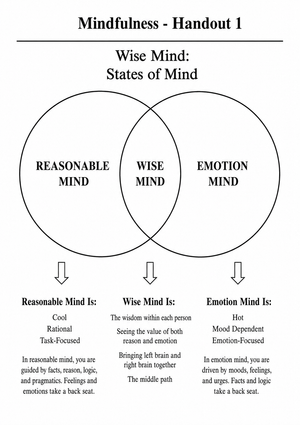
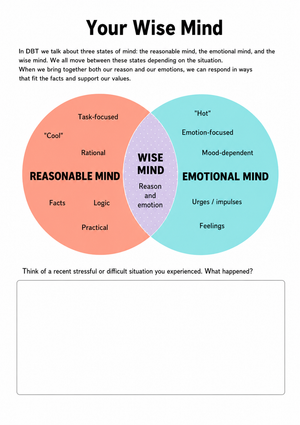
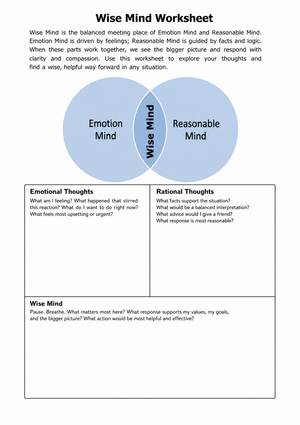
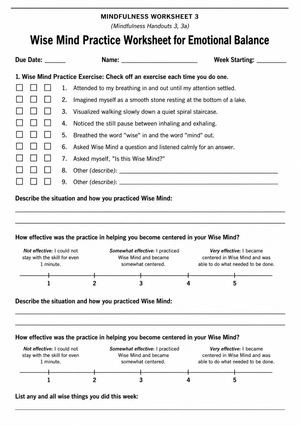
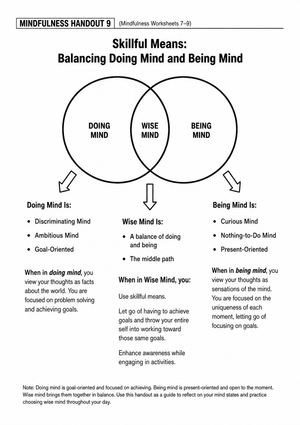
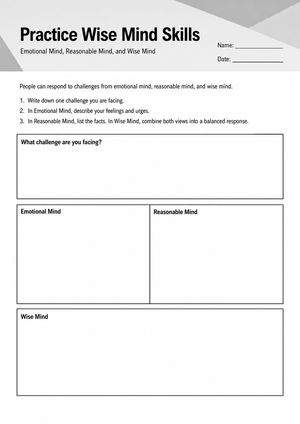
These wise mind pdf worksheets for 11th grade give counselors and classroom teachers a concrete entry point into one of DBT's most practical frameworks — the three-state model of mind that sits at the center of adolescent emotional regulation work. Each worksheet in the set focuses on the tension between Reasonable Mind and Emotional Mind, then guides students toward locating the integrated state that DBT practitioners call Wise Mind.
What the Set Covers
Wise Mind rests on a deceptively simple idea: most people swing between purely logical thinking and purely feeling-driven reaction, and both extremes create problems. For 11th graders, this maps directly onto lived experience. The Reasonable Mind runs a student's homework strategy and college research; the Emotional Mind floods their thinking when a friend conflict erupts between second and third period. The worksheets work through all three states — not as abstract categories, but as situations students have actually navigated.
Across the set, students practice these specific skills:
- Observing without labeling — noticing physical sensations and thoughts as facts, separate from judgment
- Describing accurately — translating internal experience into precise language ("I feel tension in my shoulders when my name is called on" rather than "I feel terrible")
- Participating fully — redirecting attention to the present task rather than ruminating on a past interaction or rehearsing a future one
- Acting one-mindfully — completing one task with full attention, which runs directly counter to the multitasking norm most juniors have absorbed
- Choosing what works — making decisions based on what moves toward a goal, not on what feels fair or vindicating in the moment
Each worksheet isolates one of these skills and asks students to apply it to a scenario drawn from junior-year terrain: academic pressure, peer conflict, family expectations around college choices, and the cumulative fatigue that tends to peak around midterms.
Mistakes Students Make That These Worksheets Help You Catch
The most consistent error at this level is treating Wise Mind as a synonym for calm. Students who understand the concept intellectually will still write answers that describe suppressing or dismissing the emotional reaction — "I would ignore my feelings and just focus on the facts" — rather than integrating both states. That answer is actually a description of Reasonable Mind override, which is precisely what the framework argues against. Watch for it especially in the scenario-response worksheets, where the prompt asks students to write what a Wise Mind decision would look like. If the answer contains no emotional acknowledgment whatsoever, the student is still in Reasonable Mind territory, not Wise Mind.
A related pattern: students who are highly emotionally expressive often conflate Wise Mind with their current feelings being validated. They write that the emotionally honest choice is automatically the Wise Mind choice. Asking them "Would you make this same decision if you felt completely neutral right now?" tends to surface the difference quickly in discussion.
Smart Ways to Work These Worksheets Into Your Week
These resources fit most naturally into advisory periods, SEL blocks, or the first ten minutes of a health class during a stress management unit. Wise mind pdf worksheets for 11th grade are also well-suited to the counselor's individual session toolkit — the structured prompts reduce the pressure on students to generate reflection from nothing, which matters when a student is in your office because something has already gone sideways. Before distributing any worksheet, a brief grounding exercise — even three slow breaths with attention on physical sensation — measurably increases the quality of student responses. Students who try to complete the reflective prompts while still activated by whatever happened between periods tend to produce surface-level answers.
The worksheet that asks students to map a recent decision onto the three-state model pairs particularly well with college application discussions. Asking a junior whether their first-choice school is a Wise Mind choice — not a fantasy-driven "dream school" and not a purely strategic GPA calculation — creates genuine engagement with both the SEL content and a high-stakes real decision they are already thinking about constantly.
Standard Alignment
These worksheets align with CASEL's Self-Management competency domain, specifically the indicators covering emotional regulation, impulse control, and stress management. They also address Responsible Decision-Making, which CASEL defines as evaluating personal, interpersonal, and situational factors before acting. In states using the ASCA Mindsets and Behaviors framework, the set targets Behavior Standard B-SMS 7 (demonstrate effective coping skills when faced with a problem) and B-SMS 8 (demonstrate the ability to balance school, home, and community activities). Both standards appear in 9–12 ASCA implementation guides as areas where explicit instruction — rather than assumed developmental growth — produces measurable gains in student self-report data.
Adjusting the Set for a Range of Learners
For students who arrive with prior DBT exposure — particularly those who have worked with a therapist or attended a skills group — the scenario prompts in the earlier worksheets may feel too introductory. Those students benefit more from the open-ended reflection prompts that ask them to analyze a past decision rather than respond to a provided scenario. They also work well as discussion anchors in small groups, which distributes the peer modeling without singling anyone out. Wise mind pdf worksheets for 11th grade that use a graduated response format — moving from a concrete scenario into personal application — tend to work better for students who find open-ended reflection paralyzing, because the structured prompt gives them a starting point without predetermining their answer.
For students with identified reading processing challenges, vocabulary in the three-state descriptions — particularly "dialectical" and "synthesis" — can become a distraction from the actual skill work. Pre-teaching those terms with plain synonyms ("both/and thinking" for dialectical, "blending" for synthesis) removes a barrier that has nothing to do with their capacity for emotional reflection.
Frequently Asked Questions
Do these worksheets require a counselor to facilitate, or can a classroom teacher use them independently?
A classroom teacher with basic familiarity with DBT's three-state model can run these activities without counselor support. The most important preparation is reading through the teacher notes accompanying each worksheet and anticipating the error patterns described above — especially students who equate Wise Mind with emotional suppression. If a student's responses suggest significant distress rather than typical adolescent stress, that is a signal to loop in the school counselor, but the worksheets themselves are written for a general SEL setting.
How should teachers handle a student who is currently in emotional crisis during the activity?
These worksheets are structured practice tools, not crisis intervention. A student who is acutely dysregulated will not benefit from a reflective writing exercise in that moment and may find it frustrating or dismissive of what they are experiencing. The appropriate sequence is stabilization first, then return to the skill-building material once the student is regulated enough to engage with it. That said, wise mind pdf worksheets for 11th grade work well as a follow-up tool after a calming conversation — giving students a structured way to process what happened and identify what a Wise Mind response might have looked like in retrospect.
Do the What and How skills need to be taught in a specific order across the worksheets?
The What skills (observe, describe, participate) appear in the earlier worksheets as foundational practice. The How skills (non-judgmentally, one-mindfully, effectively) are introduced once students can reliably identify which state of mind they are operating from. Teachers who skip the observation worksheets and move directly to the integration prompts often find that students produce intellectually correct but personally hollow answers — they can define Wise Mind but cannot locate it in their own experience. Running the set in sequence, at least through the observation and description worksheets, produces noticeably richer work when students reach the synthesis-level prompts.












 Interactive Worksheet Maker
 Quiz Maker
 Word Search Maker
 Crossword Puzzle Maker
 Word Scramble Generator
 Sentence Scramble Generator
 Handwriting Worksheet Generator
 Name Tracing Generator
 Fill In The Blank Generator




 BACK TOSCHOOL