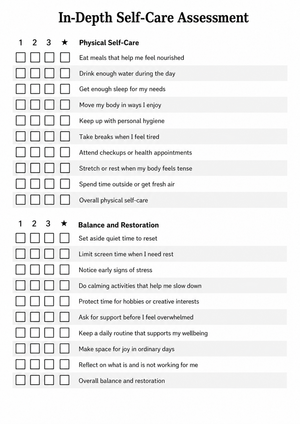
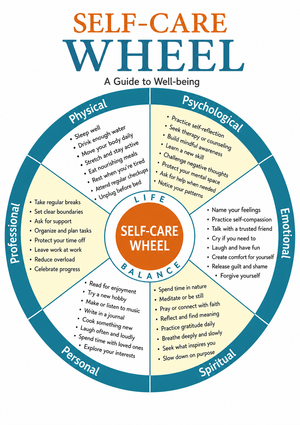
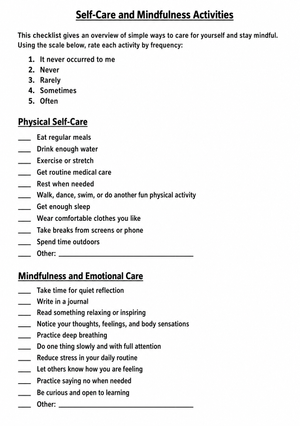
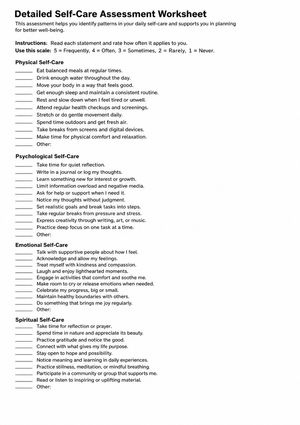
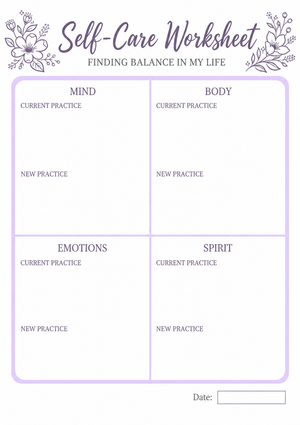
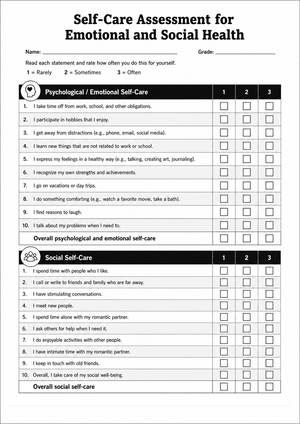
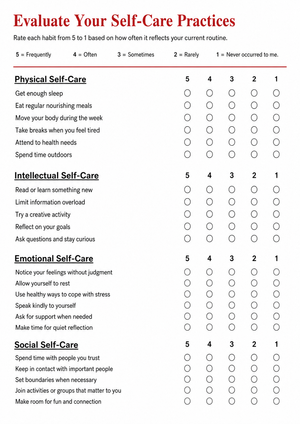
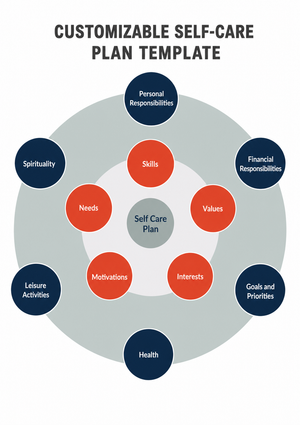
These self care assessment worksheets for 11th grade give teachers a structured entry point into wellness conversations during one of the most pressure-saturated years in secondary school. Grade 11 is when sleep debt becomes chronic, college applications start crowding out downtime, and students frequently mistake exhaustion for diligence. The set prompts students to evaluate their habits across five domains — sleep and physical health, emotional regulation, social connection, academic pacing, and personal fulfillment — and document where they are actually landing, not just where they assume they are.
What Each Worksheet Targets
The five worksheets each address a separate domain of well-being. Separating them by domain instead of presenting one sprawling checklist keeps the reflection task manageable and makes it easier to isolate which area needs the most attention at a given point in the semester.
- Physical wellness: Students rate sleep consistency, hydration, regular meals, and physical movement — not just whether they played a sport last fall, but whether they are actually moving their bodies most days of the week.
- Emotional self-care: Prompts ask how students respond to stress, whether they have any regular practice that helps them decompress, and how they handle difficult feelings when those feelings surface.
- Social and relational habits: Students examine how connected they feel to peers and family, whether they set limits with people who drain their energy, and how they navigate conflict rather than avoid it.
- Academic self-care: This domain often catches students off guard. Questions address whether they ask for help before a deadline becomes a crisis, how they manage a pile-up of assignments, and whether their study environment actually supports concentration.
- Personal fulfillment: Students identify activities that bring genuine enjoyment — not achievement, just enjoyment — and assess how much room they are making for those activities during a typical week.
Where Students Tend to Misread Their Own Habits
The most consistent pattern we see is students rating their sleep habits higher than the evidence supports. A junior who has normalized six hours a night will often mark "adequate sleep" as a strength because it simply feels normal — they have adapted to the deficit. Worth addressing before students begin: ask them to write down their actual bedtime from the previous three nights, then compare that number to the eight-to-nine hours recommended for adolescents. That brief calibration changes how honestly students complete the sleep items on the worksheet.
On the emotional self-care section, many students conflate "I don't feel particularly sad right now" with strong emotional health. If a student reports no stress-management practices but rates their emotional well-being highly anyway, the worksheet's follow-up prompts can push them further — but teachers sometimes need to ask aloud: "What do you actually do when a test comes back worse than you expected?" or "How did you handle the week before midterms?" Students respond to concrete scenarios better than abstract ratings, and those questions tend to surface more accurate self-assessments than the rating scale alone.
Folding These Into Your Weekly Rhythm
The most effective placement for this set is not a one-time activity compressed into a single class period. Spread one domain per advisory period or SEL block — five worksheets across five sessions — so students have time for genuine reflection rather than rapid checkbox completion. Ten minutes of quiet individual work followed by a short, low-pressure group conversation produces noticeably more honest responses and sets up the goal-setting step more naturally than rushing through everything at once.
The goal-setting step is where these resources pay off most. A student who scores low on physical self-care and walks away with a vague intention to "sleep more" will revert by Thursday. A goal that reads "I'll stop using my phone at 10:30 PM on school nights and track it for two weeks" is something a student can actually evaluate. Pairing each worksheet with a brief written goal template — even just three fill-in lines at the bottom — raises the follow-through rate considerably. Self care assessment worksheets for 11th grade are most useful when they lead somewhere: a written, specific commitment a student can return to and assess, not just a completed rating scale filed away in a folder.
Standard Alignment
These worksheets align with the CASEL SEL Framework's Self-Awareness and Self-Management competency clusters. Self-Awareness, as defined by CASEL, includes identifying one's emotions, recognizing personal strengths and areas for growth, and linking behaviors to outcomes — all of which students practice directly when they rate their habits and connect those ratings to how they feel across a typical school week. Self-Management covers regulating emotions, managing stress, and setting and working toward personal goals, which the goal-setting component addresses explicitly. In practical classroom terms, self care assessment worksheets for 11th grade slot naturally into advisory, health, or junior-year English classes that document CASEL competency work — the alignment is embedded in the reflection structure itself, so no additional framing is required.
Adjustments for Students Who Need More or Less Structure
For students who process written reflection slowly — often the same students who most need the wellness check-in — consider reading the prompts aloud during completion time, or narrowing each worksheet to the six or seven items most relevant to that student's known stressors. Reducing the rating scale from five points to three also cuts decision fatigue without losing meaningful information about where a student is placing themselves.
Students who move through reflective tasks quickly tend to get the most out of the academic self-care worksheet when it's extended into applied analysis. Ask those students to compare their self-rated study habits against a specific research-based practice — spaced retrieval versus last-minute cramming, for example — and write one sentence identifying a concrete swap they could make. That small addition shifts the worksheet from self-rating to genuine critical thinking and keeps faster students engaged rather than waiting for everyone else to finish.
Frequently Asked Questions
Are these worksheets appropriate for a general education classroom, or only for health and SEL courses?
The set works in any 11th-grade setting where teachers have advisory time, a weekly check-in routine, or a dedicated SEL block. English teachers have used the emotional and social domains effectively as pre-writing reflections before personal essay work. The prompts are self-explanatory and the reflection structure is accessible to any teacher willing to hold space for the conversation — no specialized training required.
How should I handle a student who seems distressed while completing the worksheets?
Frame the activity at the outset as a personal tool, not something being collected or graded. A student who scores very low across multiple domains is a quiet signal for a private follow-up — not during class, but a brief check-in afterward: "I noticed you seemed frustrated — how are you doing?" That is usually enough to open the door. These are educational reflection tools, not mental health screenings. If a student's responses suggest they need support beyond the classroom, refer them to the school counselor.
How often should students return to the full set?
A baseline at the start of the semester and a repeat near the end gives students a before-and-after comparison that carries real meaning, especially when goal-setting happened in between. Returning to the complete self care assessment worksheets for 11th grade two or three times per year is enough to show movement without the activity losing its weight through repetition. Brief weekly check-ins — a few sentences in a journal rather than another full assessment — work better for maintaining momentum between full cycles.
Can the results support a whole-class discussion, or should completion stay strictly private?
Both approaches work, depending on how the teacher holds the room. Whole-class conversations about general trends — "It sounds like sleep is a challenge for a lot of us right now" — normalize shared difficulties without exposing individual scores. The key is never asking students to read their scores aloud. Focus group conversations on strategies: what has helped, what has not, what students want to try next. Students engage more honestly when they have had five to eight minutes of quiet individual completion before any group discussion begins, so they are responding from their own reflection rather than echoing what a peer said first.












 Interactive Worksheet Maker
 Quiz Maker
 Word Search Maker
 Crossword Puzzle Maker
 Word Scramble Generator
 Sentence Scramble Generator
 Handwriting Worksheet Generator
 Name Tracing Generator
 Fill In The Blank Generator




 BACK TOSCHOOL