Hero's Journey printable worksheets for 11th Grade SEL
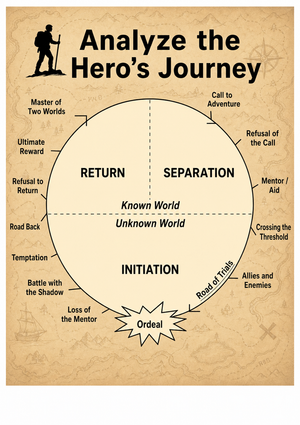
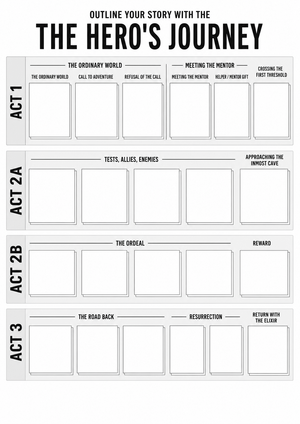
These heros journey printable worksheets for 11th grade serve a purpose that most junior-year ELA units rarely address directly: teaching students to read a narrative arc with enough precision that they can turn the same analytical lens on their own experience. Each worksheet targets one or more of Campbell's monomyth stages, pairing close-reading tasks with structured personal reflection prompts so that literary analysis and self-examination reinforce each other.
The Specific Skills These Worksheets Build
The set covers all 12 stages, but not every worksheet carries the same demand. Early worksheets anchor characterization in textual evidence before students draw any personal parallels. Later worksheets push toward synthesis — students explain why the Return with the Elixir differs meaningfully from the Reward, and what that distinction reveals about a character's internal transformation.
- Annotating and labeling specific scenes within a text according to monomyth stage, with written justification for each placement
- Distinguishing internal from external catalysts — separating a character's reluctance from the event that triggered the journey
- Analyzing mentor function beyond surface description, asking what the mentor supplies that the hero cannot yet access independently
- Mapping the Ordeal to a specific moment of crisis, supported by direct quotation or scene reference
- Writing personal reflections that connect each stage to real experience — transitions, setbacks, and the people who provided genuine support
Common Student Mistakes Teachers Should Anticipate and Address
The most persistent error at this level is collapsing "Crossing the Threshold" and "The Ordeal" into a single event. Students treat any conflict as the climactic test and skip the middle stages entirely. In practice, a student might map the opening inciting incident — a character leaving home, say — directly onto the Ordeal box, then have nowhere to place the actual climax. Worksheet prompts that ask students to identify what the hero has risked or lost at each stage, rather than just what has changed externally, disrupt that habit early.
On the personal reflection side, students default to "everything was normal before X happened," which tells you nothing about their internal state — the whole point of the Ordinary World stage. The worksheets counter this by asking students to name one specific routine, relationship, or belief they held before the disruption. A student who writes "I used to think I was bad at math until I failed the AP Calculus midterm and had to figure out a new way to study" is doing the real analytical work. "My life was fine" is not.
How to Build These Worksheets Into Your Lesson Plans
The literary analysis worksheets work best immediately after a first reading, before any formal discussion. Students annotate and label independently, then compare placements in small groups. Disagreements about where one stage ends and another begins are instructionally valuable — they force students to defend interpretations with textual evidence, which is exactly what RL.11-12.3 requires.
The personal reflection worksheets hit differently at natural turning points: the opening week of second semester, the days around when college application deadlines open, or right after a school event that brought real tension into the room. The Ordeal and Return with the Elixir worksheets, used back to back, function as a strong first move in college personal statement work. Students who can articulate what their hardest moment cost them — and what they carried out the other side — have a working argument before they ever face a blank document.
These heros journey printable worksheets for 11th grade also hold up as a weekly warm-up structure during a longer unit. One stage per week, worked in the first 8 to 10 minutes of class, keeps the framework active without consuming the lesson. Students leave the unit with a complete journey map built from low-stakes incremental entries rather than one high-pressure culminating assignment.
Standard Alignment
CCSS.ELA-LITERACY.RL.11-12.3 asks students to analyze the impact of the author's choices in developing and relating story elements — character, setting, and event sequencing. The monomyth framework gives that standard a workable structure: instead of describing change in general terms, students must locate it within a specific narrative phase and explain the cause. That precision is what separates analysis from retelling.
CCSS.ELA-LITERACY.W.11-12.3 covers narrative writing, which the personal reflection worksheets address directly. When students draft their own journey narratives — naming their mentors, ordeals, and elixirs — they apply narrative craft to lived experience rather than simply retelling it. For teachers using the CASEL framework, the set aligns most cleanly with self-awareness across the early stages and responsible decision-making through the Ordeal and Road of Trials.
Differentiating These Worksheets Across Student Readiness Levels
Students reading above grade level often rush the labeling tasks and produce thin justifications — they know the answer and skip the reasoning. Adding a requirement to name one alternative stage placement they considered and explain why they rejected it introduces the analytical friction that keeps advanced students working. It also builds the interpretive humility that shows up in strong AP-level writing.
Students who struggle with abstract thinking do better when reflection prompts start with a concrete memory before connecting it to a named stage. Instead of "describe your Ordinary World," a more accessible version asks: "Describe one thing you did every day last year that you no longer do. What changed?" That specific entry point surfaces the same quality of reflection without requiring students to already grasp the concept before they begin.
Heros journey printable worksheets for 11th grade also work well as a partner-talk task for students who need to process aloud before committing to writing. A brief paired exchange — one student describes a stage from their life, the other asks one follow-up question, then they switch — generates enough material that the blank worksheet stops feeling like a wall. Students who freeze in front of open-ended prompts consistently produce more when a short conversation precedes the independent writing.
Frequently Asked Questions
Are these worksheets text-specific, or can they work across different novels and films?
The prompts are text-agnostic. Students analyze whichever source text you assign — a canonical novel, a contemporary title, a film, or an independent reading selection. You supply the text; each worksheet supplies the analytical frame and the reflection structure.
How should I handle students who find the personal reflection prompts uncomfortable?
Give students explicit control over scope. Each worksheet functions whether a student writes about a genuinely difficult personal experience or a lower-stakes transition like switching friend groups or choosing a new elective. The reflective thinking is the same either way. These are writing tasks that draw on personal experience — they are not therapy exercises, and students should choose their own level of disclosure.
Do these printable resources connect to college and career readiness goals?
These heros journey printable worksheets for 11th grade connect directly to college application writing, especially personal statements. The analytical components address the evidence-based argument skills assessed on the SAT and ACT. A student who works through the full set has practiced close reading, structured reflection, and narrative argumentation — three moves that appear consistently across standardized assessments and post-secondary writing contexts.
Clear All