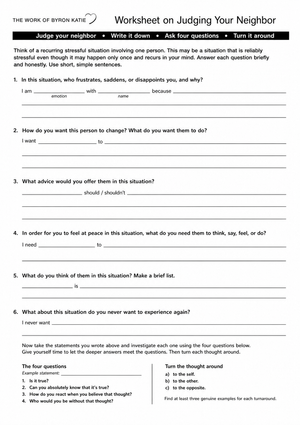
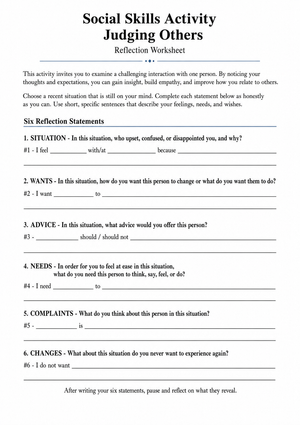
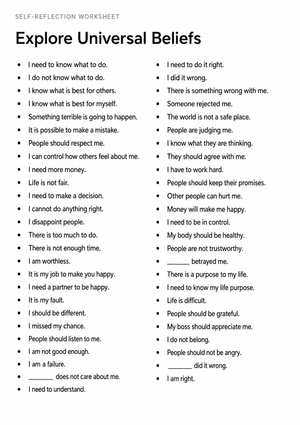
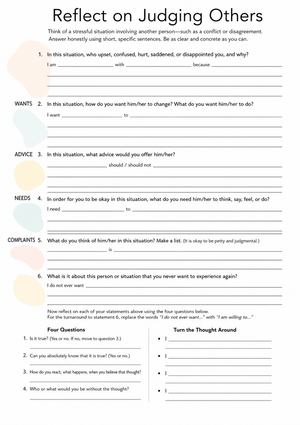
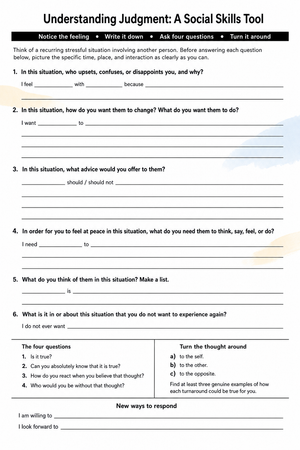
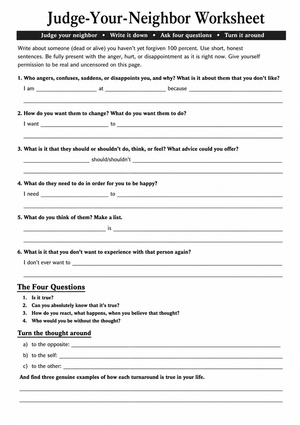
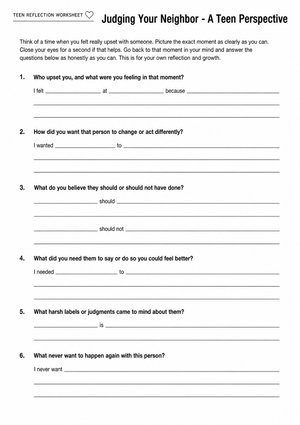
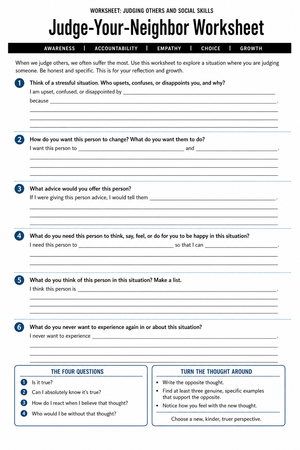
These judge your neighbor printable worksheets for 11th grade give teachers a self-inquiry tool rooted in Byron Katie's "The Work" — a six-prompt, four-question process that moves students from reactive judgment toward examined belief rather than leaving them cycling through the same grievance. The set works across two classroom contexts: SEL blocks where students apply the process to real interpersonal friction, and ELA units where the same framework becomes a character analysis lens.
What the Six Prompts Ask Students to Do
The sequence starts with identification: who is the student angry at, hurt by, or disappointed in? From there, the prompts ask what that person did or failed to do, how the student wants them to change, what advice they'd give that person, what they need from them to feel okay, and what they never want to experience with that person again. Written out, this sounds like a venting exercise. What it actually does is externalize a stressful internal narrative — pull it out of the student's head and onto paper where it can be examined rather than endlessly rehearsed.
For 11th graders specifically, that externalization is the first real skill this work builds. Students at this stage have usually constructed detailed internal arguments for why someone else is the problem. The instruction to "be as honest and judgmental as possible" when completing the opening prompts is deliberate — it gives students permission to write the unfiltered thought, which is the only version worth questioning.
The Four Questions and the Turnaround
After the six prompts, each written statement passes through four questions: Is it true? Can you absolutely know it's true? How do you react — in your body, your behavior, your relationships — when you believe that thought? And who would you be without it? The fourth question is consistently the hardest for high school students. "Without the thought" doesn't mean denying that the situation happened. It means noticing what remains when the belief isn't running the student's responses. That distinction needs explicit explanation before students work through a worksheet on their own.
The turnaround follows: each statement flips to its opposite or turns back toward the student. "My friend should be more honest with me" becomes "I should be more honest with my friend" or "I should be more honest with myself." Students frequently experience the self-directed version as accusatory before they understand its purpose. The turnaround locates places where the student has agency — it isn't about assigning fault. That reframe takes some modeling, almost always with a fictional or low-stakes example first, before students trust it enough to apply it to their own situations.
Using Literature as the Entry Point
The most reliable introduction to this process runs it through a fictional character before anything personal enters the room. Having students complete a worksheet from Jay Gatsby's perspective as he judges Tom Buchanan — arrogant, careless, unworthy of Daisy — gives them full practice with every step of the inquiry without any personal exposure. They write Gatsby's judgments, work them through the four questions, and attempt turnarounds that reveal his self-deception as clearly as his resentment. The literary analysis is richer for it, and students arrive at the personal SEL application already comfortable with the mechanics.
The Crucible runs the same way. Abigail judging John Proctor, Parris judging his congregation — the hysteria in the play is fundamentally a story about unexamined beliefs driving catastrophic action. Students who have applied a worksheet to those characters are less surprised when their own unquestioned judgments turn out to be more complicated than they first appeared. The literary bridge makes the shift to personal self-inquiry feel less threatening and more intellectually grounded.
Fitting These Worksheets Into Your Week
The judge your neighbor printable worksheets for 11th grade fit naturally into SEL blocks, but they also integrate into ELA instruction without requiring dedicated SEL time carved out of the schedule. A 20-minute block handles the six initial prompts; the four questions and turnarounds work better in a separate session 24 to 48 hours later, once the initial emotional charge has settled. Separating the two steps isn't just logistically convenient — it reflects how the inquiry actually functions. Students who rush all three phases in a single sitting tend to race through the turnarounds and miss the genuine perspective shift that makes the process worth doing.
For conflict resolution work, the timeline adjusts. A counselor or adviser gives two students in a dispute each a worksheet to complete independently before any face-to-face conversation. The cooling period built into the process means the subsequent meeting starts from "here's what I noticed about my own thinking" rather than "here's everything you did wrong." That starting point changes the entire dynamic of the exchange.
Mistakes Students Make That These Worksheets Help You Catch
The most consistent problem at the four-questions stage is students treating question one — "Is it true?" — as a formality. They answer "yes" automatically and move on without any actual reflection. One way to interrupt this is to model the difference between an automatic answer and a considered one before students work independently: "She doesn't care about me — is that true? She drove me to the airport last month, actually. So I'm not sure it's true." That brief demonstration usually breaks the habit of treating question one as a preamble rather than a genuine inquiry.
The turnaround generates its own predictable error. Students convert self-directed turnarounds into self-criticism rather than self-examination — "I shouldn't need people so much" instead of "I should be more honest about what I need." Those are not the same move, and the difference matters. A turnaround that becomes a self-attack is still running the same belief structure, just aimed inward. Catching this pattern early in the returned worksheets prevents the inquiry from reinforcing the very habits it's meant to interrupt.
Standard Alignment
The judge your neighbor printable worksheets for 11th grade align with CASEL's high school competencies for Self-Awareness — specifically recognizing how thoughts generate emotional responses — and Relationship Skills, which include perspective-taking, empathy, and conflict resolution. Within ELA, the character-analysis application maps directly to CCSS.ELA-LITERACY.RL.11-12.3, which asks students to analyze how complex characters develop across a text and how their motivations interact with major themes. Using the inquiry framework to trace how a character's unexamined beliefs drive behavior toward others is a direct implementation of that standard, not a workaround.
Adjusting the Set for a Range of Learners
Students who are newer to reflective writing often need more structure around the initial prompts — sentence starters, a worked example kept visible during independent work, or a brief partner conversation before writing. Students with more experience in SEL or reflective journaling move through the prompts quickly and benefit from being pushed further in the turnaround phase: asking them to locate three genuine, specific examples of a turnaround being true, rather than just one, deepens the reflection considerably.
For students with high social anxiety, keeping the judge your neighbor printable worksheets for 11th grade strictly private is non-negotiable. The inquiry depends entirely on the student being honest in the initial prompts. Any expectation of sharing — even framed as voluntary — shifts the writing toward performance for an audience, which undermines the whole process. Explicit reassurance that no one reads these worksheets unless the student chooses to share them should come before any independent work begins.
Frequently Asked Questions
How do I introduce this process to students who have never done structured self-inquiry before?
Start with a character from a text the class is already reading. Have students complete the worksheet from that character's perspective rather than their own. Once students have practiced the mechanics — the six prompts, the four questions, the turnaround — on a fictional figure, the shift to personal application feels like a natural next step rather than an unwanted exposure. Most classes need one or two literary rounds before personal application works smoothly.
Can these worksheets substitute for a counseling session with a distressed student?
No. These are reflection tools for everyday interpersonal stress and academic SEL work. A student experiencing crisis-level distress needs a school counselor, not a worksheet. For students who become visibly upset during the process, the right move is to pause, check in privately, and refer to appropriate support. The inquiry works best when the student is in a regulated state — not in the middle of acute emotional flooding.
How do the turnarounds differ from positive affirmations?
Significantly. A positive affirmation substitutes one belief for another without examining either. The turnaround asks students to find specific, real evidence that the opposite statement is true. If a student can't locate genuine examples, the turnaround doesn't stick — and that absence is itself instructive. The process is evidence-based reflection, not replacement thinking, which is why modeling it before independent practice matters so much.
Do these worksheets work in a 20-minute advisory period, or do they require a full block?
The six initial prompts run in a 15 to 20 minute advisory period once students are familiar with the format. The four questions and turnarounds need more time — closer to 25 to 30 minutes — and benefit from whole-class modeling before independent work. A practical approach is to assign the prompts in advisory one day and return to the questions and turnaround the following day during an ELA period or a longer scheduled SEL session. The built-in gap between steps is useful, not wasted time.












 Interactive Worksheet Maker
 Quiz Maker
 Word Search Maker
 Crossword Puzzle Maker
 Word Scramble Generator
 Sentence Scramble Generator
 Handwriting Worksheet Generator
 Name Tracing Generator
 Fill In The Blank Generator




 BACK TOSCHOOL