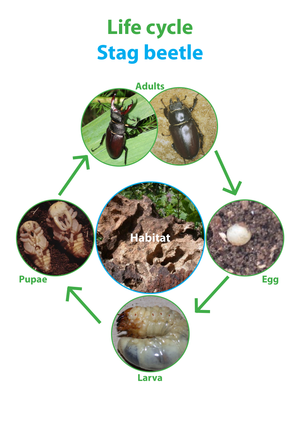
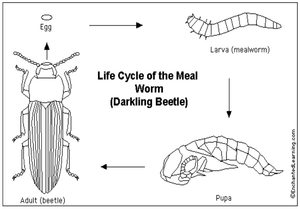
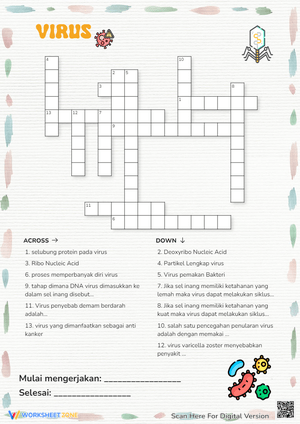
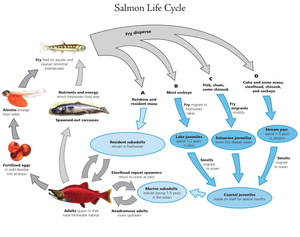
Life cycle printable worksheets for 10th grade address three distinct biological systems that, in most state standards frameworks, land in the same semester: the eukaryotic cell cycle, biogeochemical cycling of matter through ecosystems, and reproductive strategies across kingdoms. Each worksheet stands alone, so teachers can slot them into whatever sequence their pacing guide demands.
The Biological Territory Each Worksheet Covers
Cell cycle worksheets walk students through interphase in real detail — G1, S phase (where DNA replication actually happens), and G2 — before moving into the mitotic stages. Labeling exercises ask students to identify chromosomal structure changes at prophase, metaphase, anaphase, and telophase, not just name the stages in sequence. The more demanding worksheets extend into cell cycle regulation: students analyze what happens at the G1/S and G2/M checkpoints, what molecular signals advance the cell forward, and how checkpoint failure connects to tumor formation. That cancer connection runs through the analytical questions as a genuine application of the regulatory biology, not a footnote tacked on at the end.
Separate worksheets target the mitosis-versus-meiosis comparison, which is where a significant number of 10th graders lose their footing. Comparative charts and Venn diagrams ask students to track chromosome counts at each stage, mark where crossing over and independent assortment occur, and distinguish between the two meiotic divisions. Following a diploid cell through meiosis I and meiosis II to four haploid gametes — with chromosome numbers written at each arrow — makes ploidy levels concrete in a way that verbal description rarely achieves.
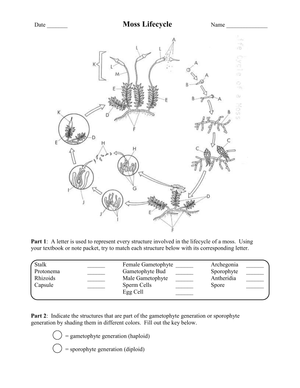
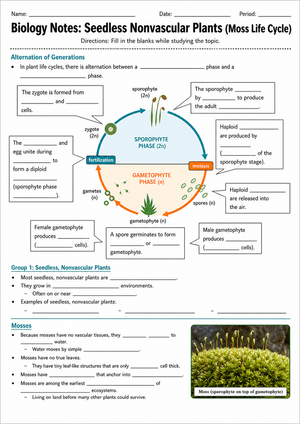
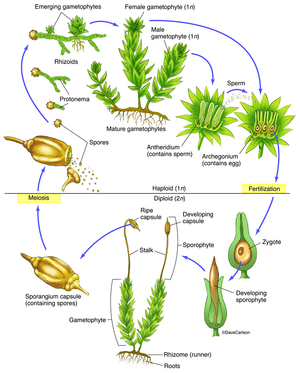
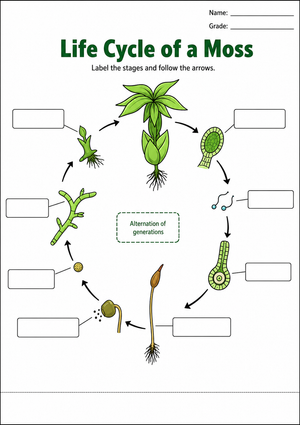
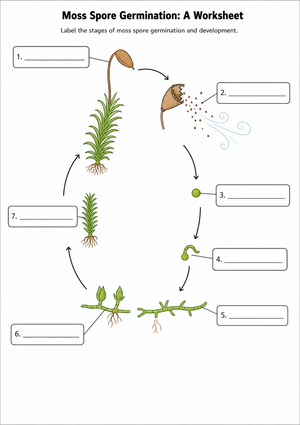
Ecology worksheets cover the nitrogen, carbon, and phosphorus cycles. Nitrogen cycle activities require students to sequence fixation, nitrification, assimilation, and denitrification while identifying the specific bacteria responsible for each transformation. Carbon cycle worksheets connect photosynthesis and cellular respiration explicitly, then ask students to annotate where human activity — fossil fuel combustion, deforestation — disrupts natural flux. A plant reproduction worksheet takes students through alternation of generations, comparing the dominant gametophyte stage in mosses against the microscopic, sporophyte-dependent gametophyte in flowering plants, an evolutionary contrast that anchors abstract ploidy concepts in something observable.
Frequent Student Errors Worth Watching For
The most persistent error in the cell cycle unit is conflating DNA replication with mitosis. Students routinely write that DNA is copied during prophase — they see chromosomes condensing and becoming visible, and assume duplication is happening right then, missing that S phase occurred well before any mitotic figure appeared. The labeling worksheets surface this immediately because they ask students to annotate S phase on the interphase diagram before a spindle fiber ever enters the picture.
Meiosis generates a separate category of errors. Students who understand the two-division structure often still misplace crossing over, writing it at metaphase I rather than prophase I, or describing it as occurring between sister chromatids instead of homologous chromosomes. Those are not the same mistake: one is a sequencing error, the other is a fundamental misconception about chromosome structure. Worksheets that ask students to draw a specific crossover event between labeled homologs, then identify the resulting chromatid combinations, separate those two errors cleanly and tell you which problem actually needs addressing.
In the ecology unit, the nitrogen cycle exposes a different gap. Students can recite the stages in sequence but cannot explain directionality — why nitrogen moves from atmosphere to soil to organism and back again. When a worksheet asks students to annotate each arrow with the organism responsible for the transformation, the mechanistic gaps appear immediately, which is exactly the moment for a brief class discussion rather than a full reteaching session.
How to Build These Worksheets Into Your Lesson Plans
Life cycle printable worksheets for 10th grade work particularly well as opening retrieval tasks. Displaying a blank cell cycle diagram and giving students the first five minutes of class to label what they remember — before notes are open, before the lesson formally starts — gives a more honest read of retention than any exit ticket filled out while the teacher is watching. It also flags which students are ready for new material and which need a brief review before the next concept can land.
Station rotations suit this content well. Running three simultaneous stations — one on mitosis labeling, one on nitrogen cycle sequencing, one on the moss-versus-angiosperm alternation of generations comparison — lets students move at slightly different paces while the teacher circulates to whichever station is generating the most confusion. In practice, that is almost always the meiosis station. Having students use colored pipe cleaners or yarn on top of the worksheet diagram to physically cross over homologous chromosomes before drawing the result in the blank diagram space turns an abstract description into something they can manipulate, and the motor memory tends to outlast the verbal explanation alone.
For end-of-unit review, completed worksheets function as a study guide. A student who has correctly mapped all four nitrogen cycle stages with bacterial agents labeled, compared mitosis and meiosis chromosome counts in a Venn diagram, and annotated a carbon cycle with human impact notes has built a reference document covering most of what will appear on the unit exam — more accurate than class notes, which by this point often have gaps and margin corrections from when students first encountered the material.
Standard Alignment
These worksheets align to NGSS HS-LS1-4, which asks students to use a model to illustrate the role of cellular division in producing new cells while maintaining genetic information. They also support HS-LS2-5, which requires students to develop a model of biogeochemical cycles showing the passage of matter through Earth's systems. Both standards center on modeling as the performance — which is why the diagram-completion and labeling format fits the instructional intent rather than just the topical content. Students are constructing representations of biological processes, not simply recalling terminology, and that distinction matters when teachers are planning what they actually want to assess.
Differentiating These Worksheets Across Ability Levels
Life cycle printable worksheets for 10th grade in this set range from partially completed diagrams — where key labels and arrows are already provided and students fill in the remaining elements — to fully blank formats where students reconstruct the entire model from a term list. Teachers can assign formats based on readiness without preparing separate lessons. Students still building content vocabulary do more work on the fill-in versions; students who already have the vocabulary work on blank formats that require simultaneous recall of structure and sequence, which is a meaningfully harder retrieval task.
For students working above grade level, the checkpoint and cancer analysis questions in the cell cycle worksheets extend into AP Biology territory — tumor suppressor genes, proto-oncogenes, and the molecular logic of cell cycle arrest. These questions are self-contained enough that advanced students can work through them independently while the rest of the class handles core labeling tasks. The extension is built into the same worksheet, so there is no separate document to manage and no visible signal to students that they are on a different track.
Frequently Asked Questions
What cell cycle content do these worksheets cover at the 10th-grade level?
The cell cycle worksheets cover interphase (G1, S, and G2), the four stages of mitosis, cytokinesis, and cell cycle regulation including the major checkpoints. The checkpoint content — particularly the G1/S checkpoint and its connection to tumor suppressor proteins — runs slightly ahead of where some standard 10th-grade courses end, which makes these worksheets useful for teachers who want to build toward AP Biology without introducing a full AP curriculum before students are ready for it.
How do the comparison worksheets handle the mitosis-meiosis distinction specifically?
Rather than asking students to list differences in text, the comparison worksheets require students to track chromosome counts at each stage of both processes — writing the chromosome number at the end of mitosis (2n), after meiosis I (n), and after meiosis II (n). That numerical tracking format catches students who have learned the vocabulary but lack the underlying numerical model of ploidy, which is the more common gap at this level than simple vocabulary gaps.
Do these worksheets connect to state or AP assessments?
The cell cycle and biogeochemical cycles content appears on most state end-of-course biology assessments and on AP Biology free-response questions. For teachers who use life cycle printable worksheets for 10th grade as a review sequence in the final weeks before a cumulative exam, completed worksheets give students a set of verified, accurate diagrams to study from — more reliable than class notes, which by exam time often contain gaps or uncorrected errors from when students first encountered the material.
How do these worksheets work in a co-taught biology classroom?
The range of formats — from partially completed to fully blank — suits co-taught settings because the co-teacher can work alongside students using the supported versions while the lead teacher addresses students on the open formats. The key is deciding before class which format each student receives. Assigning formats mid-lesson, once students are already seated and working, creates more disruption than the adjustment is worth.












 Interactive Worksheet Maker
 Quiz Maker
 Word Search Maker
 Crossword Puzzle Maker
 Word Scramble Generator
 Sentence Scramble Generator
 Handwriting Worksheet Generator
 Name Tracing Generator
 Fill In The Blank Generator