


























Views
Downloads
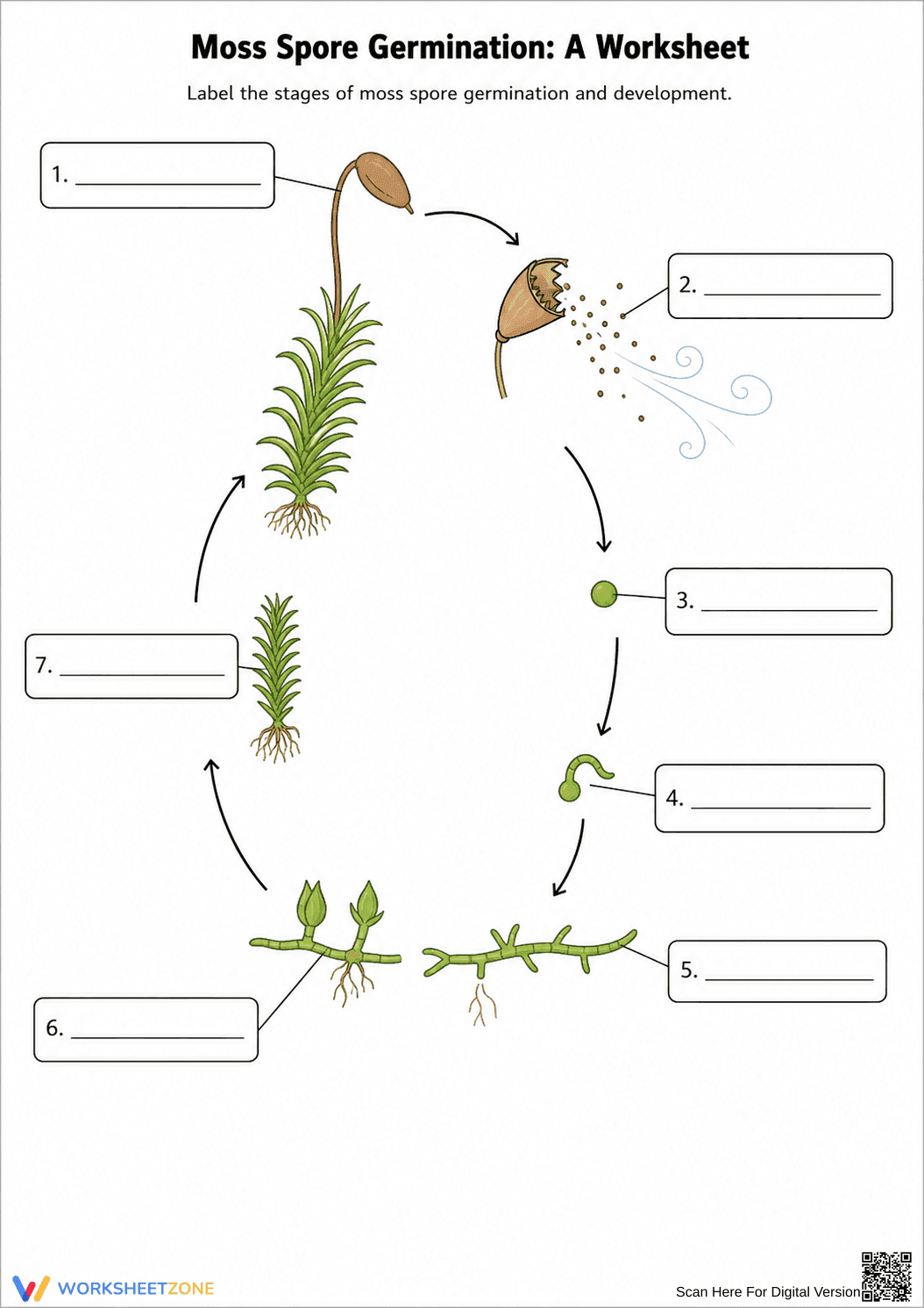

Grade 7 Moss Life Cycle — Printable No-Prep Worksheet
Paste this activity's link or code into your existing LMS (Google Classroom, Canvas, Teams, Schoology, Moodle, etc.).
Students can open and work on the activity right away, with no student login required.
You'll still be able to track student progress and results from your teacher account.
This printable biology worksheet helps students master the stages of moss spore germination by labeling a detailed life cycle diagram. By identifying key structures like the sporophyte, spores, and gametophyte, learners build a concrete understanding of how non-vascular plants reproduce and develop through the alternation of generations.
At a Glance
- Grade: 7 · Subject: Science
- Standard:
MS-LS1-4— Explain how specialized plant structures affect the probability of successful reproduction.- Skill Focus: Labeling plant life cycles
- Format: 1 page · 7 problems · Answer key included · PDF
- Best For: Independent practice and review
- Time: 10–15 minutes
What's Inside
This single-page resource features a clear, professionally illustrated diagram of the moss life cycle. Students are tasked with completing seven fill-in-the-blank labeling problems that track the progression from spore release to mature gametophyte. A complete answer key is provided to ensure accurate grading and immediate feedback, making the structural progression of bryophytes easy to follow.
Zero-Prep Workflow
This resource offers a straightforward three-step workflow. First, print the diagram and answer key (1 minute). Second, distribute copies to students (1 minute). Third, review the correct labels together using a document camera (5 minutes). Total teacher preparation requires under two minutes. Because the visual instructions are self-explanatory, this diagram functions perfectly as an emergency sub plan or a quiet bell-ringer activity.
Standards Alignment
Aligned to MS-LS1-4: Use argument based on empirical evidence and scientific reasoning to support an explanation for how characteristic animal behaviors and specialized plant structures affect the probability of successful reproduction. By identifying specific reproductive structures of moss, students gather evidence of plant adaptations. Both standard codes can be copied directly into lesson plans, IEP goals, or district curriculum mapping tools.
How to Use It
Deploy this diagram during direct instruction as a guided note-taking tool while explaining the alternation of generations. Alternatively, assign it as an independent exit ticket after a lesson on non-vascular plants to assess retention. As a formative assessment observation tip, watch whether students correctly sequence the protonema stage before the mature gametophyte, as this indicates a true grasp of the developmental timeline. Expected completion time ranges from ten to fifteen minutes.
Who It's For
This resource is primarily designed for middle school life science and high school biology students studying botany. To support learners who need accommodations, teachers can provide a word bank on the board containing the seven target vocabulary terms. This visual worksheet pairs excellently with a hands-on microscope lab observing live moss specimens, bridging the gap between theoretical diagrams and real-world biological structures.
Understanding the alternation of generations is a foundational concept in secondary life sciences. Aligning with MS-LS1-4, this resource requires students to explain how specialized plant structures affect the probability of successful reproduction by accurately labeling the moss life cycle. According to a ScienceDirect TpT Analysis, visual diagramming significantly improves student retention of complex biological processes compared to text-based instruction alone. When learners actively map out the transition from sporophyte to gametophyte, they develop stronger cognitive schemas regarding plant reproduction and evolutionary adaptations. This specific labeling exercise forces students to confront the sequential nature of spore germination, ensuring they do not merely memorize terms but actually comprehend the chronological development of bryophytes. By integrating targeted visual assessments into the curriculum, educators can more effectively measure student mastery of specialized reproductive structures and their functions within diverse ecosystems.


