


























Views
Downloads

Essential Moss Life Cycle Worksheet | Grade 9-12 Biology
Paste this activity's link or code into your existing LMS (Google Classroom, Canvas, Teams, Schoology, Moodle, etc.).
Students can open and work on the activity right away, with no student login required.
You'll still be able to track student progress and results from your teacher account.
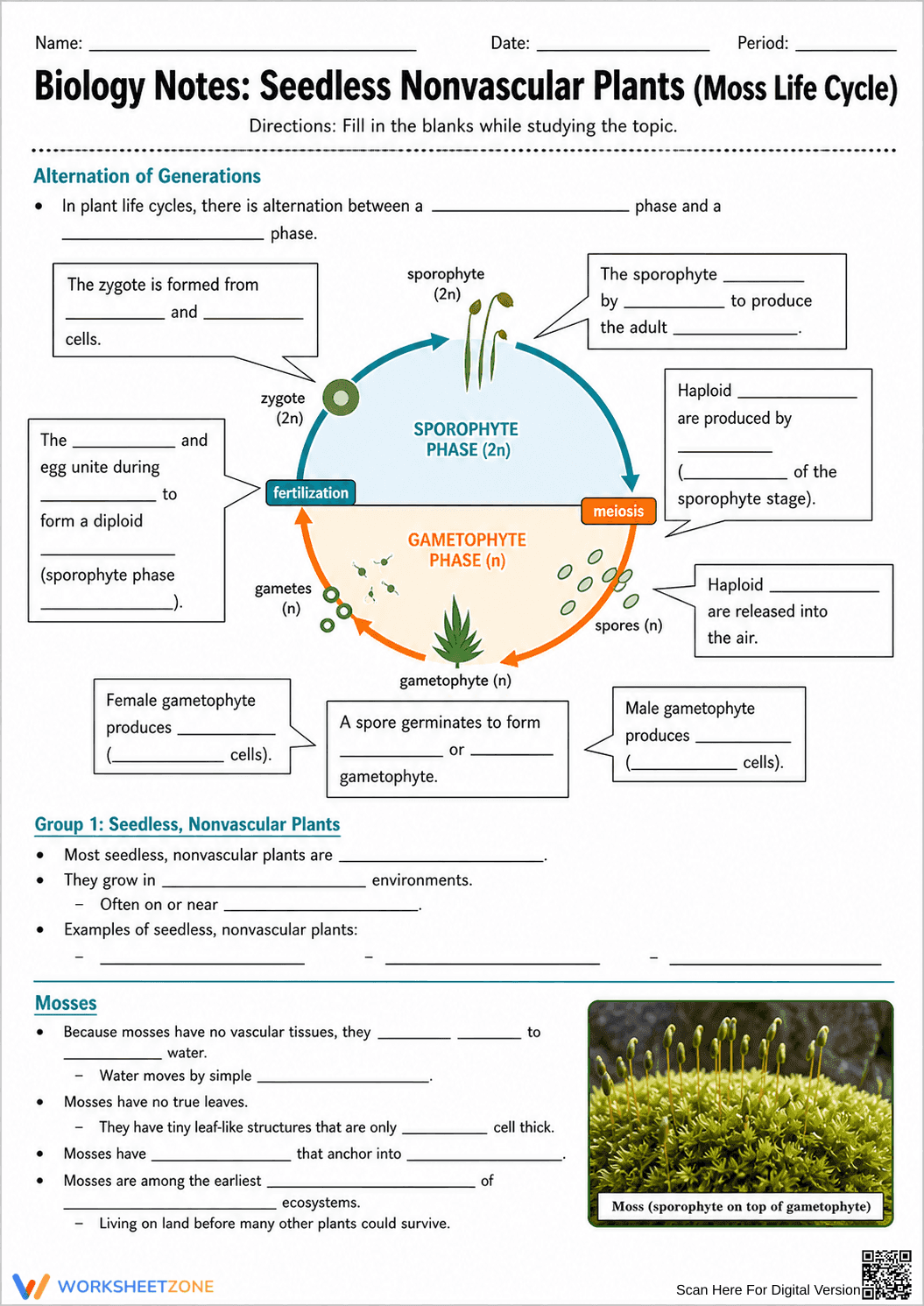
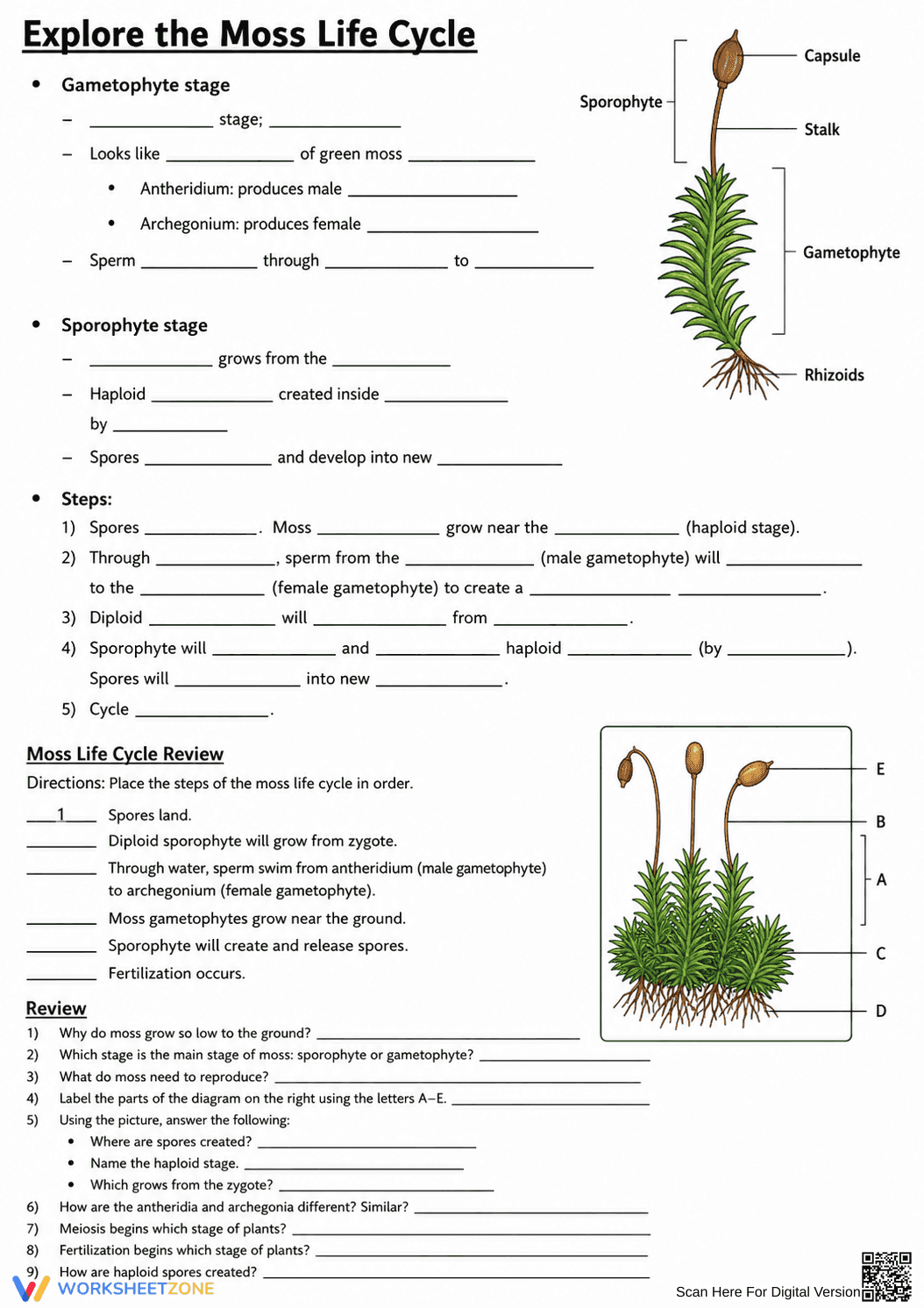
This comprehensive biology worksheet provides a structured exploration of seedless nonvascular plants, focusing specifically on the intricate moss life cycle. Students will master the concept of alternation of generations by identifying the specific roles of sporophytes and gametophytes, ensuring a deep understanding of plant reproduction and cellular differentiation.
At a Glance
- Grade: 9-12 · Subject: Biology
- Standard:
HS-LS1-4— Use models to illustrate cellular differentiation and life cycles in complex organisms- Skill Focus: Moss Life Cycle
- Format: 2 pages · 45 problems · Answer key included · PDF
- Best For: High school biology unit on plants
- Time: 30–45 minutes
What's Inside
This 2-page instructional resource includes a detailed diagram of the moss life cycle with labeling blanks, a series of fill-in-the-blank conceptual questions, and a sequencing task to order the stages of reproduction. The second page features a review section with nine short-answer questions and a secondary diagram for anatomical identification, supported by a clear photo of moss in its natural habitat.
Zero-Prep Workflow
- Print: Generate copies of the 2-page PDF for your class in under 1 minute.
- Distribute: Hand out the worksheets as a guided note-taking tool during your lecture on bryophytes.
- Review: Use the included answer key to conduct a 10-minute whole-class review or for rapid formative grading.
This resource is designed for immediate implementation, making it an ideal choice for substitute plans or as a primary reinforcement activity following direct instruction.
Standards Alignment
This worksheet is aligned to HS-LS1-4: "Use a model to illustrate the role of cellular division (mitosis) and differentiation in producing and maintaining complex organisms." It specifically addresses the transition between haploid and diploid phases in plant life cycles. Both standard codes can be copied directly into lesson plans, IEP goals, or district curriculum mapping tools.
How to Use It
Assign this worksheet during the middle of a plant biology unit to reinforce the differences between vascular and nonvascular plants. It serves as an excellent formative assessment; observe students as they label the diagram to identify misconceptions regarding meiosis and fertilization. Expected completion time ranges from 30 to 45 minutes depending on student familiarity with the terminology.
Who It's For
This resource is tailored for high school biology students (Grades 9-12) studying botany or general life science. It provides necessary scaffolding for learners who benefit from visual models and active recall exercises. Pair this worksheet with a textbook chapter on seedless plants or a laboratory observation of live moss samples for a complete instructional experience.
This resource aligns with HS-LS1-4 by providing a structured model for students to trace the alternation of generations in bryophytes. By distinguishing between the haploid gametophyte and diploid sporophyte phases, students engage in active recall of cellular differentiation processes. Research by Fisher & Frey (2014) emphasizes that complex biological diagrams paired with scaffolded fill-in-the-blank tasks significantly improve the retention of specialized vocabulary in secondary science settings. This worksheet facilitates that transition from guided note-taking to independent mastery through its multi-modal approach, combining visual labeling with conceptual sequencing. The inclusion of 45 distinct tasks ensures comprehensive coverage of seedless nonvascular plant characteristics, including rhizoid function and environmental adaptations. Educators can utilize this tool to bridge the gap between direct instruction and summative assessment, providing a clear evidence base for student progress in understanding plant reproduction and evolutionary biology. The standard HS-LS1-4 is directly supported through this detailed life cycle analysis.


