




























Views
Downloads

HIV Life Cycle Worksheet | Essential Grade 9-12 Biology

Paste this activity's link or code into your existing LMS (Google Classroom, Canvas, Teams, Schoology, Moodle, etc.).
Students can open and work on the activity right away, with no student login required.
You'll still be able to track student progress and results from your teacher account.
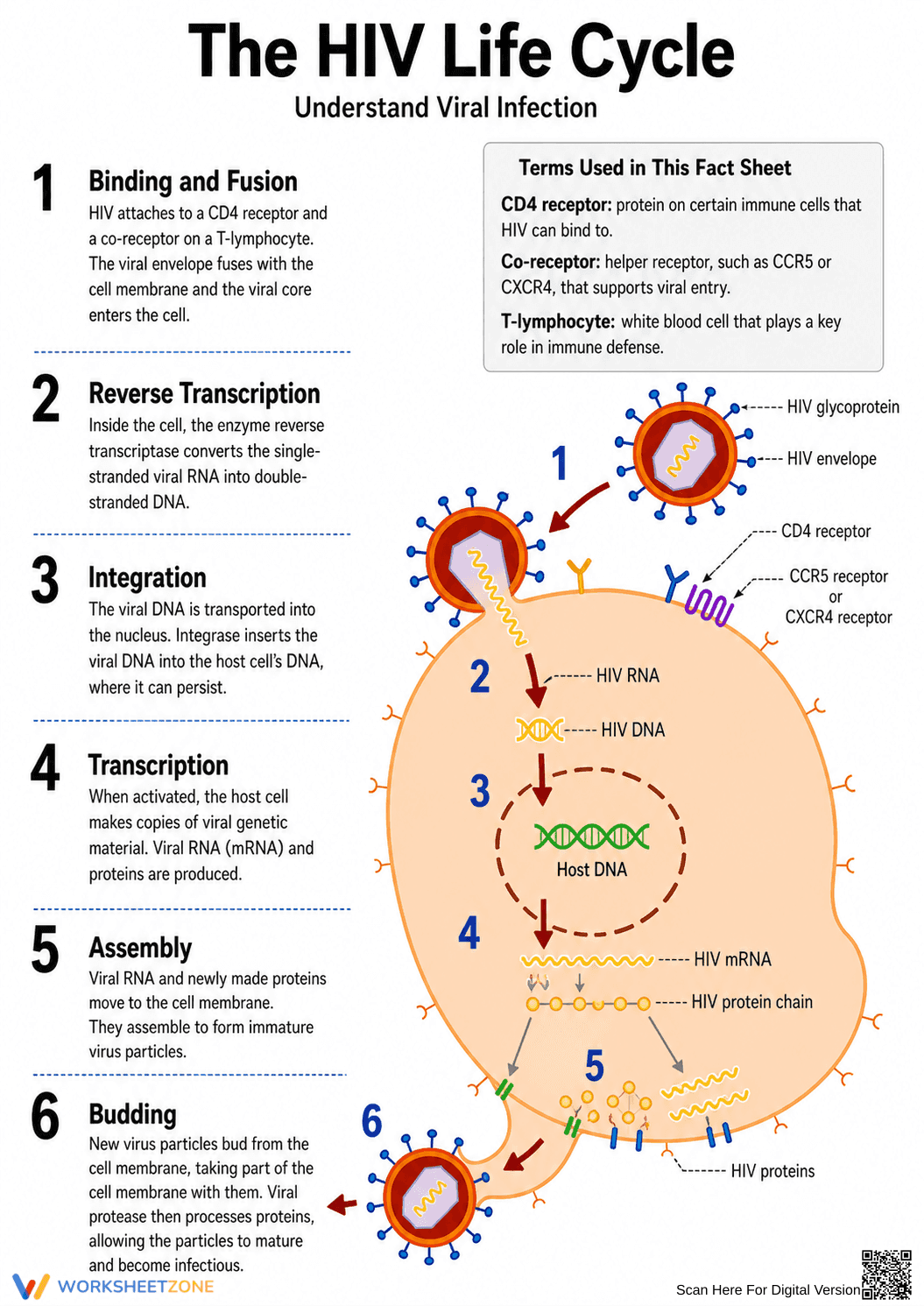
This Grade 9-12 biology worksheet provides a comprehensive visual and textual breakdown of the HIV life cycle. Students will identify the specific mechanisms of viral entry, replication, and exit within a host T-lymphocyte. By connecting complex terminology to a clear diagram, learners gain a functional understanding of how retroviruses hijack cellular machinery.
At a Glance
- Grade: 9-12 · Subject: Biology
- Standard:
HS-LS1-1— Explain how the structure of DNA determines the structure of proteins- Skill Focus: Viral Replication Stages
- Format: 1 page · 6 stages · Fact sheet format · PDF
- Best For: Introductory virology and immunology lessons
- Time: 15–25 minutes
The resource features a high-resolution diagram of a host cell being infected by HIV, with 6 numbered stages corresponding to detailed text descriptions. It includes a dedicated "Terms Used" box defining critical vocabulary such as CD4 receptors, co-receptors, and T-lymphocytes. The layout is designed for maximum readability, using color-coded arrows to track the movement of viral RNA and DNA through the nucleus.
Zero-Prep Workflow
- Print: Generate the single-page PDF for your entire class in seconds.
- Distribute: Hand out the sheet as a supplemental reading or anchor chart during direct instruction.
- Review: Use the provided diagram to check for student comprehension during a 5-minute wrap-up.
Total teacher preparation time is under 2 minutes, making it an ideal choice for sub plans or quick review sessions.
Standards Alignment
This worksheet aligns with `HS-LS1-1`, focusing on how specialized structures within cells facilitate essential life functions. It specifically illustrates the process of transcription and translation in the context of viral hijacking. Both standard codes can be copied directly into lesson plans, IEP goals, or district curriculum mapping tools.
How to Use It
Use this worksheet during the "Explain" phase of a 5E lesson cycle on infectious diseases. It serves as an excellent scaffold for students to label their own blank diagrams or to summarize the role of reverse transcriptase. For formative assessment, ask students to identify which stage is targeted by specific antiretroviral medications. Completion typically takes 20 minutes.
Who It's For
This material is tailored for high school biology students and introductory health science courses. It provides necessary scaffolding for English Language Learners through the use of visual aids and a glossary. It pairs naturally with a lecture on the immune system or a case study on global health initiatives.
The HIV Life Cycle worksheet utilizes a dual-coding approach to facilitate the acquisition of complex biological concepts. By integrating precise scientific terminology with a sequential visual model, the resource aligns with the instructional frameworks suggested by Fisher & Frey (2014) regarding the importance of visual literacy in science education. The content covers the six critical phases of retroviral infection, including integration into the host genome, which is a fundamental concept in modern genetics and pathology. According to recent NAEP science framework analysis, students who engage with multi-modal representations of microscopic processes demonstrate higher retention rates of abstract biological cycles. This resource provides the necessary structural support for students to master the HS-LS1-1 standard while developing a nuanced understanding of virology. It is a reliable tool for secondary educators seeking to bridge the gap between basic cell biology and advanced immunology.


