


























Views
Downloads

Virus Life Cycle Worksheet | Essential Grade 7-10 Science
Paste this activity's link or code into your existing LMS (Google Classroom, Canvas, Teams, Schoology, Moodle, etc.).
Students can open and work on the activity right away, with no student login required.
You'll still be able to track student progress and results from your teacher account.
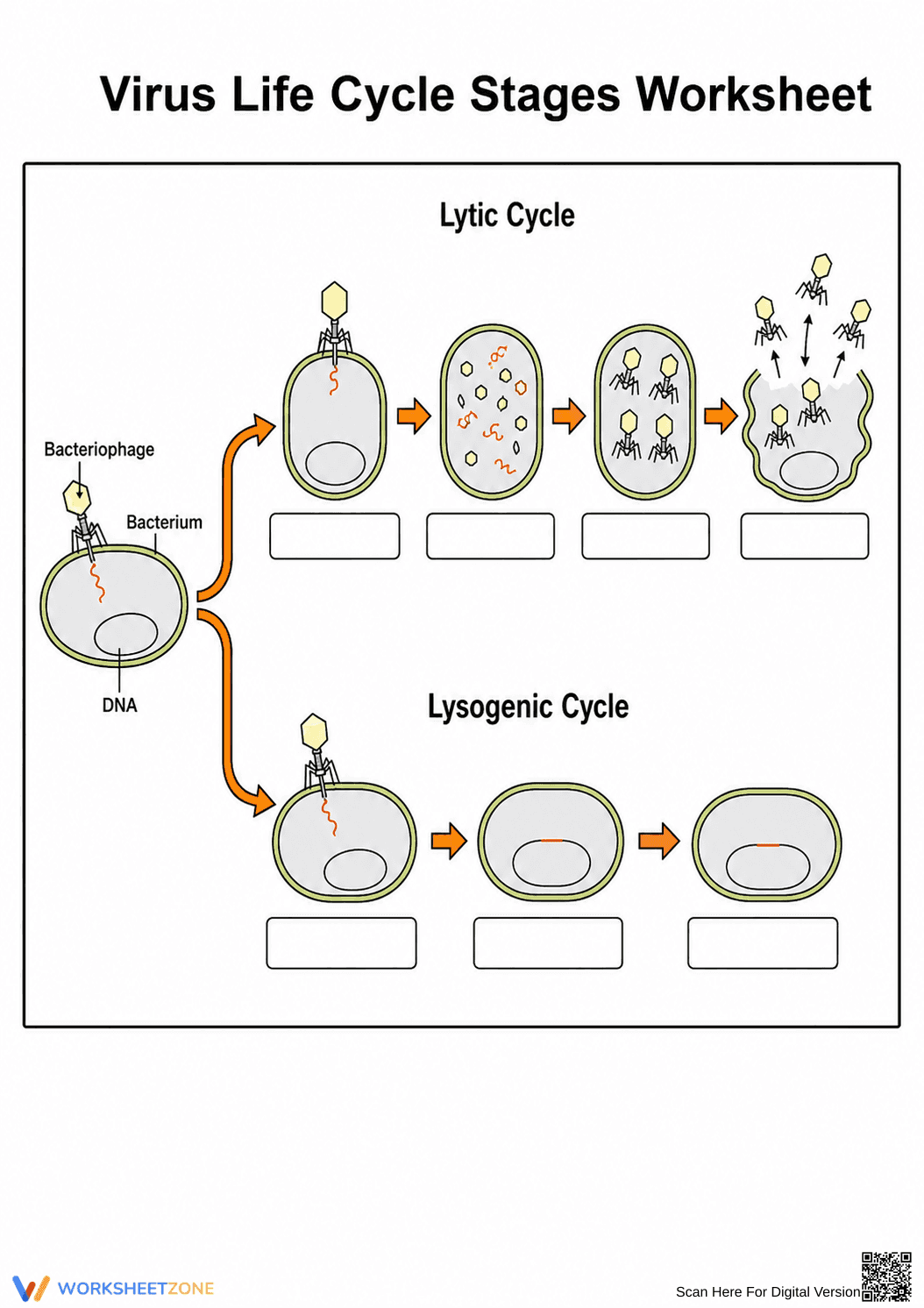
This virus life cycle worksheet provides a clear visual framework for students to identify and differentiate between the lytic and lysogenic replication pathways. By labeling the specific stages of bacteriophage infection, learners develop a concrete understanding of how viruses hijack host cellular machinery. It is an ideal resource for reinforcing complex biological concepts through active diagramming and visual analysis.
At a Glance
- Grade: 7-10 · Subject: Biology
- Standard:
MS-LS1-1— Provide evidence that living things are made of cells and contrast with viruses.- Skill Focus: Viral replication cycles
- Format: 1 page · 7 problems · Answer key included · PDF
- Best For: Formative assessment or biology review
- Time: 15–20 minutes
The worksheet features a high-resolution diagram illustrating two distinct viral pathways. It includes 7 dedicated labeling boxes where students must identify key transition points, such as attachment, DNA injection, integration, and lysis. The layout is clean and distraction-free, ensuring students focus entirely on the biological sequence. A comprehensive answer key is provided for rapid grading and immediate student feedback.
This resource is designed for immediate classroom implementation. Teachers can print the single-page PDF in under 2 minutes, distribute it to the class for a 15-minute independent labeling session, and spend less than 2 minutes reviewing the correct stages using the provided key. It serves as a perfect "plug-and-play" activity for sub plans or unexpected schedule shifts where high-quality instructional materials are needed instantly.
This activity aligns with `MS-LS1-1`, focusing on the distinction between cellular life and viral structures. By examining how viruses interact with bacterial cells, students gain insight into the fundamental requirements of life and cellular function. Both standard codes can be copied directly into lesson plans, IEP goals, or district curriculum mapping tools to ensure compliance with state science frameworks.
Use this worksheet as a mid-lesson check for understanding after introducing the concept of bacteriophages. Alternatively, assign it as a bell-ringer activity to activate prior knowledge before a lab on microorganisms. Observe if students can correctly identify the point where the lysogenic cycle diverges from the lytic cycle to gauge their grasp of viral latency and genetic integration.
This resource is tailored for middle and high school biology students, particularly those in General Biology or Life Science courses. It provides necessary visual scaffolding for English Language Learners (ELL) and students with IEPs who benefit from diagram-based learning. It pairs perfectly with a lecture on the "Characteristics of Life" or a video on viral pathology and host-pathogen interactions.
According to research by Fisher & Frey (2014) on the efficacy of visual non-linguistic representations, diagram labeling significantly enhances the retention of complex biological sequences like the virus life cycle. This worksheet targets the MS-LS1-1 standard by requiring students to analyze the structural interactions between viruses and host cells. By engaging with the 7 specific tasks, students move beyond rote memorization toward a functional understanding of the lytic and lysogenic pathways. The clear distinction between the two cycles helps prevent common misconceptions regarding viral replication and latency. This evidence-based approach ensures that learners can accurately describe how a bacteriophage utilizes a host to reproduce, a core competency in secondary life science. This resource provides a structured, high-utility tool for any biology curriculum focused on microbiology or cellular health.


