


























Views
Downloads

Codominance & Blood Types Worksheet | Grade 9 Printable
Paste this activity's link or code into your existing LMS (Google Classroom, Canvas, Teams, Schoology, Moodle, etc.).
Students can open and work on the activity right away, with no student login required.
You'll still be able to track student progress and results from your teacher account.
Mastering genetic inheritance requires hands-on practice with real-world traits. This comprehensive biology worksheet helps students understand codominance and multiple alleles through the lens of human blood types. By completing these targeted exercises, learners will confidently predict genetic outcomes and calculate phenotype probabilities using Punnett squares.
At a Glance
- Grade: 9 · Subject: Biology
- Standard:
HS-LS3-3— Apply probability concepts to explain trait variation- Skill Focus: Codominance and Punnett Squares
- Format: 4 pages · 15 problems · Answer key included · PDF
- Best For: Independent practice
- Time: 30–45 minutes
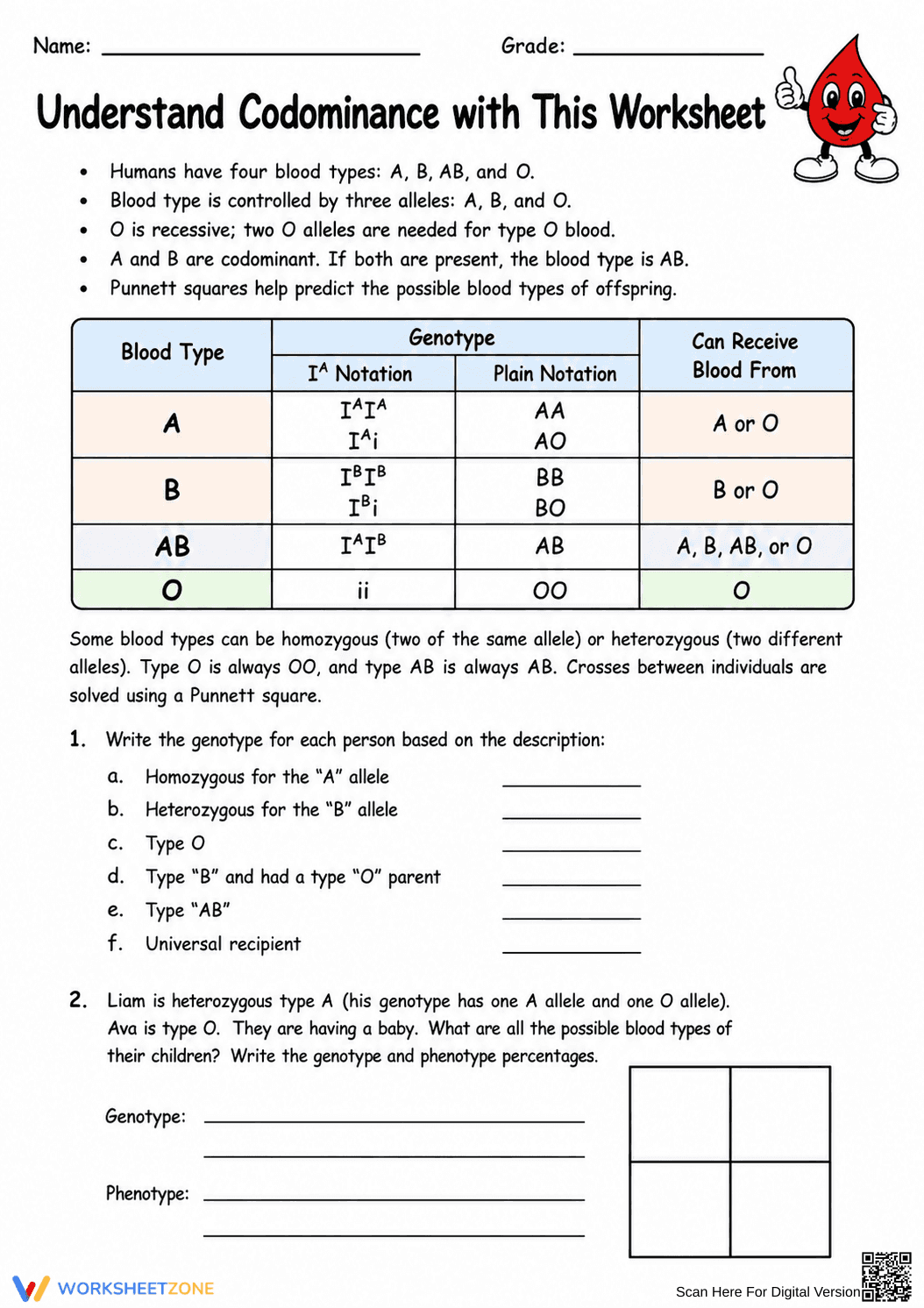
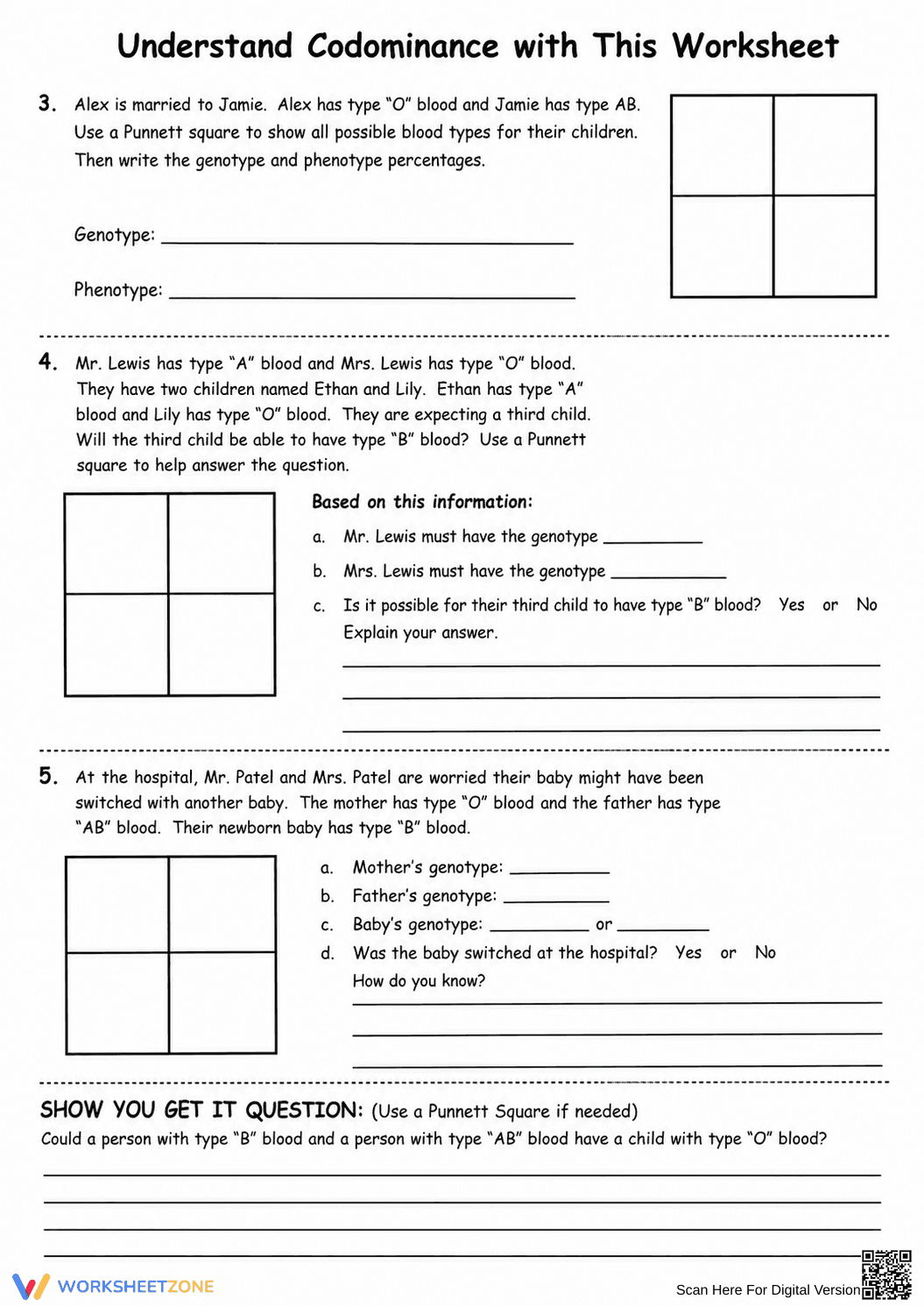
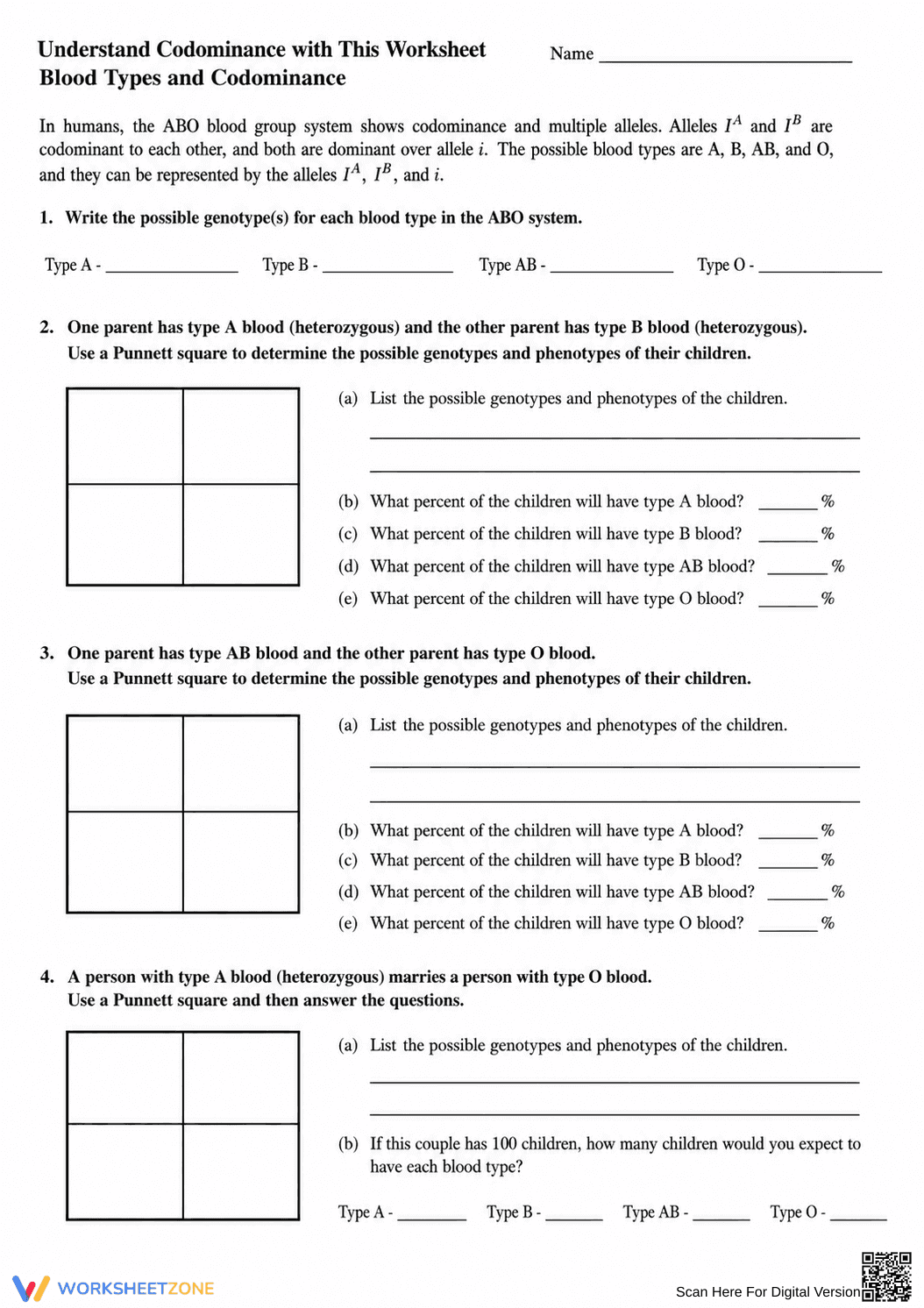
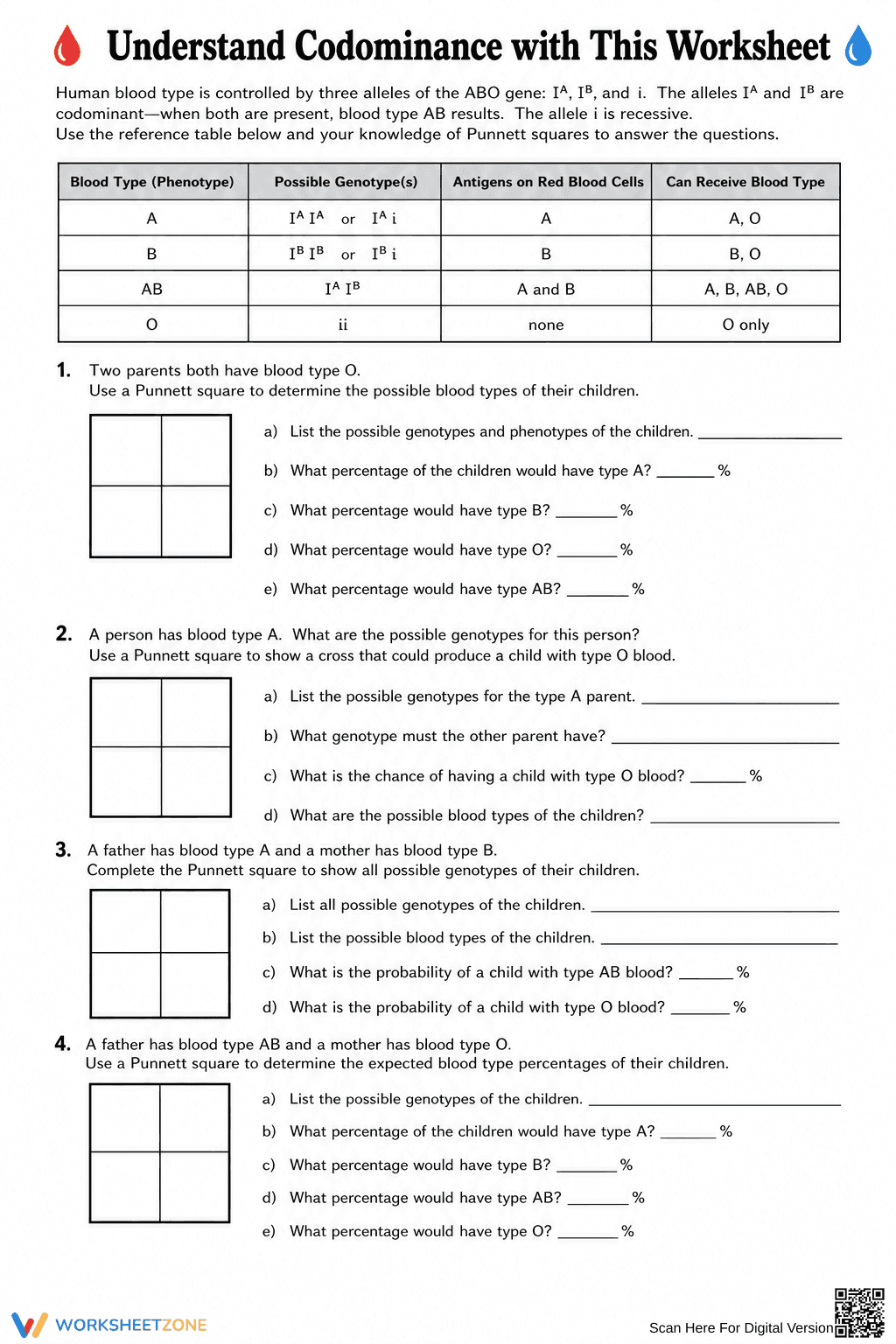
This four-page packet features a clear introductory reference table explaining the ABO blood group system, genotypes, and antigens. Students will tackle approximately 15 multi-part problems, ranging from basic genotype identification to complex, real-world scenario questions involving hospital mix-ups and family lineage. The resource includes blank Punnett squares for every cross, structured spaces for calculating percentage outcomes, and a complete answer key for accurate grading.
- Guided practice: The first section provides a detailed reference chart and asks students to translate basic descriptions into specific genotypes, building foundational vocabulary.
- Supported practice: Students complete standard monohybrid crosses using provided Punnett squares to determine the probability of specific blood types in offspring.
- Independent practice: The final tasks challenge learners with word problems and scenario questions requiring them to synthesize their knowledge of multiple alleles without direct prompts.
This gradual-release approach ensures students build confidence before tackling complex genetic word problems independently.
This resource is aligned to HS-LS3-3: Apply concepts of statistics and probability to explain the variation and distribution of expressed traits in a population. It also supports foundational middle school genetics standards regarding sexual reproduction and genetic variation. Both standard codes can be copied directly into lesson plans, IEP goals, or district curriculum mapping tools.
Deploy this packet immediately following your direct instruction on non-Mendelian genetics. It serves as an excellent in-class independent assignment or a comprehensive homework packet. While students work, teachers can use the final scenario questions as a quick formative assessment to check if learners correctly distinguish between codominant and recessive alleles. Expect students to complete the full packet in 30 to 45 minutes.
This resource is designed for high school biology students in grades 9 and 10, though it can be adapted for advanced middle school life science classes. The built-in reference tables provide excellent scaffolding for students who struggle with memorizing allele interactions. Pair this worksheet with a visual anchor chart demonstrating the difference between incomplete dominance and codominance for maximum impact.
Effective genetics instruction requires students to move beyond rote memorization and actively apply mathematical reasoning to biological concepts. Aligned with HS-LS3-3, this resource requires students to apply probability concepts to explain trait variation using Punnett squares. According to a 2024 EdReports analysis of high school science curricula, students demonstrate significantly higher retention of non-Mendelian inheritance patterns when they engage with authentic, relatable phenomena like human blood typing rather than abstract letter combinations alone. By integrating multiple alleles and codominance into scenario-based problem solving, this worksheet bridges the gap between theoretical probability and observable biological traits. The structured progression from basic genotype identification to complex predictive modeling ensures learners develop the critical thinking skills necessary for advanced scientific literacy and standardized assessment success.


