


























Views
Downloads

Monohybrid Cross Practice Worksheet | Essential Biology
Paste this activity's link or code into your existing LMS (Google Classroom, Canvas, Teams, Schoology, Moodle, etc.).
Students can open and work on the activity right away, with no student login required.
You'll still be able to track student progress and results from your teacher account.
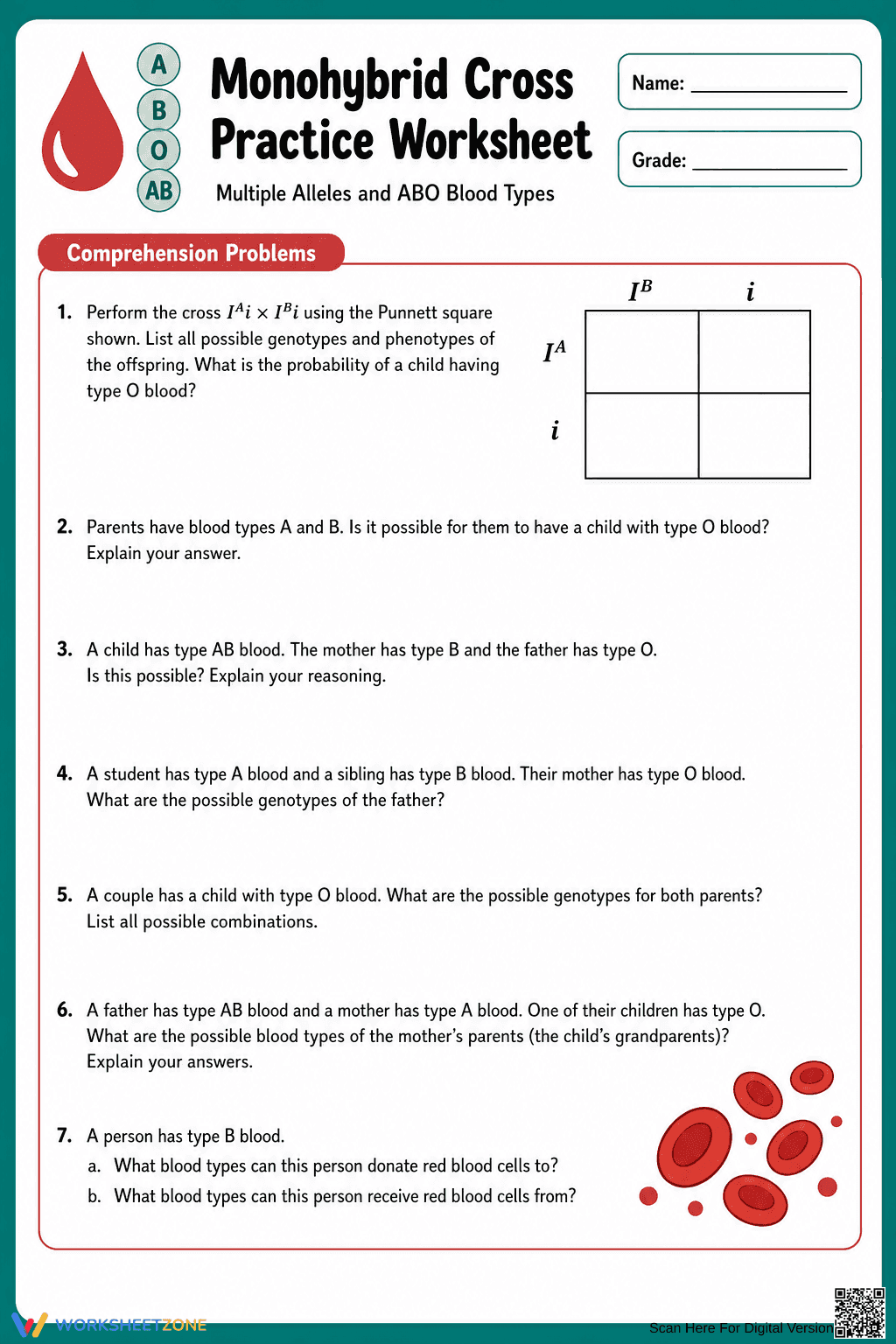
This worksheet provides comprehensive practice for high school biology students mastering the complexities of multiple alleles through ABO blood type inheritance. Students apply Mendelian principles to solve real-world genetic scenarios, determining probabilities and identifying parental genotypes. It ensures learners can accurately predict phenotypic outcomes using Punnett squares and logical deduction.
At a Glance
- Grade: 9-12 · Subject: Biology
- Standard:
HS-LS3-3— Apply probability concepts to explain the variation and distribution of expressed traits- Skill Focus: ABO Blood Type Genetics
- Format: 1 page · 7 problems · Answer key included · PDF
- Best For: Independent practice or formative assessment
- Time: 20–30 minutes
This single-page PDF features 7 rigorous comprehension problems focused on human blood types. It includes a pre-formatted Punnett square for initial guided practice, followed by 5 complex word problems requiring backward reasoning to identify parental genotypes. The final section transitions to practical application, testing knowledge of blood transfusion compatibility and donor-recipient relationships.
Skill Progression
- Guided Practice: Problem 1 provides a structured Punnett square setup for direct calculation of genotype and phenotype ratios.
- Supported Practice: Problems 2 through 6 offer scenarios where students must interpret narrative clues to deduce hidden genetic information and parental alleles.
- Independent Application: Problem 7 requires students to apply genetic theory to the physiological reality of blood transfusions and donor compatibility.
This gradual-release approach ensures students move from basic computation to higher-order analysis using the I Do, We Do, You Do instructional model.
Standards Alignment
Primary standard: `HS-LS3-3`. Students apply concepts of statistics and probability to explain the variation and distribution of expressed traits in a population. This resource specifically targets the "Multiple Alleles" component of heredity by requiring students to calculate the likelihood of specific blood type combinations. Both standard codes can be copied directly into lesson plans, IEP goals, or district curriculum mapping tools.
How to Use It
Assign this worksheet during the elaborate phase of a genetics unit after students have mastered basic dominant-recessive crosses. It serves as an excellent formative assessment to check for misconceptions regarding codominance and multiple alleles. Teachers should observe students during Problem 4, as it requires multi-step logic to identify the father's genotype based on sibling phenotypes. Completion typically takes 25 minutes.
Who It's For
This resource is designed for high school biology students, including those in Honors or AP tracks who need to solidify their understanding of non-Mendelian inheritance. It is particularly effective when paired with a blood typing lab or a visual anchor chart detailing the relationship between antigens and antibodies.
According to the RAND AIRS 2024 report on science literacy, structured problem-solving in genetics significantly improves student retention of complex biological mechanisms. This worksheet aligns with the HS-LS3-3 standard, which emphasizes the use of mathematical models like Punnett squares to predict trait distribution. By engaging with 7 distinct scenarios involving ABO blood types, students move beyond rote memorization to a functional understanding of multiple alleles. Research from Fisher & Frey (2014) suggests that applying genetic principles to human-centric examples, such as blood transfusions, increases student engagement and the likelihood of long-term conceptual mastery. This resource provides the necessary scaffolding to bridge the gap between simple monohybrid crosses and the nuanced reality of human heredity, making it a vital tool for any secondary biology curriculum focused on evidence-based instruction.


