


























Views
Downloads
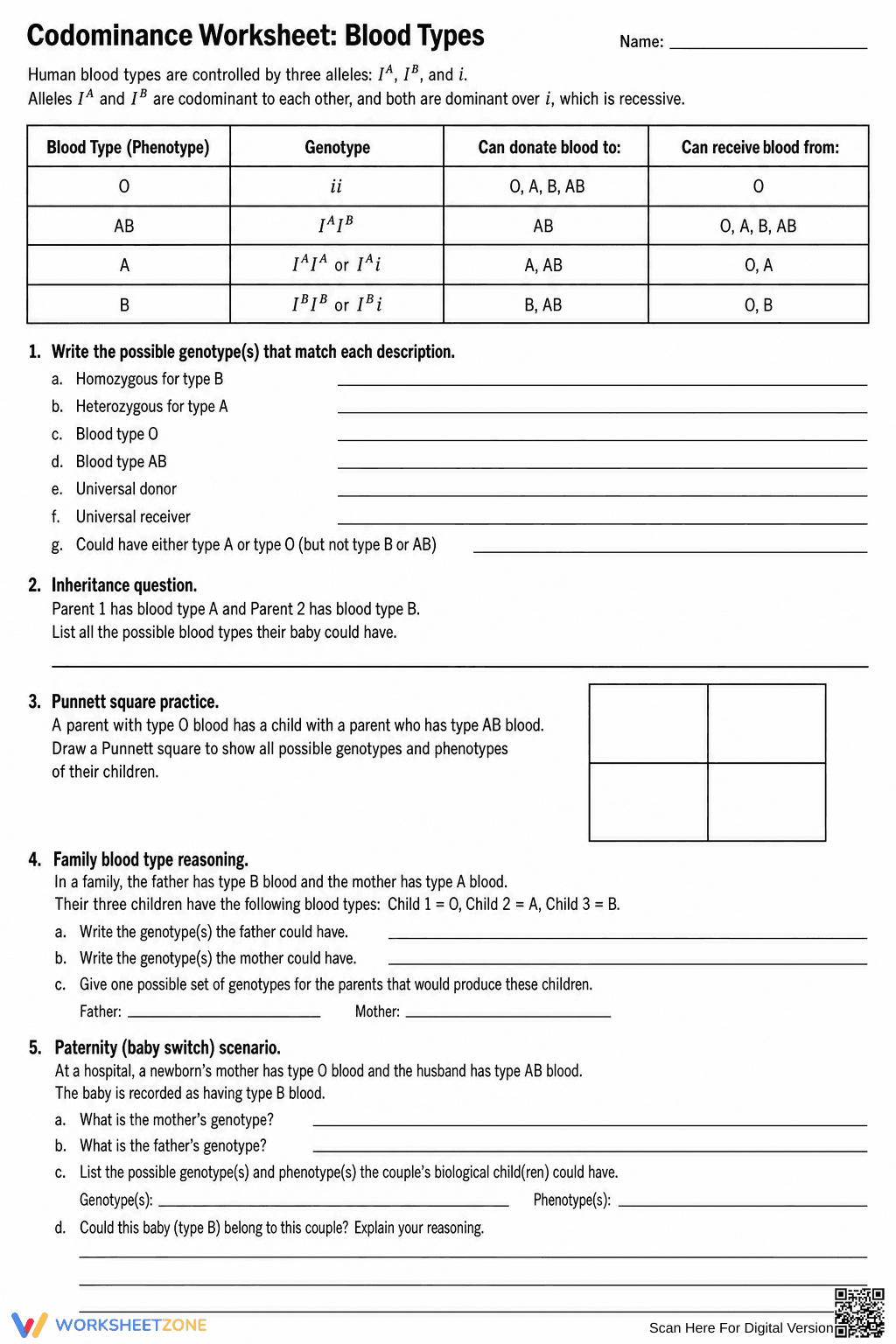

Essential Codominance Worksheet | Grade 9-10 Biology
Paste this activity's link or code into your existing LMS (Google Classroom, Canvas, Teams, Schoology, Moodle, etc.).
Students can open and work on the activity right away, with no student login required.
You'll still be able to track student progress and results from your teacher account.
This codominance worksheet provides high school biology students with targeted practice on human blood type inheritance. Students analyze the relationship between genotypes and phenotypes while solving complex genetic scenarios. By applying Punnett squares to real-world paternity and inheritance problems, learners develop a concrete understanding of how multiple alleles and codominant traits function in human populations.
At a Glance
- Grade: 9-10 · Subject: Biology
- Standard:
HS-LS3-3— Apply probability to explain the variation and distribution of expressed traits- Skill Focus: Codominance and Blood Type Genotypes
- Format: 1 page · 16 problems · Answer key included · PDF
- Best For: Independent practice or formative assessment
- Time: 25–35 minutes
This single-page PDF features a comprehensive reference table detailing phenotypes, genotypes, and donor/recipient compatibility for types A, B, AB, and O. The 16 tasks include identifying genotypes from descriptions, predicting offspring ratios, and constructing a Punnett square. It concludes with high-interest word problems involving family reasoning and a hospital "baby switch" paternity scenario to test critical thinking and logic.
Skill Progression
- Guided Practice: Students begin by using the provided reference table to identify specific homozygous and heterozygous genotypes for 7 different blood type descriptions.
- Supported Practice: Learners solve basic inheritance questions and construct a 4-cell Punnett square to visualize allele distribution between parents.
- Independent Practice: The final section requires students to apply their knowledge to 2 complex word problems involving paternity and family lineage reasoning.
This worksheet follows a gradual-release model, moving from simple identification to higher-order application of genetic principles.
Standards Alignment
This resource is aligned to `HS-LS3-3`: "Apply concepts of statistics and probability to explain the variation and distribution of expressed traits in a population." It specifically addresses the non-Mendelian inheritance pattern of codominance where both alleles are expressed in the phenotype. Both standard codes can be copied directly into lesson plans, IEP goals, or district curriculum mapping tools.
How to Use It
Use this worksheet as a mid-unit formative assessment after introducing multiple alleles. It works best during the independent practice phase of a lesson on non-Mendelian genetics. Teachers should observe students during the paternity scenario (Task 5) to identify misconceptions regarding the recessive nature of the 'i' allele. Expected completion time is approximately 30 minutes.
Who It's For
This resource is designed for high school biology students, including those in Honors tracks needing a refresher on basic blood genetics. It is particularly effective for visual learners who benefit from the included reference table. Pair this with a blood typing lab or a digital pedigree simulator for a comprehensive genetics unit that meets secondary science requirements.
The use of Punnett squares to model codominance in blood types is a foundational component of secondary life science education. According to Fisher & Frey (2014), providing students with structured scaffolds—such as the genotype-phenotype reference table included here—facilitates the transition from rote memorization to higher-order genetic analysis. This worksheet aligns with the HS-LS3-3 standard by requiring students to calculate the probability of trait distribution within specific family lineages. Research from the NAEP indicates that students who engage in problem-solving involving real-world applications, such as the paternity scenarios featured in this 16-task set, show higher retention of Mendelian and non-Mendelian principles. This 1-page printable serves as a reliable tool for verifying student mastery of allele interactions and phenotypic expression in human biology.


