


























Views
Downloads

HS-LS3-3 Worksheet: Blood Types — Grade 9-10 Aligned
Paste this activity's link or code into your existing LMS (Google Classroom, Canvas, Teams, Schoology, Moodle, etc.).
Students can open and work on the activity right away, with no student login required.
You'll still be able to track student progress and results from your teacher account.
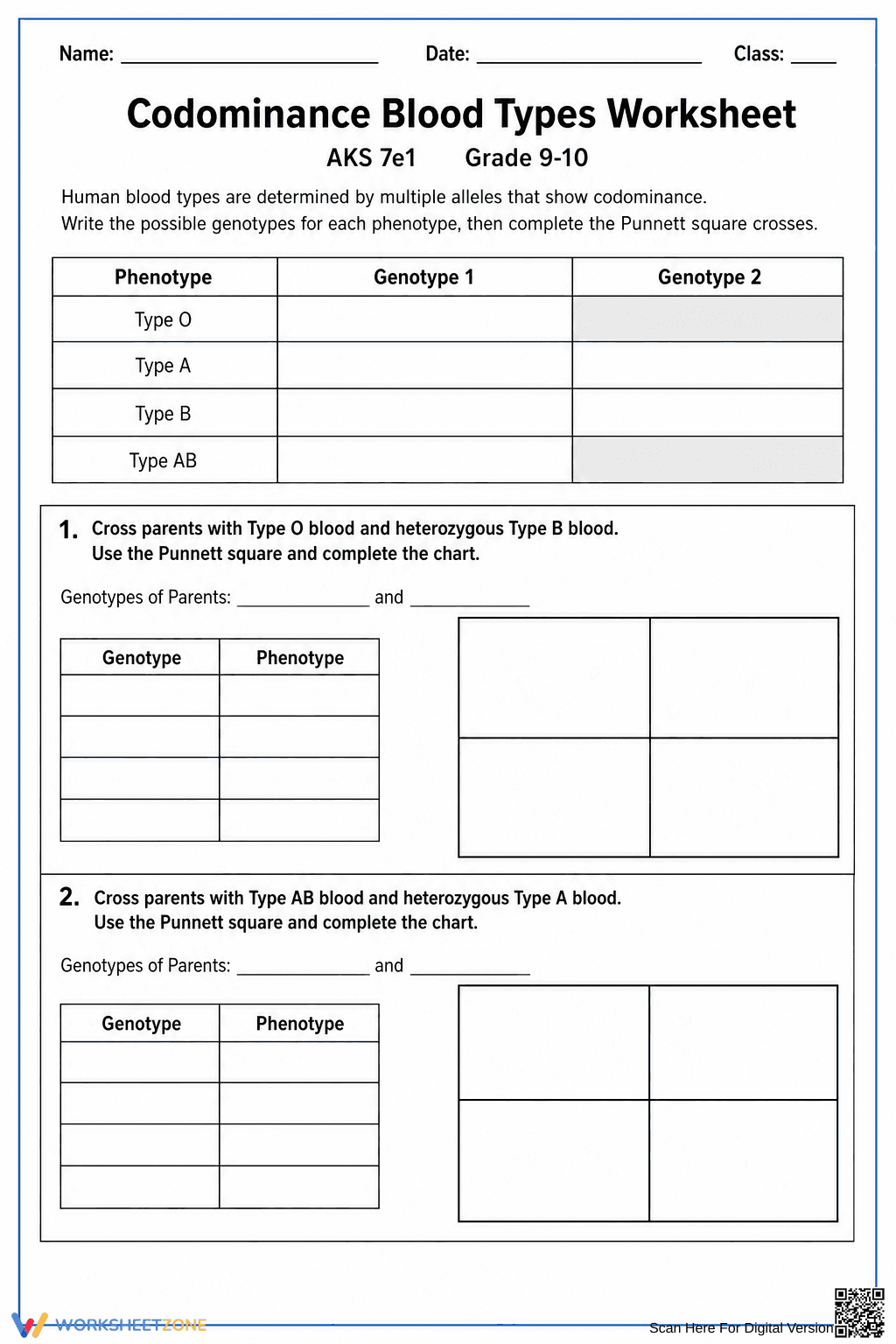
This Grade 9-10 biology worksheet provides targeted practice for students to master codominance inheritance patterns through the lens of human blood types. By completing genotype tables and Punnett square crosses, learners demonstrate their ability to predict genetic outcomes and understand multiple alleles.
At a Glance
- Grade: 9-10 · Subject: Biology
- Standard:
HS-LS3-3— Apply probability to explain variation of expressed traits- Skill Focus: Codominance inheritance patterns
- Format: 1 page · 3 tasks · Answer key included · PDF
- Best For: Formative assessment or independent practice
- Time: 20–30 minutes
This single-page PDF features a comprehensive review of ABO blood group genetics. It begins with a reference table where students identify genotypes for Type O, A, B, and AB blood. Following this, students engage in two multi-step Punnett square problems requiring them to identify parental genotypes, complete the 2x2 grid, and summarize the resulting genotypic and phenotypic ratios. A complete answer key is included for efficient grading.
Mastery Evidence
The worksheet is structured to provide clear evidence of student mastery across cognitive tiers. The initial genotype table serves as an identification assessment (Approaching), ensuring students can decode allele symbols. The Punnett square crosses require the application of probability to biological systems (Meeting/Exceeding). These discrete tasks provide quantifiable data points that can be directly entered into gradebooks or used to document progress toward specific IEP goals in science.
Standards Alignment
The primary focus is HS-LS3-3, which requires students to apply concepts of statistics and probability to explain the variation and distribution of expressed traits. This resource specifically addresses the non-Mendelian pattern of codominance, where both alleles in a heterozygote are fully expressed. It also aligns with the Georgia AKS 7e1 standard cited on the page. Both standard codes can be copied directly into lesson plans, IEP goals, or district curriculum mapping tools.
How to Use It
This resource is best utilized as a formative assessment following direct instruction on non-Mendelian genetics. Teachers can distribute the worksheet during the independent practice phase. As students work, circulate to observe if they are correctly placing the superscripts on the alleles. The worksheet typically takes 20–30 minutes to complete, making it an ideal exit ticket or mid-period check for understanding.
Who It's For
This practice is designed for high school biology students in general or honors settings. The structured layout provides necessary scaffolding for students who struggle with abstract genetic concepts. It pairs naturally with a blood typing laboratory activity or a digital simulation of ABO inheritance to provide a multi-modal learning experience for diverse learners.
According to the EdReports 2024 analysis of high school science curricula, effective genetics instruction must move beyond simple Mendelian traits to include complex inheritance patterns like codominance to meet the rigor of modern standards. This worksheet facilitates that transition by requiring students to manipulate multiple alleles within a structured mathematical framework. By focusing on the ABO blood system, the resource grounds abstract probability in a concrete human context, which research suggests improves long-term retention of biological principles. The inclusion of the HS-LS3-3 standard ensures that the tasks are not merely rote memorization but are instead focused on the statistical distribution of traits. This alignment supports educators in providing evidence-based practice that mirrors the complexity of the NAEP science framework. The worksheet serves as a reliable tool for documenting student growth in predicting phenotypic outcomes based on specific genotypic combinations.


