


























0
Views
0
Downloads

0.0
0
Save
0 Likes
Share
Coding Nonfiction Text: The History of Crayons
0 Views
0 Downloads
Paste this activity's link or code into your existing LMS (Google Classroom, Canvas, Teams, Schoology, Moodle, etc.).
Students can open and work on the activity right away, with no student login required.
You'll still be able to track student progress and results from your teacher account.
Information
Description
What It Is:
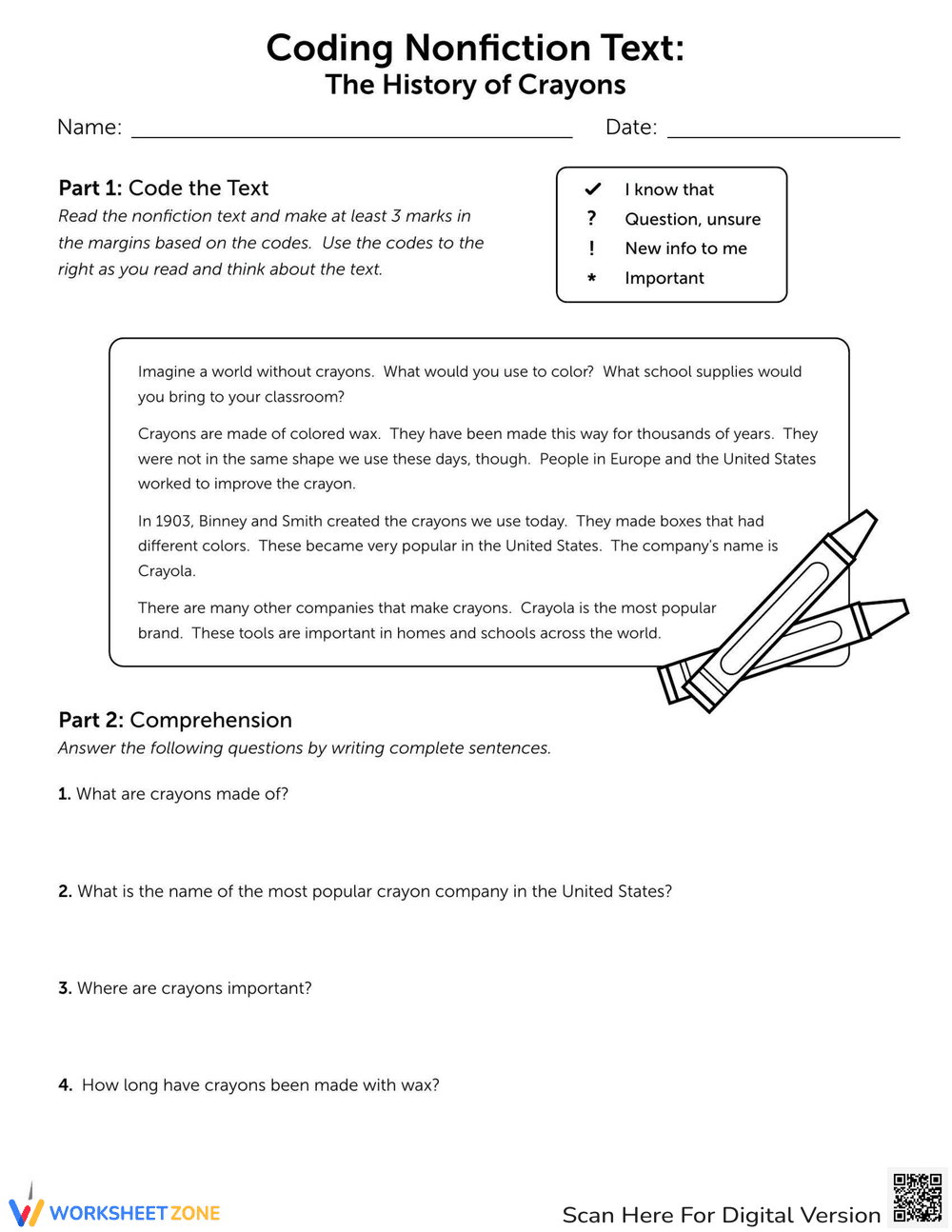
This is an educational worksheet titled 'Coding Nonfiction Text: The History of Crayons.' It includes two parts. Part 1 involves reading a short nonfiction passage about crayons and marking the text with codes indicating 'I know that,' 'Question, unsure,' 'New info to me,' and 'Important.' Part 2 consists of comprehension questions about the text, requiring complete sentence answers. The questions ask about the composition of crayons, the name of the most popular crayon company, where crayons are important, and how long crayons have been made with wax.
Grade Level Suitability:
This worksheet is suitable for grades 2-4. The reading level of the text and the complexity of the comprehension questions are appropriate for students in these grade levels. The coding activity also introduces a basic form of text analysis suitable for this age range.
Why Use It:
This worksheet helps students develop reading comprehension skills, practice identifying key information in nonfiction text, and improve their ability to answer questions using complete sentences. It also introduces a simple coding system to encourage active reading and critical thinking. It teaches children about the history of crayons.
How to Use It:
First, have students read the nonfiction text about crayons. As they read, they should use the provided codes (checkmark, question mark, exclamation point, and dot) to mark the text in the margins. After reading and coding the text, students should answer the comprehension questions in Part 2, writing their answers in complete sentences.
Target Users:
This worksheet is ideal for elementary school students in grades 2-4. It is particularly beneficial for students who need practice with reading comprehension, nonfiction text analysis, and answering questions with complete sentences. Teachers can use it as a classroom activity or homework assignment.
This is an educational worksheet titled 'Coding Nonfiction Text: The History of Crayons.' It includes two parts. Part 1 involves reading a short nonfiction passage about crayons and marking the text with codes indicating 'I know that,' 'Question, unsure,' 'New info to me,' and 'Important.' Part 2 consists of comprehension questions about the text, requiring complete sentence answers. The questions ask about the composition of crayons, the name of the most popular crayon company, where crayons are important, and how long crayons have been made with wax.
Grade Level Suitability:
This worksheet is suitable for grades 2-4. The reading level of the text and the complexity of the comprehension questions are appropriate for students in these grade levels. The coding activity also introduces a basic form of text analysis suitable for this age range.
Why Use It:
This worksheet helps students develop reading comprehension skills, practice identifying key information in nonfiction text, and improve their ability to answer questions using complete sentences. It also introduces a simple coding system to encourage active reading and critical thinking. It teaches children about the history of crayons.
How to Use It:
First, have students read the nonfiction text about crayons. As they read, they should use the provided codes (checkmark, question mark, exclamation point, and dot) to mark the text in the margins. After reading and coding the text, students should answer the comprehension questions in Part 2, writing their answers in complete sentences.
Target Users:
This worksheet is ideal for elementary school students in grades 2-4. It is particularly beneficial for students who need practice with reading comprehension, nonfiction text analysis, and answering questions with complete sentences. Teachers can use it as a classroom activity or homework assignment.


