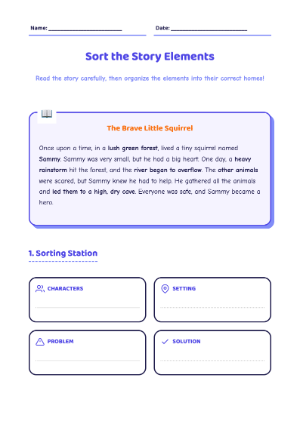
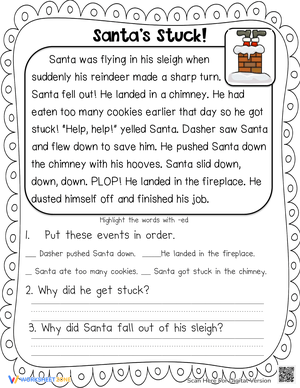
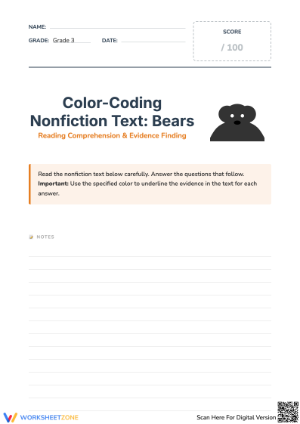
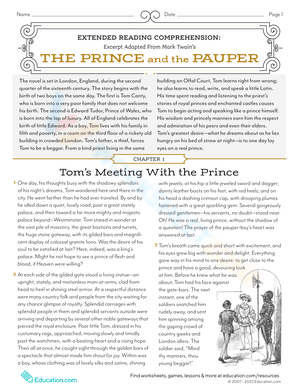
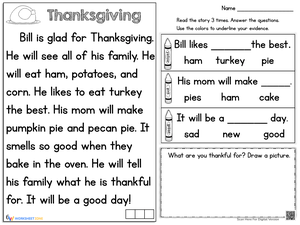
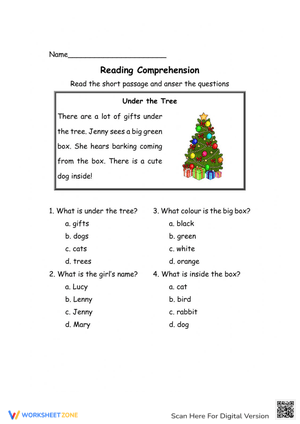
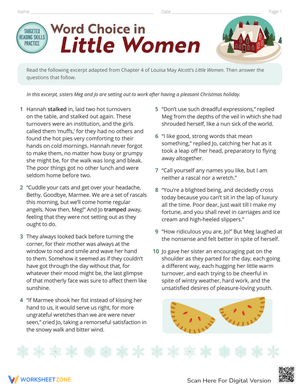
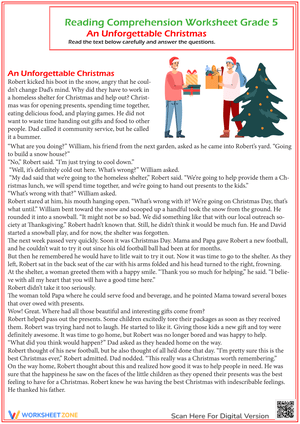
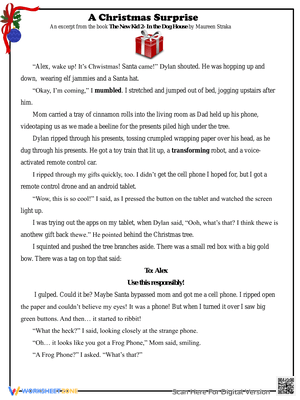
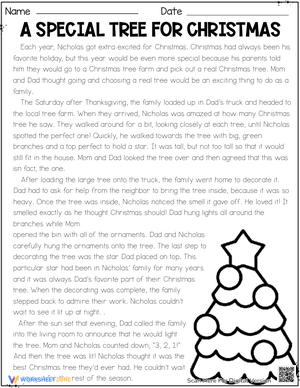
These fiction comprehension questions worksheets give teachers a structured set of narrative reading tasks that move students deliberately from surface-level recall into close textual analysis — covering character development, plot structure, conflict, and theme without collapsing every skill into a single overwhelming response. Each worksheet isolates one story element so that instruction stays focused and student responses stay interpretable. The set runs from literal-recall questions through evaluative thinking, which makes it practical across grades 3 through 5 and across multiple instructional contexts.
What the Set Covers
Six skill areas appear across the worksheets, each building on the previous one:
- Literal recall — identifying characters, setting, and key events with direct text support
- Character analysis — tracing how a character's actions, speech, and choices signal traits or change over time
- Setting and mood — explaining how time and place shape the story's atmosphere and influence character decisions
- Conflict — distinguishing internal from external conflict and connecting each to the overall plot arc
- Inference — drawing supported conclusions from textual evidence when the answer isn't stated directly
- Theme — articulating what the story reveals about people or choices, written as a full claim rather than a one-word topic
That last distinction matters more than it might seem. Students who handle inference questions reasonably well often stall on theme because theme demands a different cognitive move: stepping out of the story's events and into what those events collectively mean. A student might write "the theme is friendship" when the answer needs to be something closer to "true friendship requires honesty even when it's uncomfortable." Each worksheet keeps inference and theme as separate tasks for exactly that reason — so teachers can see precisely where a student's thinking stops rather than getting a blurred picture from a combined question.
Reading Errors That Surface Fast — and What They Tell You
The most consistent error across grade levels is students treating inference as guessing. When a story shows a character quietly gathering her belongings and avoiding eye contact before a difficult conversation, a student might write "I think she was nervous" and stop there. That's a hunch, not an inference. A real inference looks like this: "She packed her bag slowly and didn't speak to anyone, which shows she was nervous because people get quiet and deliberate when they're dreading what's coming." The text clue plus the stated connection — that two-part move — is what most students don't make explicit until they've practiced it several times with direct feedback. The questions in these worksheets push students to write both parts every time, which surfaces that gap quickly.
A second reliable pattern: students who conflate theme with topic. If a story follows a boy who learns to accept help after months of struggling alone, many students write "the theme is independence" or "the theme is asking for help." Those are topics. A theme statement needs a verb and a claim — something like "Accepting help from others doesn't mean you're weak; it means you understand your own limits." The worksheets ask students to write the theme as a complete sentence and then locate two passages that support it. That format makes the theme-as-topic shortcut impossible to hide, which is exactly the instructional point.
How to Work These Into Your Teaching Week
These fiction comprehension questions worksheets hold up best when used in the 10 to 15 minutes immediately after a shared read-aloud, before the class transitions to independent writing. The story is still fresh enough that students can reach back into specific details rather than defaulting to plot summary. Delaying the worksheet until the next day typically produces thinner, vaguer responses — students reconstruct a general outline of what happened rather than attending to the specific moments the questions are asking about.
During small-group guided reading, the questions work well as a listening tool. A student who says "I don't know" to an inference question is in a different place than one who identifies the right clue but can't explain the connection. Hearing students work through the questions aloud reveals that distinction in ways a completed written response often doesn't. A few planning notes worth keeping in mind:
- Assign one worksheet per story or chapter — not multiple worksheets at once. Asking students to address character, setting, and theme simultaneously after a single reading produces shallow work across all three.
- Use the literal-recall section as a quick entry check at the start of small group. Students who can't answer those questions reliably aren't ready to infer, and knowing that before the lesson continues is more useful than discovering it afterward.
- The evaluative questions — "Was the author's choice effective? Why?" — work better as a brief spoken discussion before students write. Going straight to cold written response on evaluative tasks typically yields one-sentence answers with no supporting reasoning.
Setting the Right Level for Every Reader in the Room
For students reading below grade level, the practical move is to limit each worksheet to the literal-recall questions plus one inference question. Add a response frame for the inference: "In the text it says ___, which suggests ___ because ___." That frame doesn't remove the thinking — it removes the sentence-construction barrier so students' effort stays on the reading itself rather than on how to begin a written response.
Advanced readers get the most traction from theme and evaluative questions. Push those students to write a follow-up paragraph comparing the theme of the current story to a text the class read earlier in the unit. That comparison requires holding two works in mind simultaneously and tracing a conceptual thread between them — a skill most grade-level assignments don't ask for. These fiction comprehension questions worksheets set a floor for advanced students rather than a ceiling when teachers add that cross-text layer.
Students in the middle — comfortable with literal recall but resistant to inference — respond well when the teacher models a complete inference response on the board before students attempt it independently. Writing the model in real time, thinking aloud about the text clue and the connection, gives this group a structure to imitate before they've internalized the process. That one-time demonstration is often more useful than re-reading the directions.
Standard Alignment
These fiction comprehension questions worksheets address CCSS.ELA-LITERACY.RL.3.1 through RL.5.3. RL.3.1 requires students to ask and answer questions and refer explicitly to the text — the foundation all other narrative standards depend on. RL.4.3 asks students to describe in depth a character, setting, or event by drawing on specific details from the text, which maps directly to the character-analysis and setting questions in the set. RL.5.2 addresses theme and summarization, requiring students to determine a theme and explain how it is supported by key details — the most direct match to the theme questions where we see the sharpest instructional payoff.
In practical terms, the literal-recall questions carry the RL.3.1 load, the character and setting questions carry RL.4.3, and the theme questions carry RL.5.2. A teacher who uses this set across a unit is building toward all three standards in sequence rather than treating them as separate, isolated targets.
Frequently Asked Questions
What grade levels do these worksheets fit?
The set targets grades 3 through 5. Individual worksheets are usable in grade 2 with teacher support during small-group instruction, and they serve as a review or intervention resource in grade 6. The literal-to-inferential-to-evaluative sequence maps onto the upper elementary band where narrative text standards are most heavily front-loaded in most district scope and sequences.
Can I use these worksheets with a story I'm already teaching?
Yes. The questions are text-agnostic at the skill level — the inference and character-analysis questions apply to any narrative text with sufficient complexity. The plot-structure questions reference generic story terms (rising action, climax, resolution) rather than specific passages, so they transfer to whatever text the class is currently reading without modification.
Do these work for novel chapters as well as short stories?
Each worksheet is built around a single reading event — one short story, one picture book, or one chapter — rather than spread across an extended text. For novels, the practical approach is to assign one worksheet per chapter or reading section and use a separate synthesis task at the end of the book to pull the thinking together across the full arc.
Are answer keys included?
Yes. The key for literal-recall questions is direct. For inference and theme questions, the key provides exemplar responses with brief annotations explaining what makes each response strong — not just the "right" answer, but why it demonstrates close reading. Those annotations give teachers specific language to use during feedback conferences rather than simply marking a response correct or incorrect.












 Interactive Worksheet Maker
 Quiz Maker
 Word Search Maker
 Crossword Puzzle Maker
 Word Scramble Generator
 Sentence Scramble Generator
 Handwriting Worksheet Generator
 Name Tracing Generator
 Fill In The Blank Generator