


























Views
Downloads
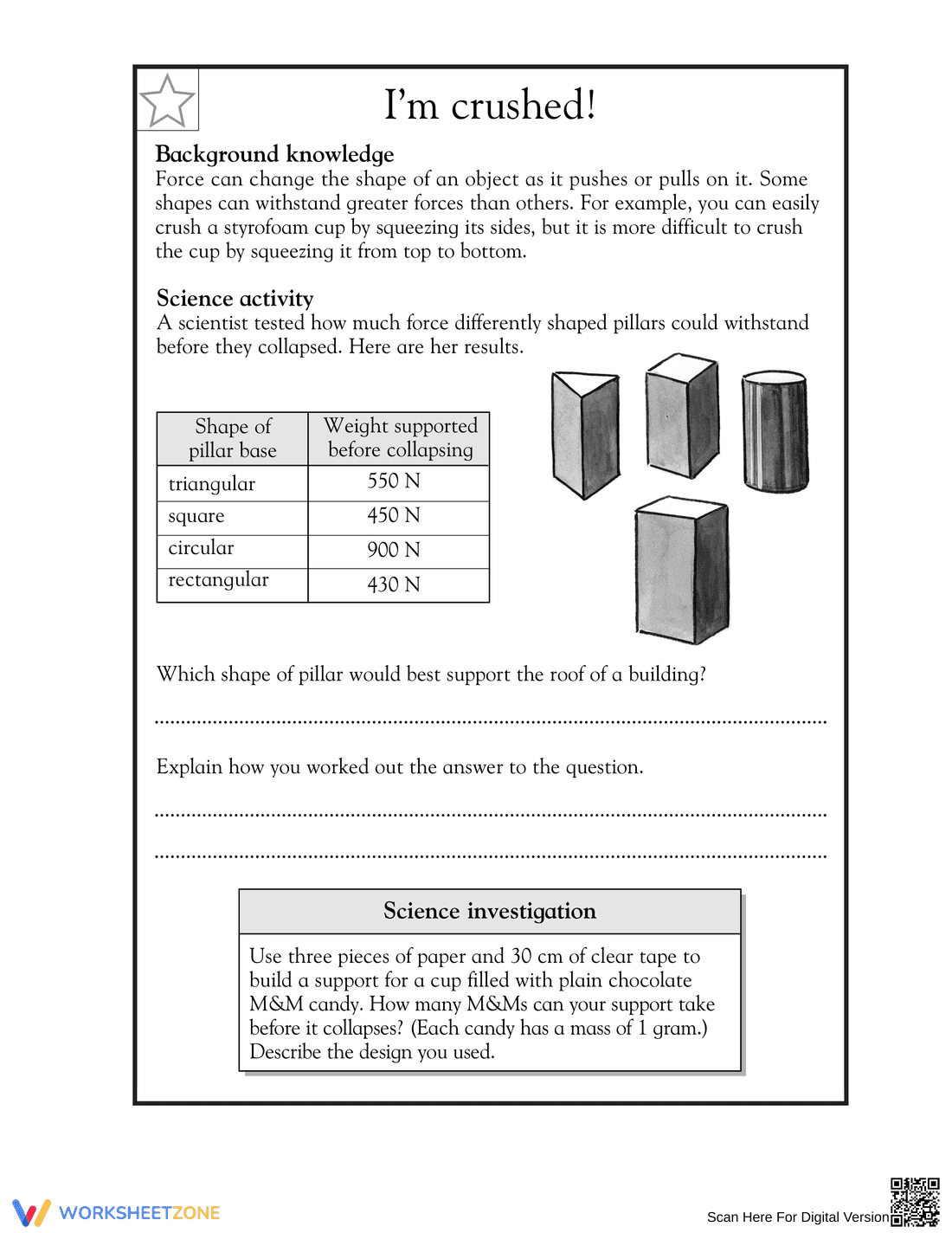


Essential Grade 5 Force and Pillars Science Worksheet
Paste this activity's link or code into your existing LMS (Google Classroom, Canvas, Teams, Schoology, Moodle, etc.).
Students can open and work on the activity right away, with no student login required.
You'll still be able to track student progress and results from your teacher account.
Students explore the physics of structural support and compression in this engaging Grade 5 science worksheet. By analyzing pillar strength data and conducting a hands-on paper-pillar investigation, learners develop a concrete understanding of how shape influences the amount of force an object can withstand before it collapses. It is an ideal blend of data literacy and engineering.
At a Glance
- Grade: 5 · Subject: Science
- Standard:
3-5-ETS1-3— Plan and carry out fair tests to identify structural failure points- Skill Focus: Force, Compression, and Structural Engineering
- Format: 1 page · 3 tasks · Answer key included · PDF
- Best For: Introduction to structural engineering and physics
- Time: 30–45 minutes
This comprehensive one-page worksheet features three distinct components designed to build conceptual depth. It begins with a background knowledge section explaining compression force, followed by a data analysis table comparing triangular, square, circular, and rectangular pillars. Students conclude with a hands-on science investigation where they test paper supports with mass to find the collapse point. A full answer key is included.
The zero-prep design makes this resource a reliable choice for busy educators. Step 1: Print the single-page PDF (30 seconds). Step 2: Distribute to students and review the background knowledge together (5 minutes). Step 3: Facilitate the hands-on investigation with basic classroom materials like paper and tape (25 minutes). Total teacher preparation is under two minutes, requiring no specialized lab equipment.
Standards Alignment
Aligned to NGSS 3-5-ETS1-3, this worksheet requires students to plan and carry out fair tests in which variables are controlled and failure points are considered. Students must interpret quantitative data to determine which design best meets the criteria for supporting a roof. This standard code can be copied directly into lesson plans or district curriculum mapping tools to ensure instructional compliance.
How to Use It
Use this worksheet as a bridge between direct instruction on forces and a larger engineering design challenge. It works best during the explore phase of a 5E lesson cycle, allowing students to observe physical properties before formal definitions are solidified. Teachers should observe if students can articulate why the circular pillar supports more weight during the analysis phase.
Who It's For
This resource is designed for Grade 5 students but is adaptable for Grade 4 or 6 learners exploring physical science. It provides excellent scaffolding for students who benefit from visual data representations and hands-on tactile learning. The investigation can be paired naturally with an anchor chart on balanced forces or a reading passage on bridge architecture.
According to Fisher & Frey (2014), the integration of data interpretation with hands-on application significantly enhances the retention of complex physical science concepts like compression. This Grade 5 worksheet aligns with evidence-based practices by requiring students to move beyond rote memorization of force definitions toward the active analysis of structural failure points. By utilizing the 3-5-ETS1-3 standard, the resource ensures that students are practicing the high-level engineering skills identified as critical for middle school readiness. Research indicates that when students participate in build-and-test cycles, they develop a more sophisticated understanding of variables and constraints than through text-based learning alone. This approach mirrors the iterative design process used by professional engineers, providing a foundation for future STEM success. The inclusion of quantitative data provides essential cross-curricular support for math standards regarding measurement and data analysis in a real-world scientific context.


