




























Views
Downloads

Essential Grade 5 Newton & Force Science Worksheet

Paste this activity's link or code into your existing LMS (Google Classroom, Canvas, Teams, Schoology, Moodle, etc.).
Students can open and work on the activity right away, with no student login required.
You'll still be able to track student progress and results from your teacher account.
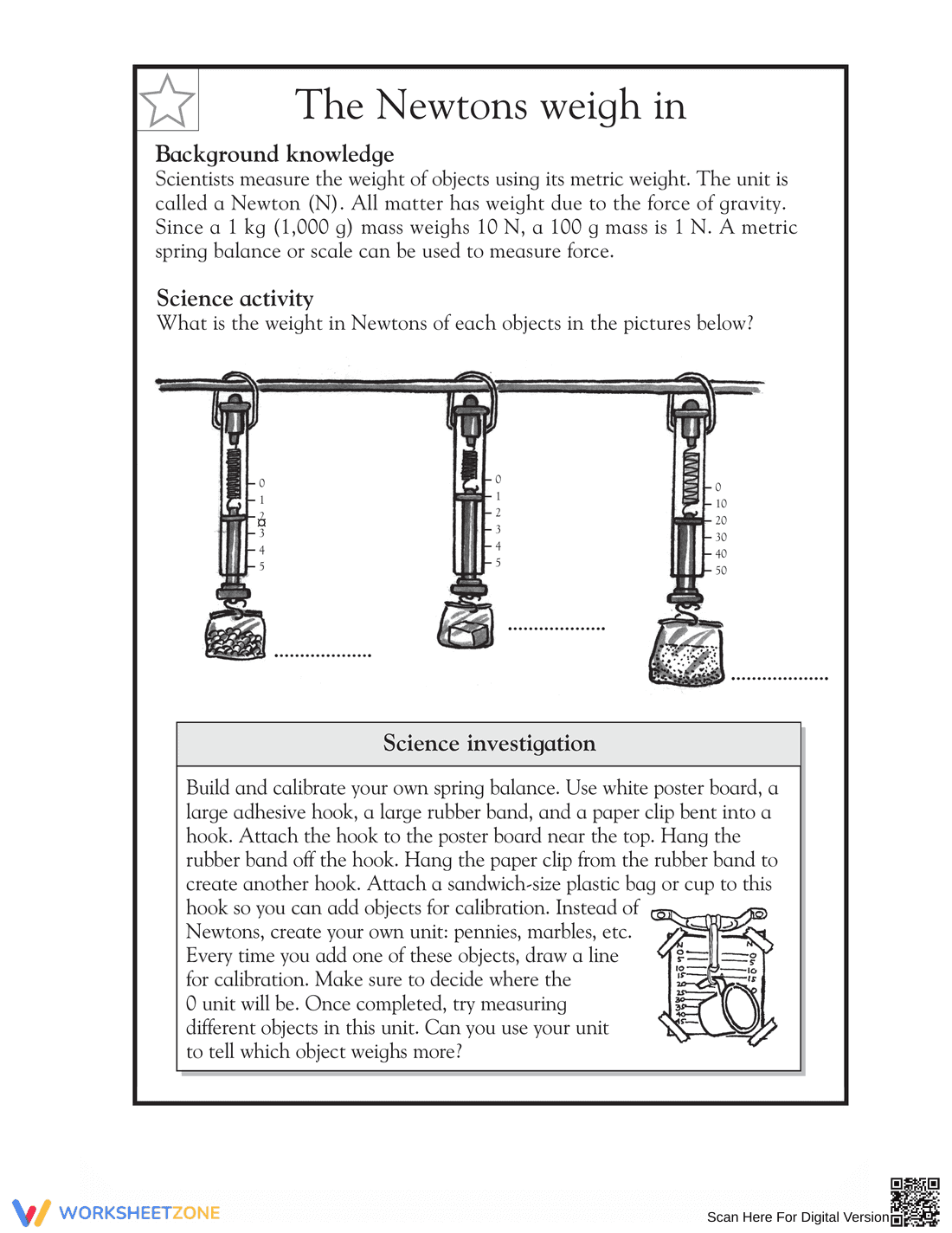
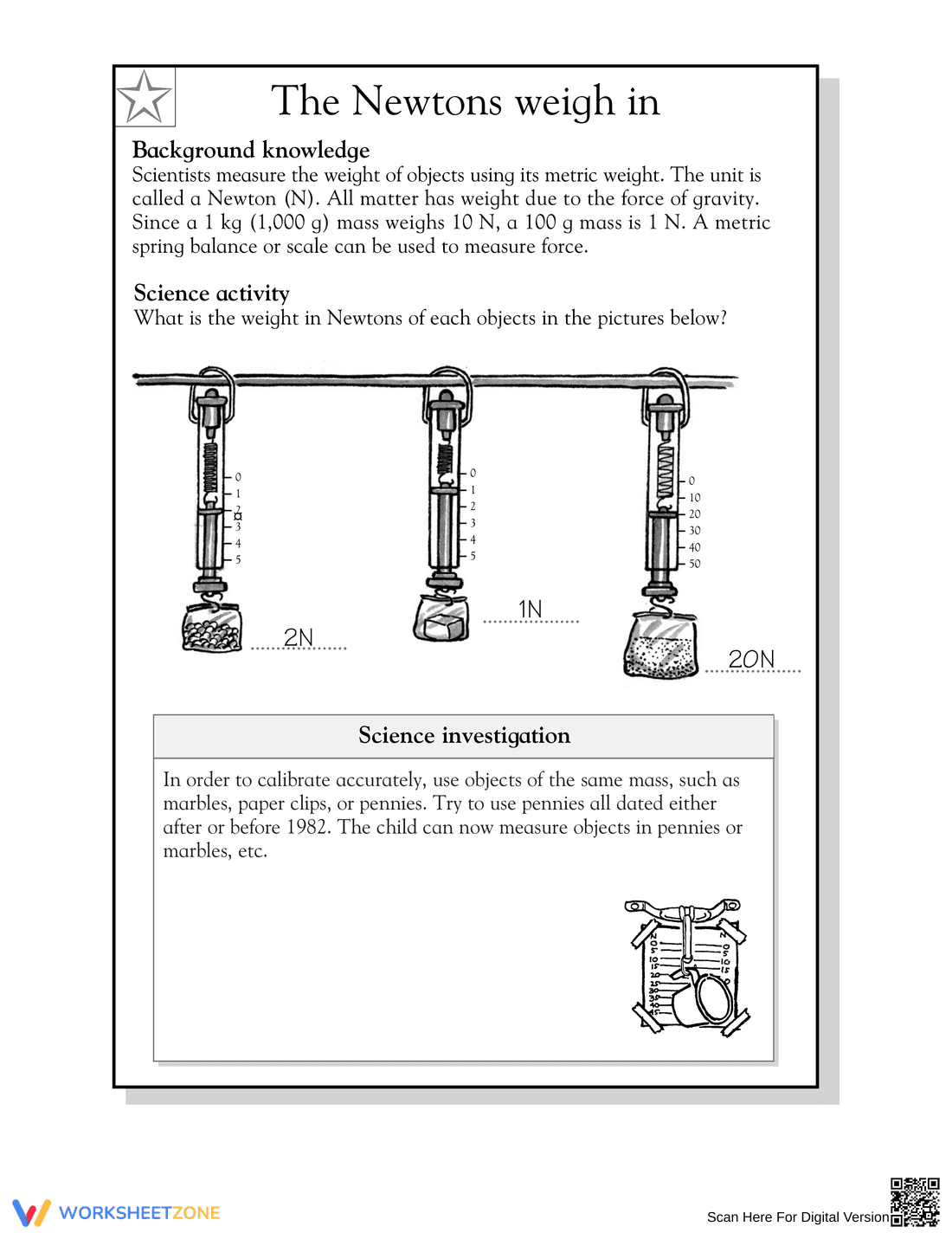
This Grade 5 science worksheet teaches students to measure force in Newtons (N) through scale-reading exercises and hands-on experimentation. By connecting mass to the force of gravity, students develop a concrete understanding of metric weight. This resource empowers learners to accurately calibrate measurements and observe the physical properties of gravity in action.
At a Glance
- Grade: 5 · Subject: Science
- Standard:
5-PS2-1— Support an argument that the gravitational force exerted by Earth on objects is directed down- Skill Focus: Measuring force in Newtons
- Format: 1 page · 4 tasks · Answer key included · PDF
- Best For: Introduction to gravity and force units
- Time: 20–45 minutes
This resource includes a clear background section explaining the relationship between mass and weight in Newtons. Students first complete an activity identifying the weight of three objects on illustrated spring scales. It concludes with a science investigation providing detailed instructions for building and calibrating a custom spring balance using common classroom materials like rubber bands and poster board.
The zero-prep workflow is designed for maximum efficiency in the classroom. Step 1: Print the single-page PDF (less than 30 seconds). Step 2: Distribute the worksheets and have students read the background section independently (5 minutes). Step 3: Review the scale-reading answers class-wide before transitioning to the hands-on lab (10 minutes). Total teacher preparation time is under 2 minutes, making this ideal for substitute plans or emergency science blocks.
This activity aligns to 5-PS2-1, which requires students to support arguments regarding gravitational force. By measuring downward pull on spring scales, students collect empirical evidence of gravity's constant effect on matter. The investigation also supports 3-5-ETS1-3 by requiring students to plan and carry out fair tests during the calibration process. Both standard codes can be copied directly into lesson plans or district curriculum mapping tools.
Use this worksheet as a bridge between gravity instruction and a hands-on lab. During scale-reading, observe students to ensure they are reading the metric increments correctly as a key formative assessment moment. For a deeper extension, have students use their DIY balances to measure classroom objects and record the data in a science journal. Completion time for the paper portion is 15 minutes; the full investigation may take up to 45 minutes.
Designed for fifth graders beginning their study of physical science, this resource provides necessary scaffolds through background text, supporting English Language Learners and students needing literacy support. Pair this worksheet with a physical spring scale to transition from 2D representations to tactile experiences. It is suitable for diverse learners needing structured practice in metric force measurement and gravity concepts.
Research in science education emphasizes the importance of moving from abstract concepts of gravity to concrete measurements of force. According to Fisher & Frey (2014), the gradual release of responsibility—moving from guided reading of scale illustrations to the independent construction of a measurement tool—significantly improves student retention of unit-specific vocabulary. This worksheet facilitates that transition by providing the necessary 5-PS2-1 alignment and the 100g-to-1N conversion ratio within the text. Measuring weight in Newtons rather than mass is a critical conceptual shift required by the NGSS for upper elementary students. By engaging in the calibration of a DIY spring balance, learners internalize the mechanics of force measurement and the consistency of Earth's gravitational pull. This 1-page resource provides the structured practice needed to move students toward mastery in physical science, ensuring they can cite specific evidence for the downward direction of force in their subsequent scientific arguments.


