


























Views
Downloads


Effects of Forces Worksheet | Grade 7 Physics Printable
Paste this activity's link or code into your existing LMS (Google Classroom, Canvas, Teams, Schoology, Moodle, etc.).
Students can open and work on the activity right away, with no student login required.
You'll still be able to track student progress and results from your teacher account.
Master the fundamental principles of physical science with this comprehensive effects of forces worksheet. Designed for Grade 7 learners, this resource provides a structured pathway for students to investigate how forces influence motion, shape, and pressure. Students will solve real-world problems and master standard MS-PS2-2.
At a Glance
- Grade: 7 · Subject: Physics
- Standard:
MS-PS2-2— Plan investigations to provide evidence of balanced and unbalanced forces on motion- Skill Focus: Effects of Forces & Pressure
- Format: 5 pages · 15 problems · Answer key included · PDF
- Best For: Comprehensive chapter review and formal formative assessment
- Time: 45–60 minutes of classroom work
What's Inside
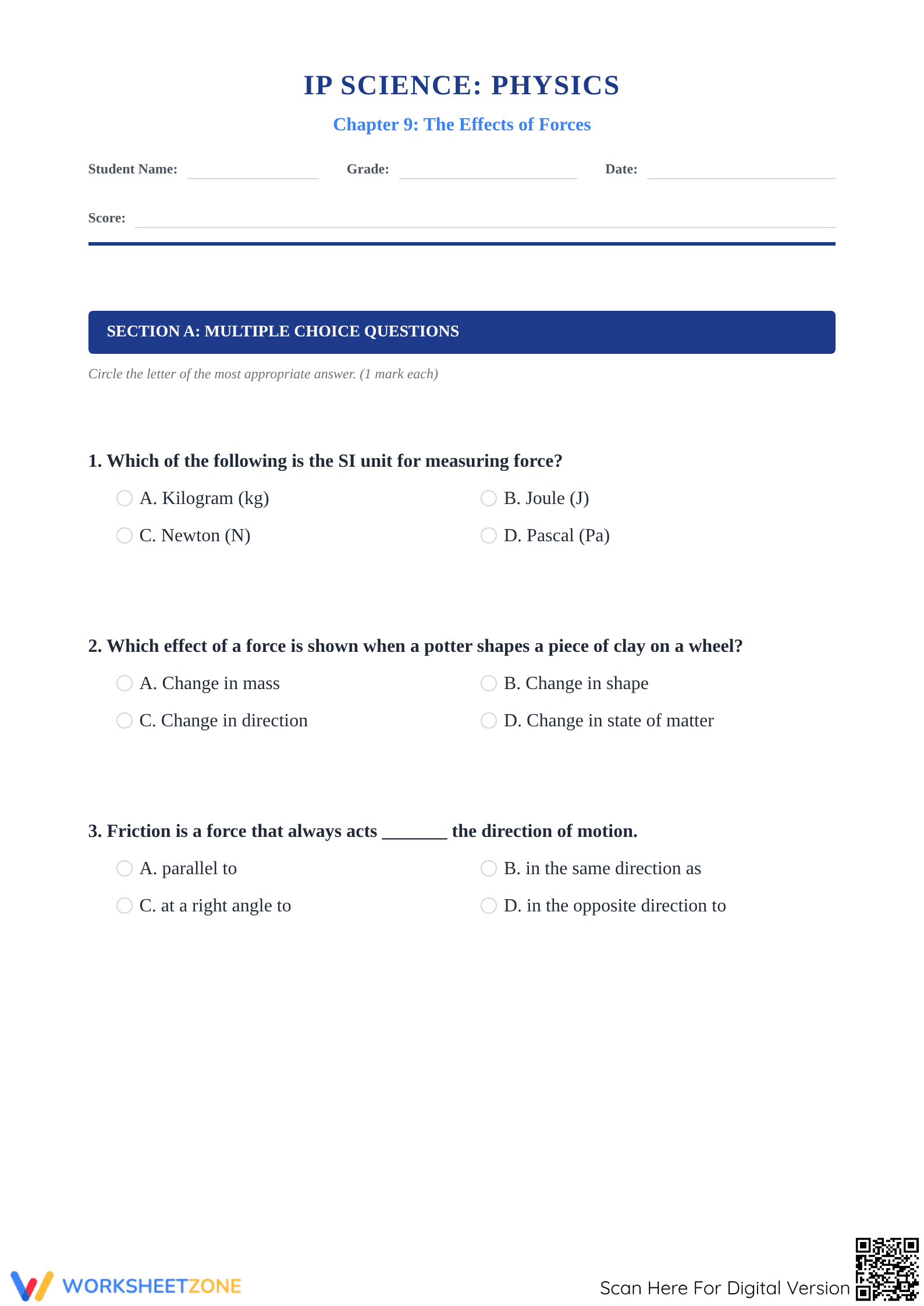
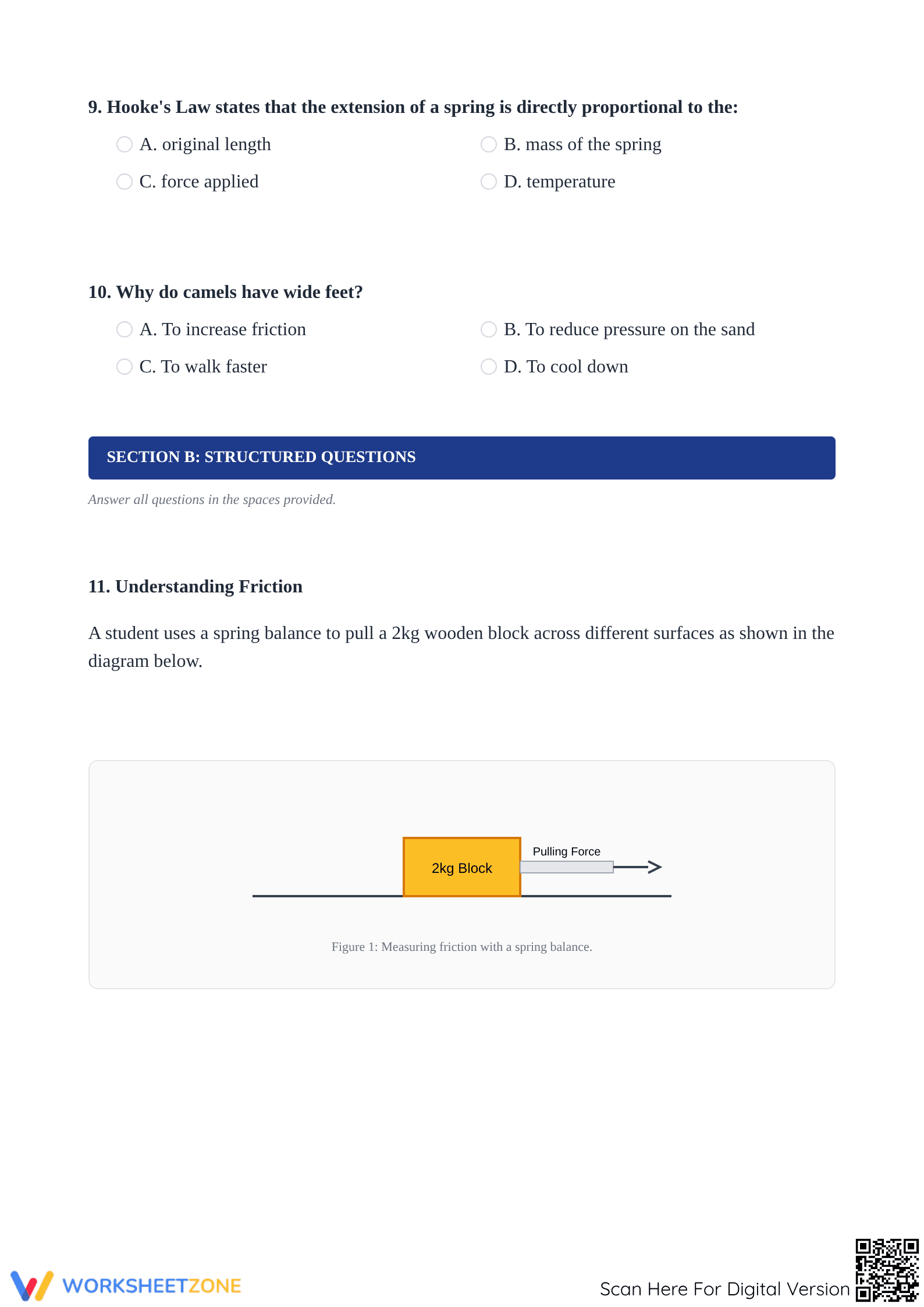
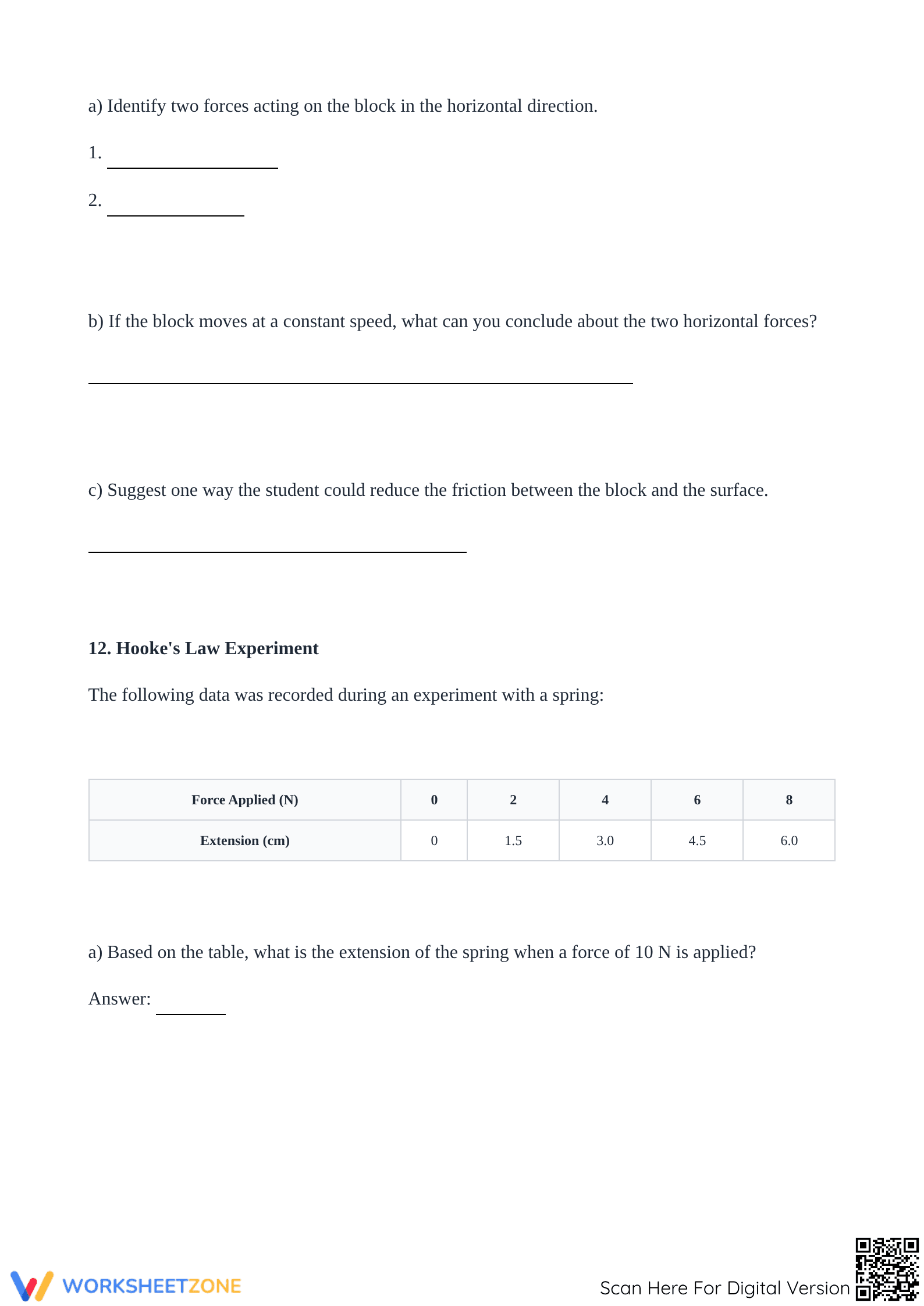
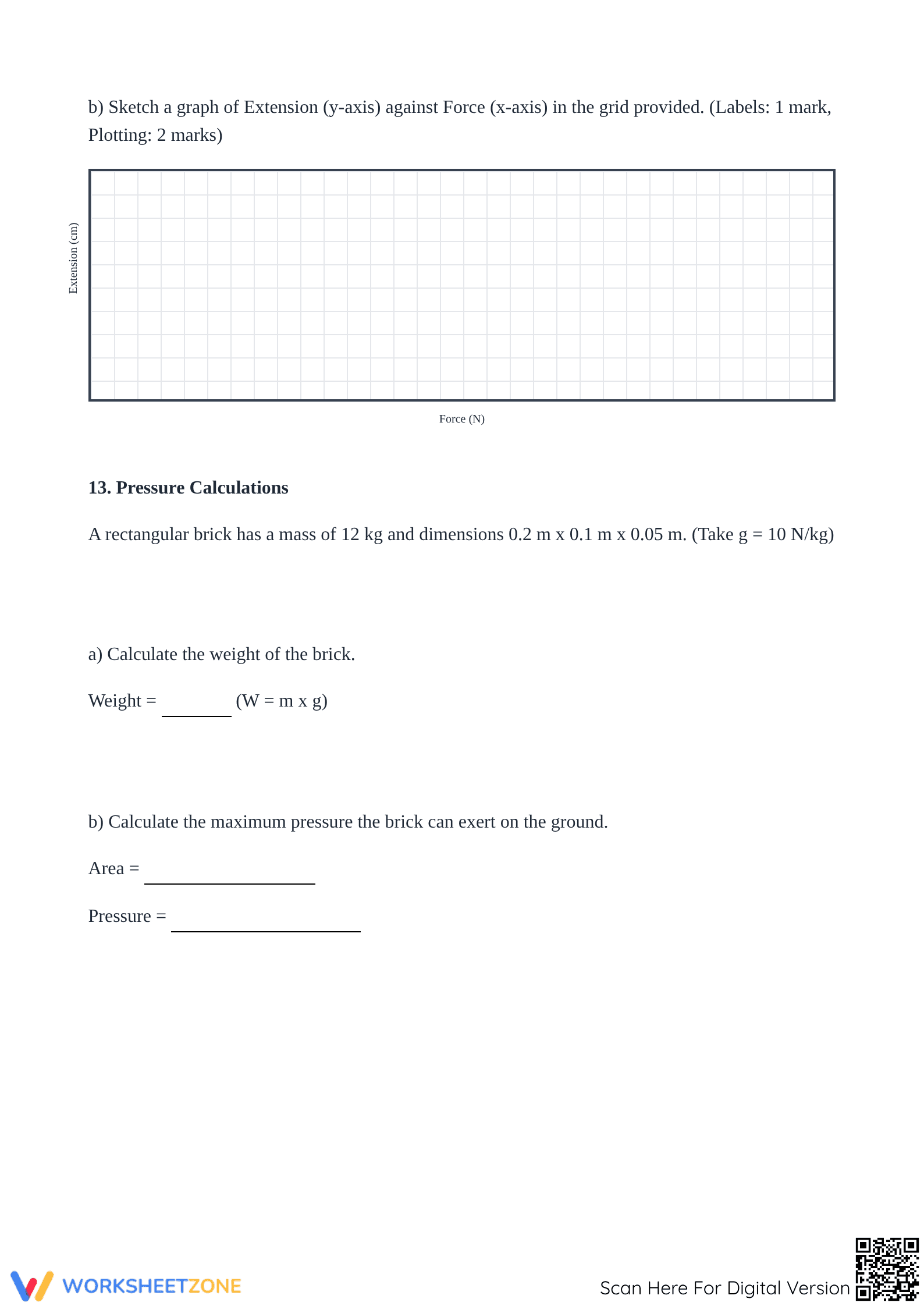
This five-page worksheet includes eight multiple-choice questions and five structured tasks. Students will explore concepts from SI units to Hooke's Law and pressure. The layout includes clear diagrams for experiments and data tables. A complete answer key is included to support immediate feedback.
Skill Progression
- Guided Practice: Multiple-choice questions reinforce key terminology and basic concepts like SI units and force types.
- Supported Practice: Structured sections require students to identify forces on block diagrams and conclude effects based on constant speed.
- Independent Practice: Learners engage in complex data analysis of Hooke's Law and multi-step pressure calculations (P=F/A).
This gradual release of responsibility ensures students build mastery through sequential cognitive demands and practical application.
Standards Alignment
This resource aligns to MS-PS2-2: "Plan an investigation to provide evidence that the change in an object’s motion depends on the sum of the forces on the object and the mass of the object." It addresses balanced forces, friction, and the relationship between force and mass. This code can be copied directly into lesson plans or curriculum tools.
How to Use It
Use this worksheet as a chapter review before a summative assessment. Teachers can also use the structured questions for a collaborative group activity. For a formative tip, monitor how students calculate pressure to identify those struggling with the mathematical application of physics formulas.
Who It's For
This resource is ideal for Grade 7 physical science students. It provides scaffolding through visual aids and varied question formats. Pair this worksheet with a lesson on Newton's Laws or a hands-on lab involving spring balances and friction blocks for the best outcomes.
According to the RAND AIRS 2024 report, high-quality science materials that integrate experimental data analysis with theoretical concepts significantly improve student retention in physical science. This worksheet follows these evidence-based practices by requiring students to interpret data from a Hooke's Law experiment and perform complex pressure calculations. By engaging with multi-step structured questions, learners move beyond simple recall to apply physics principles in realistic scenarios, such as explaining why camels have wide feet or calculating the weight of a rectangular brick. The inclusion of both multiple-choice and open-ended items ensures a comprehensive assessment of student understanding across the MS-PS2-2 standard. Educators can use these tasks to identify specific misconceptions regarding friction and non-contact forces before moving into more advanced mechanics. This resource provides the rigorous, standards-aligned practice necessary for mastering the foundational concepts of forces and interactions in the middle school classroom.


