


























Views
Downloads

Tulip Life Cycle Worksheet | Grade 3 Printable
Paste this activity's link or code into your existing LMS (Google Classroom, Canvas, Teams, Schoology, Moodle, etc.).
Students can open and work on the activity right away, with no student login required.
You'll still be able to track student progress and results from your teacher account.
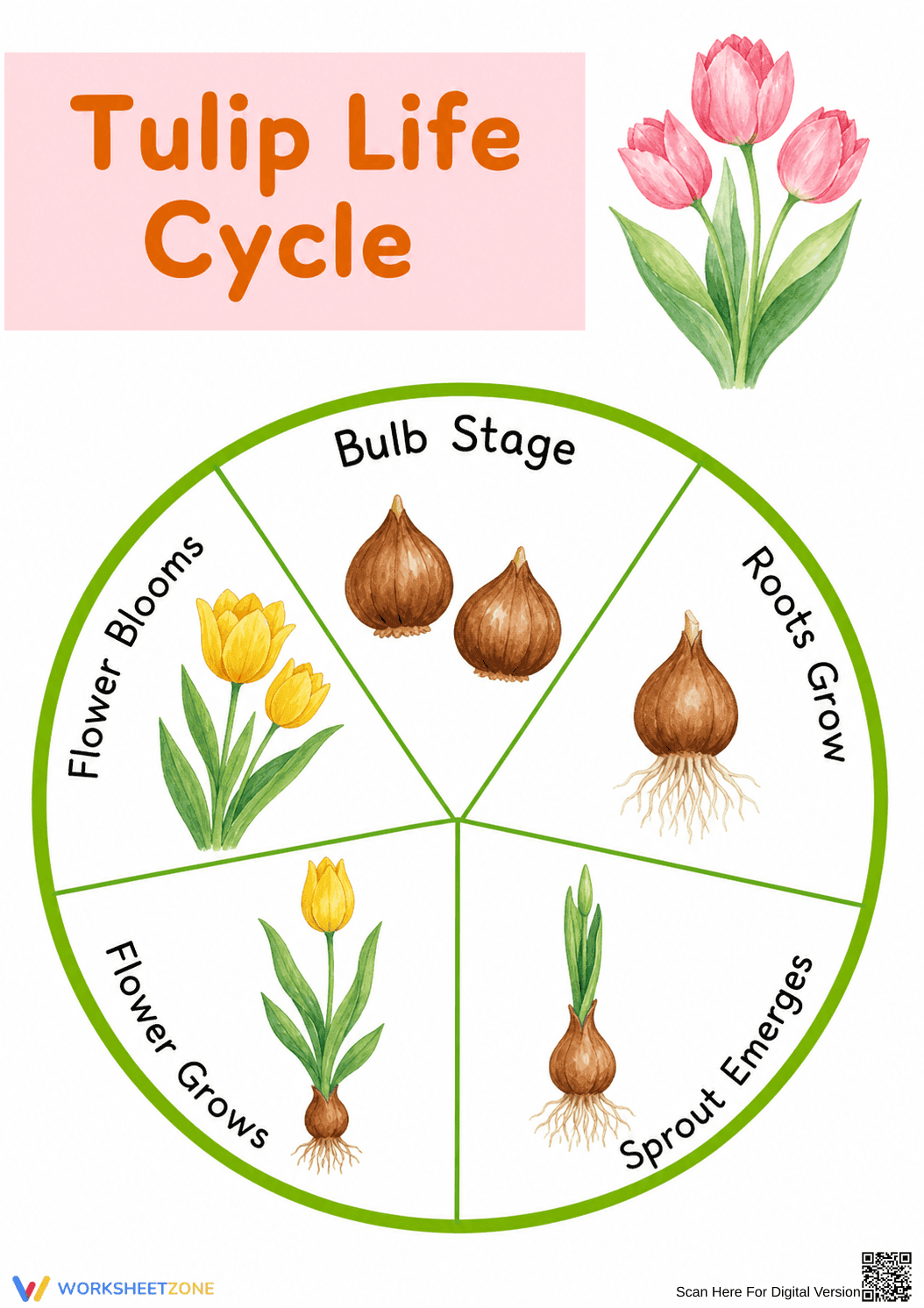
This Grade 3 science worksheet provides a clear visual model of the tulip life cycle to help students understand biological growth patterns. By observing the 5 distinct stages from bulb to bloom, learners develop a foundational understanding of how flowering plants develop over time. It serves as an essential tool for mastering life science concepts.
At a Glance
- Grade: 3 · Subject: Science
- Standard:
3-LS1-1— Develop models to describe that organisms have unique and diverse life cycles- Skill Focus: Plant growth sequencing
- Format: 1 page · 5 stages · Answer key included · PDF
- Best For: Science centers and introductory biology lessons
- Time: 10–15 minutes
The resource features a high-quality circular diagram divided into five chronological segments. Each segment includes a detailed illustration and a corresponding label: Bulb Stage, Roots Grow, Sprout Emerges, Flower Grows, and Flower Blooms. This 1-page PDF is designed for immediate use as a reference sheet or a sequencing guide for primary science lessons.
Zero-Prep Workflow
- Print: Generate the single-page PDF for your entire class in under 30 seconds.
- Distribute: Hand out the diagrams during your life science block to anchor your direct instruction.
- Review: Use the visual as a whole-group discussion prompt or a station guide for independent work.
Total teacher preparation time is under 2 minutes, making it an ideal choice for busy classrooms or emergency sub plans.
Standards Alignment
This worksheet aligns with 3-LS1-1: "Develop models to describe that organisms have unique and diverse life cycles but all have in common birth, growth, reproduction, and death." It specifically addresses the growth and development phases of a perennial plant. Both standard codes can be copied directly into lesson plans, IEP goals, or district curriculum mapping tools.
How to Use It
Use this diagram during the "Explain" phase of a 5E lesson model to provide concrete vocabulary for plant development. It also works well as a formative assessment tool; ask students to cover the labels and name the stages based on the illustrations. Expected completion for a labeling activity using this guide is 10–15 minutes.
Who It's For
This resource is designed for elementary students in Grades 1 through 4. It is particularly effective for visual learners and English Language Learners (ELLs) who benefit from the direct pairing of images and text. Pair this worksheet with a live bulb-planting activity or a non-fiction text about spring flowers for a comprehensive unit.
According to RAND AIRS 2024, the use of high-quality visual models in early science education significantly improves the retention of complex biological sequences. This worksheet leverages the 3-LS1-1 standard to provide a structured pathway for students to identify the specific stages of a tulip's development, from the dormant bulb to the reproductive bloom. Research from Fisher & Frey (2014) emphasizes that diagrams serve as essential scaffolds that bridge the gap between observation and academic vocabulary acquisition. By utilizing this 5-stage model, educators provide a clear framework for students to compare plant life cycles across different species. The inclusion of specific botanical milestones like root development and sprout emergence ensures that students move beyond surface-level understanding toward a more technical grasp of life science. This resource is a reliable, evidence-based addition to any primary science curriculum.


