


























Views
Downloads

Grade 3 Tulip Life Cycle — Printable No-Prep Worksheet
Paste this activity's link or code into your existing LMS (Google Classroom, Canvas, Teams, Schoology, Moodle, etc.).
Students can open and work on the activity right away, with no student login required.
You'll still be able to track student progress and results from your teacher account.
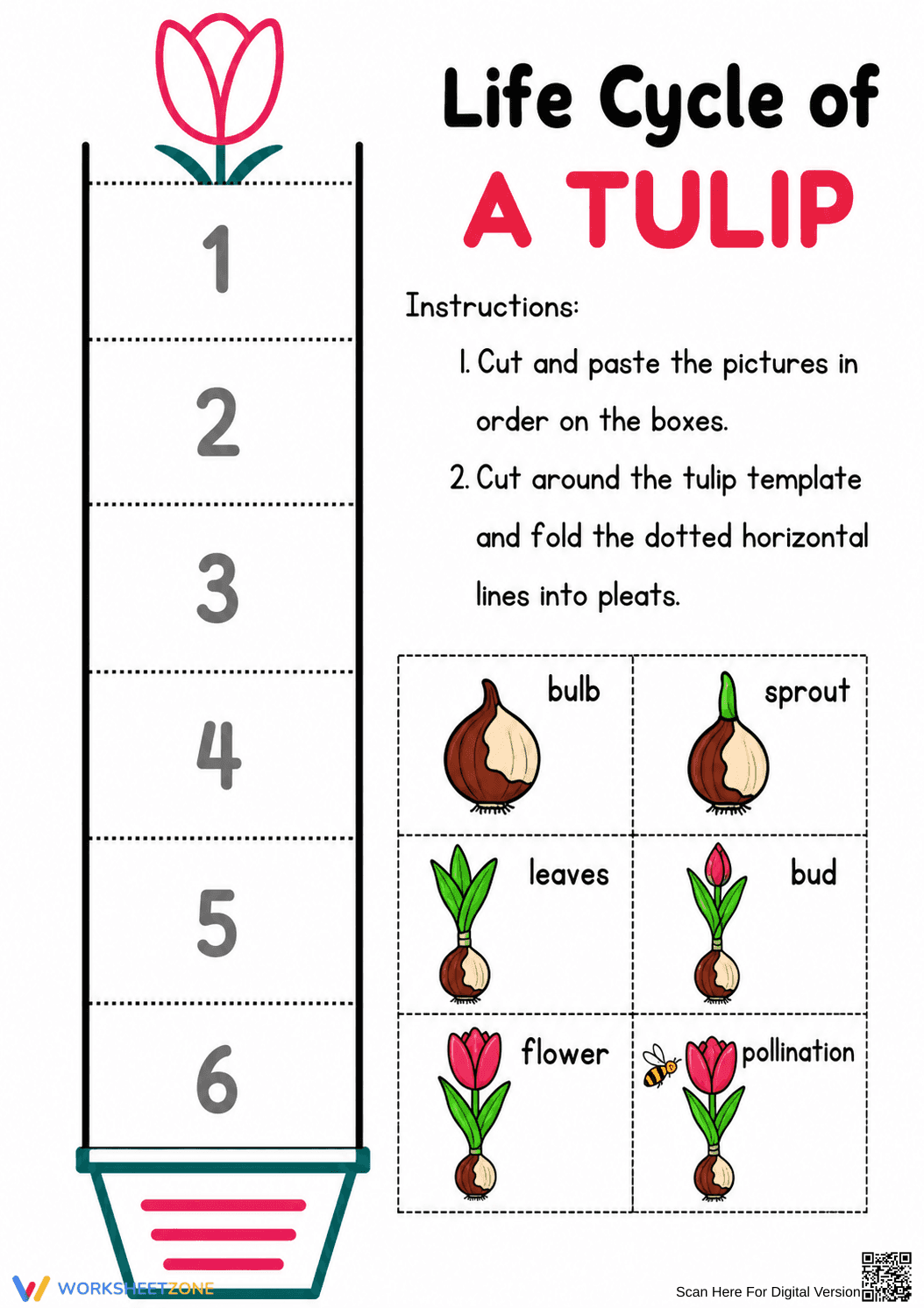
This hands-on science worksheet helps students master plant growth by sequencing the life cycle of a tulip. By cutting, ordering, and pasting six developmental phases, learners actively build their understanding of biological progression while practicing fine motor skills in an interactive format.
At a Glance
- Grade: 3 · Subject: Science
- Standard:
3-LS1-1— Develop models to describe organism life cycles- Skill Focus: Sequencing plant growth stages
- Format: 1 page · 6 problems · No answer key · PDF
- Best For: Independent practice and science centers
- Time: 15–20 minutes
This single-page resource features a clear template where students construct a foldable tulip chart. The bottom section provides six illustrated tiles—bulb, sprout, leaves, bud, flower, and pollination. Students cut these out and correctly sequence them from one to six, pasting them into the numbered vertical graphic organizer before folding the paper into a pleated study tool.
Designed for immediate classroom implementation, this activity requires minimal preparation:
- Print (1 minute): Generate copies of the single-page PDF for your class.
- Distribute (1 minute): Hand out worksheets, scissors, and glue. Instructions are printed directly on the page.
- Review (2 minutes): Verify the correct sequence of the six stages.
With under two minutes of total teacher setup time, this resource is excellent for emergency sub plans or busy science blocks.
This activity aligns to the Next Generation Science Standards, specifically 3-LS1-1: Develop models to describe that organisms have unique and diverse life cycles but all have in common birth, growth, reproduction, and death. By creating a physical model of the tulip's progression, students demonstrate comprehension of biological patterns. Both standard codes can be copied directly into lesson plans, IEP goals, or district curriculum mapping tools.
Integrate this cut-and-paste activity during a unit on plant biology. It serves as an excellent independent practice task following direct instruction. As a formative assessment observation tip, watch how students order the bud and flower stages before gluing to gauge their understanding of chronological development. Students typically complete the task within 15 to 20 minutes.
Designed for third-grade students, this worksheet is adaptable for early elementary life science units. The illustrated tiles provide built-in scaffolding for visual learners and English Language Learners. Pair this hands-on craftivity with a time-lapse video of a blooming tulip to solidify the sequencing concepts.
Effectively teaching foundational biological concepts aligned to standard 3-LS1-1 requires instructional materials that actively allow students to develop models to describe organism life cycles. According to a comprehensive 2024 report by EdReports, elementary science curricula that incorporate hands-on modeling and physical sequencing tasks significantly improve long-term retention of complex biological processes. When young students physically manipulate information—such as cutting, sorting, and ordering the six distinct stages of a tulip's growth—they engage multiple cognitive pathways, deeply reinforcing their understanding of chronological development in nature. This interactive, tactile approach successfully shifts learners from being passive recipients of information to becoming active participants in their own scientific discovery. By integrating essential fine motor skills with core science standards, educators can create multidimensional learning experiences that support both physical dexterity and academic mastery in the elementary classroom.


