


























Views
Downloads

Printable Tulip Life Cycle Worksheet | Grade 3 Science
Paste this activity's link or code into your existing LMS (Google Classroom, Canvas, Teams, Schoology, Moodle, etc.).
Students can open and work on the activity right away, with no student login required.
You'll still be able to track student progress and results from your teacher account.
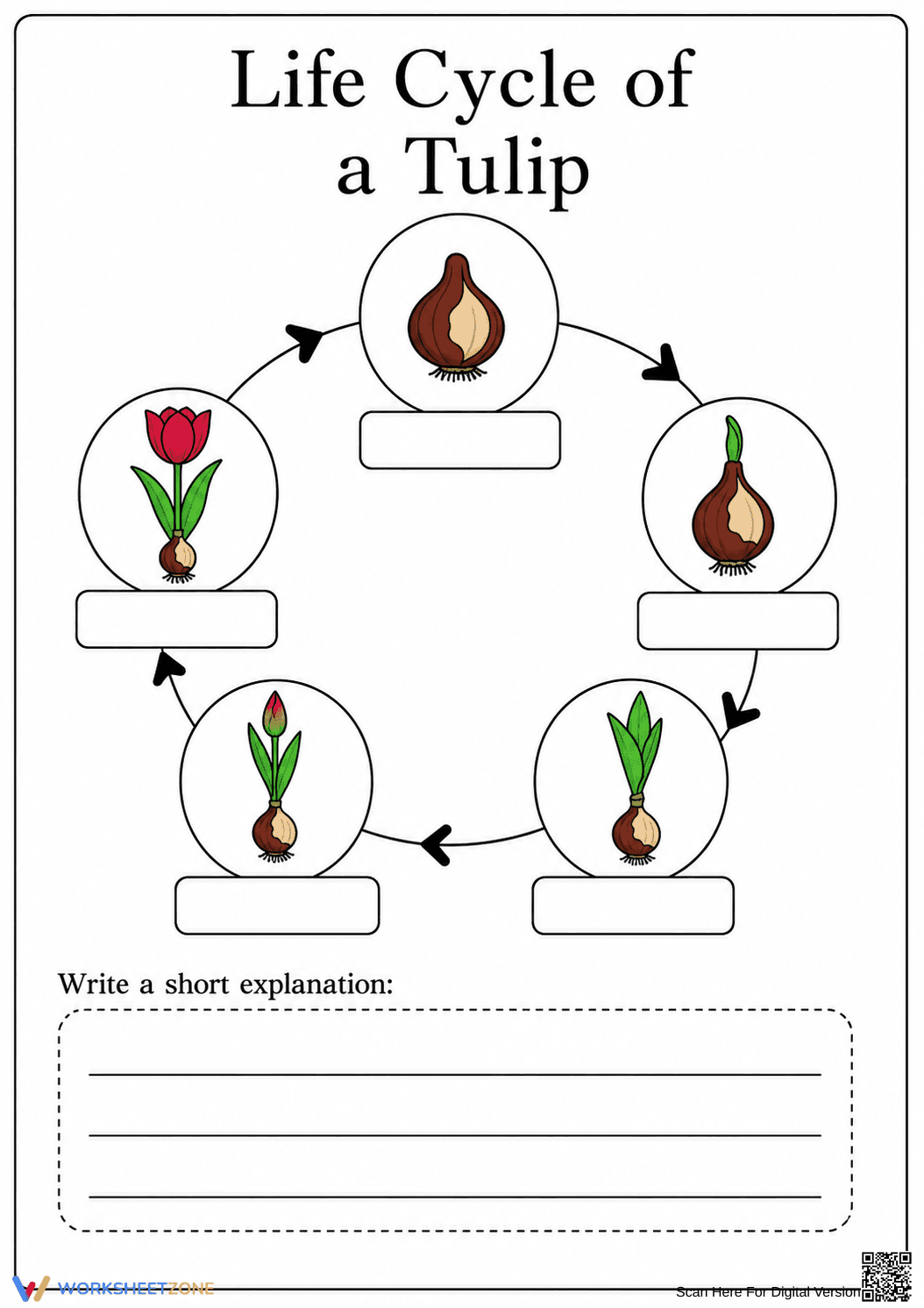
This Grade 3 science worksheet helps students master plant biology by labeling the stages of a tulip's growth and writing a clear explanatory paragraph. By combining visual sequencing with informative writing, learners solidify their understanding of how organisms grow, develop, and reproduce over time.
At a Glance
- Grade: 3 · Subject: Science
- Standard:
3-LS1-1— Develop models to describe organism life cycles- Skill Focus: Sequencing and Explanatory Writing
- Format: 2 pages · 6 problems · PDF
- Best For: Independent practice or science centers
- Time: 20–30 minutes
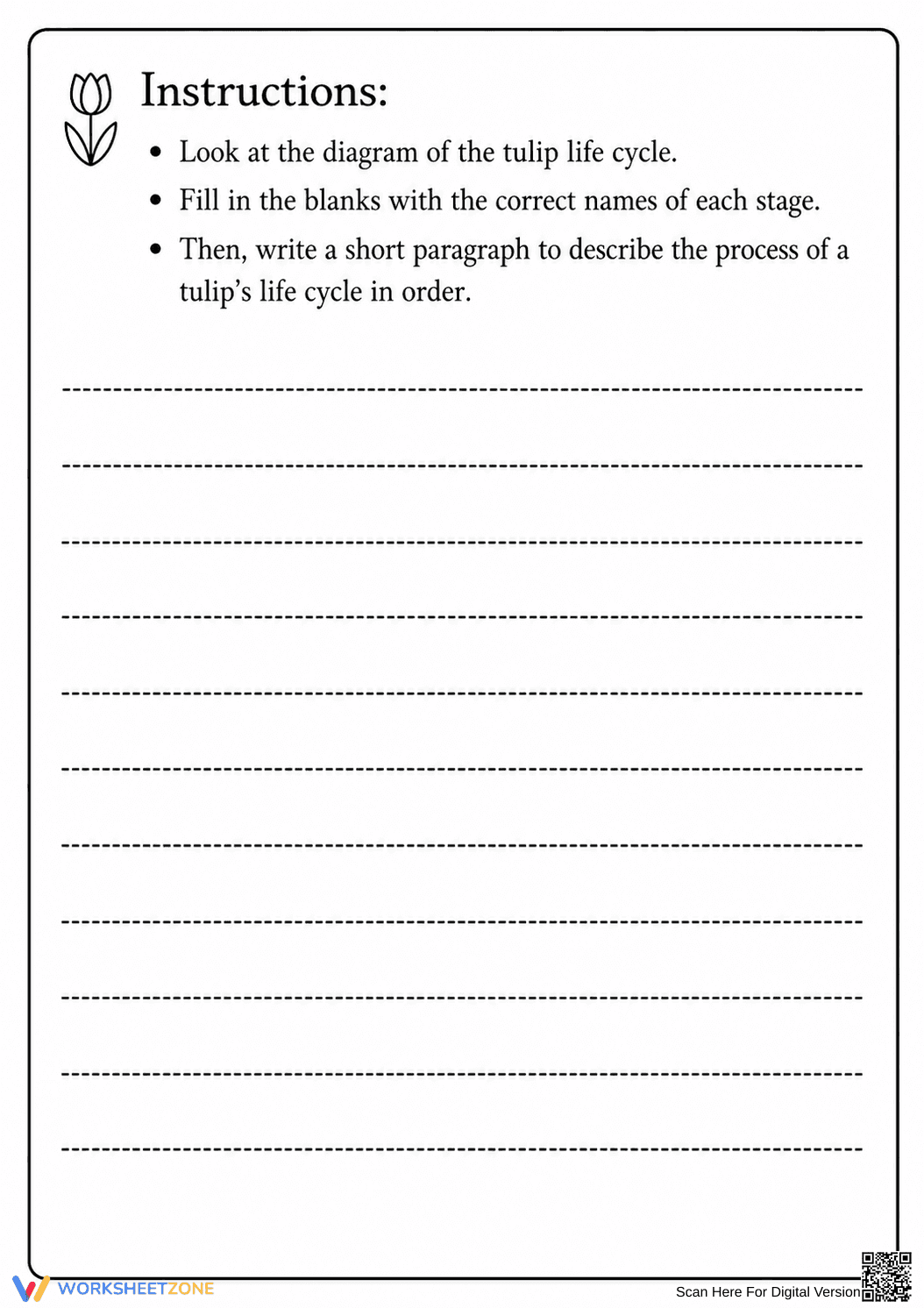
This two-page resource features a clear, circular diagram of a tulip's life cycle with five blank labeling boxes. The first page introduces the visual model, while the second page offers explicit instructions and dedicated lined space for an explanatory paragraph. Students identify the bulb, sprout, bud, and blooming stages before synthesizing their knowledge into a written response.
Designed for immediate use, this resource requires minimal setup:
- Print (1 minute): Generate double-sided copies of the two-page PDF for your entire class.
- Distribute (1 minute): Hand out the worksheets alongside pencils. No extra materials are required.
- Review (3 minutes): Quickly check the five diagram labels before students move on to the independent writing task.
With under two minutes of total prep time, this activity is an excellent addition to emergency sub plans or busy spring science units.
This activity is directly aligned to 3-LS1-1: Develop models to describe that organisms have unique and diverse life cycles but all have in common birth, growth, reproduction, and death. It also supports cross-curricular ELA goals by requiring students to write informative texts to examine a topic and convey ideas clearly. Both standard codes can be copied directly into lesson plans, IEP goals, or district curriculum mapping tools.
Deploy this worksheet during the middle of a plant biology unit, right after direct instruction on how seeds and bulbs grow. It serves as an excellent independent practice activity while the teacher pulls small groups. Alternatively, use it as a formative assessment to gauge science comprehension and writing proficiency. As students write, observe whether they use appropriate transition words to sequence the stages accurately. Expect completion within 20 to 30 minutes.
This resource is primarily designed for third-grade general education students, though it can easily be adapted for second graders with guided teacher support or fourth graders needing a quick review. For students requiring writing accommodations, teachers can provide a word bank or sentence starters to scaffold the paragraph section. Pair this worksheet with a hands-on bulb planting activity or a read-aloud book about spring flowers to create a comprehensive learning experience.
Integrating visual models with explanatory writing tasks significantly enhances student retention of complex scientific concepts. According to EdReports 2024, instructional materials that require students to translate diagrams into written explanations foster deeper cognitive processing and stronger cross-curricular literacy skills. This specific worksheet directly targets 3-LS1-1 by asking learners to develop models to describe organism life cycles. By labeling the visual stages of a tulip and subsequently drafting a sequential paragraph, students actively bridge the gap between visual observation and written articulation. This dual-modal approach ensures that learners do not merely memorize isolated vocabulary words, but actually comprehend the biological progression of plant growth and reproduction. Providing structured, independent opportunities for students to write about science directly supports long-term mastery of both domain-specific knowledge and foundational communication abilities in the elementary classroom.


