


























Views
Downloads

Printable Tulip Life Cycle Worksheet | Grade 3 Science
Paste this activity's link or code into your existing LMS (Google Classroom, Canvas, Teams, Schoology, Moodle, etc.).
Students can open and work on the activity right away, with no student login required.
You'll still be able to track student progress and results from your teacher account.
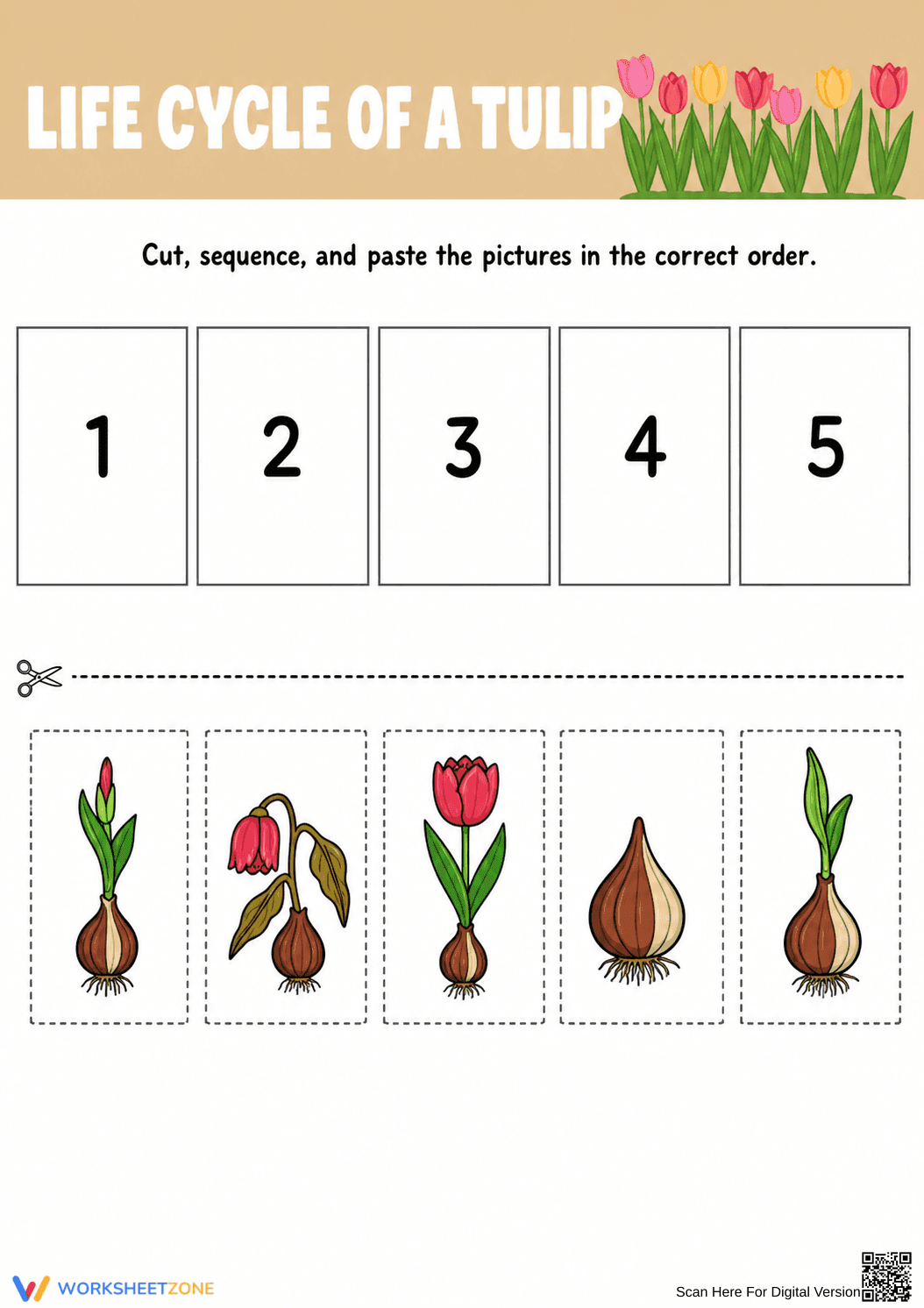
This hands-on science worksheet helps students master plant biology by sequencing the life cycle of a tulip. By cutting and pasting five distinct growth stages into the correct order, young learners actively build their understanding of how living things grow, change, and reproduce over time.
At a Glance
- Grade: 3 · Subject: Science
- Standard:
3-LS1-1— Describe that organisms have unique and diverse life cycles.- Skill Focus: Sequencing Plant Life Cycles
- Format: 1 page · 5 problems · PDF
- Best For: Independent practice or science centers
- Time: 15–20 minutes
This single-page resource features a clear, five-step sequencing activity. Students are provided with five numbered blank boxes at the top and a dashed cut-out section at the bottom containing illustrated tulip stages: bulb, sprout, bud, full bloom, and wilting plant. The visual cues support early readers and visual learners in identifying the chronological progression of plant growth.
This activity is designed for immediate classroom implementation with minimal teacher setup:
- Print (1 minute): Generate enough copies of the single-page PDF for your class roster.
- Distribute (1 minute): Hand out the worksheets along with scissors and glue sticks.
- Review (3 minutes): Briefly check the completed sequences before students paste them down permanently.
With under two minutes of total prep time, this worksheet is an excellent addition to emergency sub plans or independent science stations.
This activity aligns with 3-LS1-1, requiring students to develop models to describe that organisms have unique and diverse life cycles but all have in common birth, growth, reproduction, and death. By organizing the tulip's stages, students create a visual model of this biological process. Both standard codes can be copied directly into lesson plans, IEP goals, or district curriculum mapping tools.
Deploy this worksheet during a spring botany unit after direct instruction on plant growth. It works beautifully as an independent science center activity where students can practice fine motor skills alongside scientific reasoning. As a formative assessment tip, observe students while they arrange the pieces before gluing; ask them to explain why the sprout must come before the bud to check for conceptual understanding. Expect completion to take 15 to 20 minutes.
This resource is ideal for early elementary students, specifically third graders solidifying their grasp of biological cycles. The strong visual scaffolds make it highly accessible for English Language Learners and students requiring modified assignments. Pair this worksheet with a read-aloud book about spring flowers or a hands-on bulb planting activity to reinforce the concepts.
Understanding biological progressions is a foundational component of early elementary science education. Aligning with 3-LS1-1, this resource requires students to describe that organisms have unique and diverse life cycles. According to a ScienceDirect TpT Analysis, integrating hands-on manipulatives like cut-and-paste sequencing tasks significantly improves retention of chronological scientific processes compared to passive observation. By physically moving the stages of the tulip from bulb to bloom, students engage multiple modalities, reinforcing the cognitive mapping of birth, growth, reproduction, and death. This tactile approach not only builds fine motor proficiency but also deepens conceptual mastery of plant biology. Educators can utilize this evidence-based strategy to ensure learners accurately conceptualize the continuous nature of life cycles, providing a robust framework for more complex ecological studies in subsequent grade levels.


