


























Views
Downloads

Tulip Life Cycle Worksheet | Essential Grade 1-3 Science
Paste this activity's link or code into your existing LMS (Google Classroom, Canvas, Teams, Schoology, Moodle, etc.).
Students can open and work on the activity right away, with no student login required.
You'll still be able to track student progress and results from your teacher account.
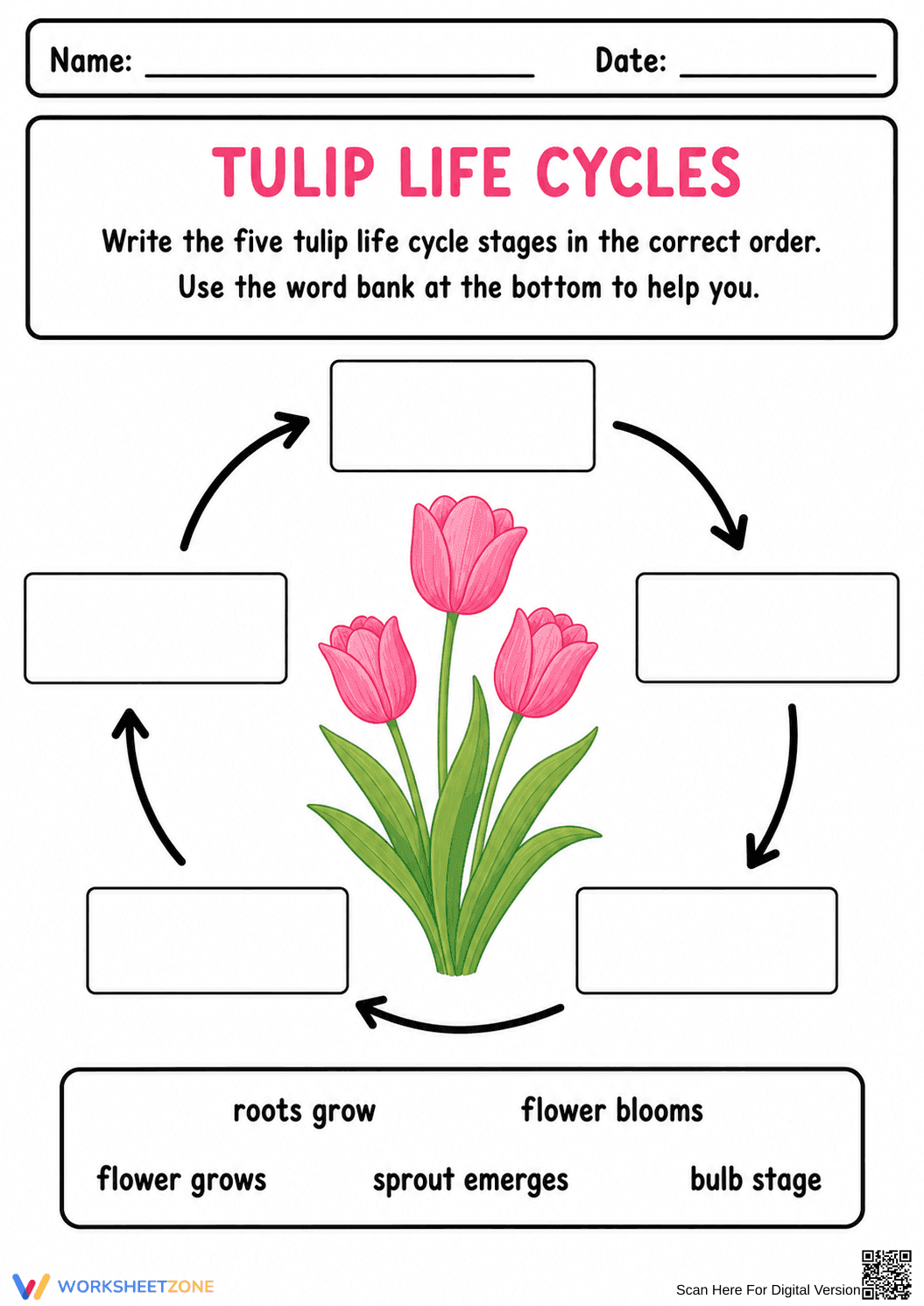
This tulip life cycle worksheet provides a clear, visual framework for students to master the stages of plant development. By sequencing the growth from bulb to bloom, learners build essential biological vocabulary and understand the cyclical nature of living organisms. It is designed to bridge the gap between observation and scientific terminology.
At a Glance
- Grade: 1-3 · Subject: Science
- Standard:
3-LS1-1— Develop models to describe that organisms have unique and diverse life cycles- Skill Focus: Life cycle sequencing
- Format: 1 page · 5 problems · Answer key included · PDF
- Best For: Independent practice or science centers
- Time: 10–15 minutes
What's Inside
The resource features a single-page layout centered around a high-quality illustration of a blooming tulip. Surrounding the image is a five-step circular flow diagram with empty text boxes. At the bottom, a clear word bank includes terms like "bulb stage," "roots grow," and "flower blooms." The clean design ensures students focus on the sequence without visual clutter.
Zero-Prep Workflow
- Print: Generate the PDF and print copies for your class in under 30 seconds.
- Distribute: Hand out the sheets as a quick warm-up or transition activity (1 minute).
- Review: Use the included answer key for a rapid whole-group check or peer grading (5 minutes).
This worksheet is an ideal resource for substitute folders or unexpected schedule changes where meaningful science instruction is needed immediately.
Standards Alignment
Primary alignment is to `3-LS1-1`, which requires students to develop models to describe that organisms have unique and diverse life cycles. This worksheet acts as a foundational model for plant growth. Both standard codes can be copied directly into lesson plans, IEP goals, or district curriculum mapping tools.
How to Use It
Use this as a formative assessment after a lesson on spring flowers or plant parts. It works exceptionally well during the independent practice phase of a 5E science lesson. Teachers should observe if students can correctly identify the "bulb stage" as the starting point, which indicates a solid grasp of non-seed plant beginnings. Expected completion time is 10 to 15 minutes.
Who It's For
This resource is tailored for Grade 1 through Grade 3 students, including English Language Learners who benefit from the provided word bank. It pairs naturally with a classroom tulip-planting project or a digital slideshow showing time-lapse photography of flower growth. It is also suitable for homeschool science units on botany.
According to the RAND AIRS 2024 report on elementary science instruction, visual sequencing tasks are critical for developing mental models of biological processes in early learners. This worksheet aligns with the 3-LS1-1 standard by requiring students to organize the "bulb stage," "roots grow," "sprout emerges," "flower grows," and "flower blooms" into a coherent cycle. Research by Fisher & Frey (2014) emphasizes that scaffolds like word banks allow students to focus on the conceptual logic of the life cycle rather than just spelling, which is vital for Grade 1-3 mastery. By providing a structured 5-task model, this resource ensures students can demonstrate their understanding of plant development. This evidence-based approach supports long-term retention of scientific vocabulary and prepares students for more complex ecological studies in later grades.


