


























Views
Downloads
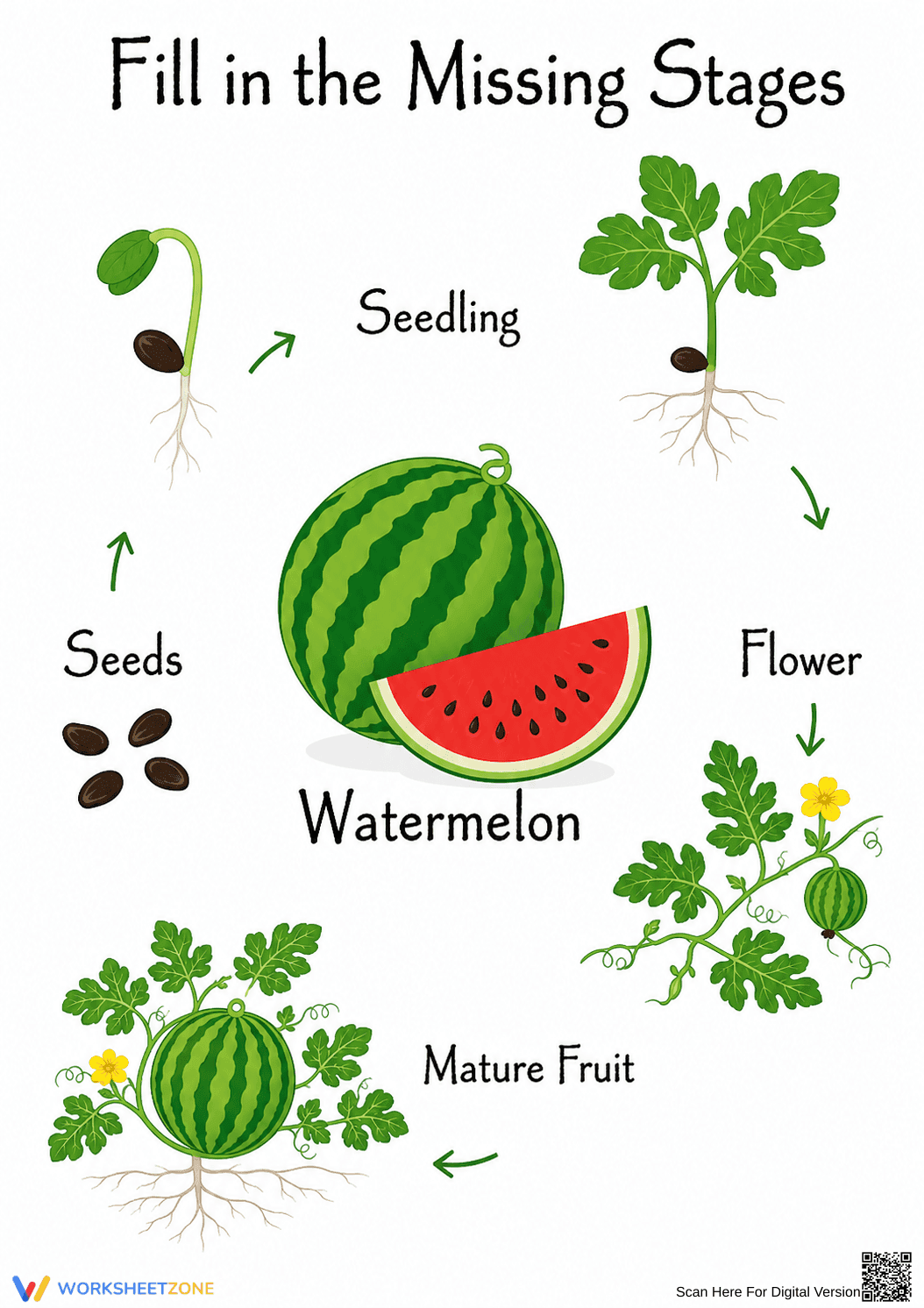

Watermelon Life Cycle Worksheet | Grade 3 Printable
Paste this activity's link or code into your existing LMS (Google Classroom, Canvas, Teams, Schoology, Moodle, etc.).
Students can open and work on the activity right away, with no student login required.
You'll still be able to track student progress and results from your teacher account.
This Grade 3 watermelon life cycle worksheet helps students visualize and sequence the biological progression of a flowering plant. By identifying key growth phases from seed to mature fruit, learners develop a concrete understanding of plant development and reproduction. It provides a clear, engaging model for students to master essential biological concepts through active identification.
At a Glance
- Grade: 3 · Subject: Science
- Standard:
3-LS1-1— Develop models to describe that organisms have unique and diverse life cycles- Skill Focus: Plant life cycle sequencing
- Format: 1 page · 4 stages · Answer key included · PDF
- Best For: Independent practice or formative assessment
- Time: 10–15 minutes
This single-page PDF features a circular diagram of the watermelon life cycle. It includes high-quality illustrations of seeds, seedlings, flowers, and mature fruit. Students are tasked with matching the correct terminology to the visual representations. The layout is clean and intuitive, featuring a built-in answer key for quick grading or student self-correction.
The workflow for this resource is designed for maximum efficiency. First, print the single-page PDF (30 seconds). Next, distribute the sheets to students as a warm-up or exit ticket (1 minute). Finally, review the four stages as a whole class using the provided answer key (5 minutes). This resource is an ideal "grab-and-go" option for substitute plans or unexpected schedule changes.
This resource aligns directly with 3-LS1-1, requiring students to develop models to describe that organisms have unique and diverse life cycles. By mapping the watermelon's growth, students observe the commonalities of birth, growth, and reproduction. This standard code can be copied directly into lesson plans, IEP goals, or district curriculum mapping tools.
Use this worksheet during the "Explain" phase of a 5E lesson cycle to reinforce direct instruction on plant biology. It serves as an excellent formative assessment tool to check for understanding before moving on to more complex botanical concepts. Expect students to complete the identification task within 10 to 15 minutes.
This worksheet is designed for third-grade general education classrooms, but it is also highly effective for English Language Learners (ELLs) due to the strong visual support. It pairs naturally with a classroom seed-planting project or a non-fiction reading passage about agricultural cycles and fruit production.
According to the RAND AIRS 2024 report, high-quality visual models are essential for elementary students to internalize abstract biological sequences. This worksheet addresses the 3-LS1-1 standard by providing a structured framework for students to identify the birth, growth, and reproduction phases of a watermelon plant. Research indicates that sequencing tasks help bridge the gap between observation and conceptual mastery in early science education. By focusing on the specific skill of life cycle modeling, this resource ensures that Grade 3 learners can accurately describe how organisms change over time. The inclusion of clear labels like "seedling" and "mature fruit" supports vocabulary acquisition alongside scientific inquiry. Educators can use this data-driven approach to meet state requirements while providing students with a clear path toward biological literacy. This resource represents a focused application of evidence-based instructional design for the primary science classroom.


