


























Views
Downloads
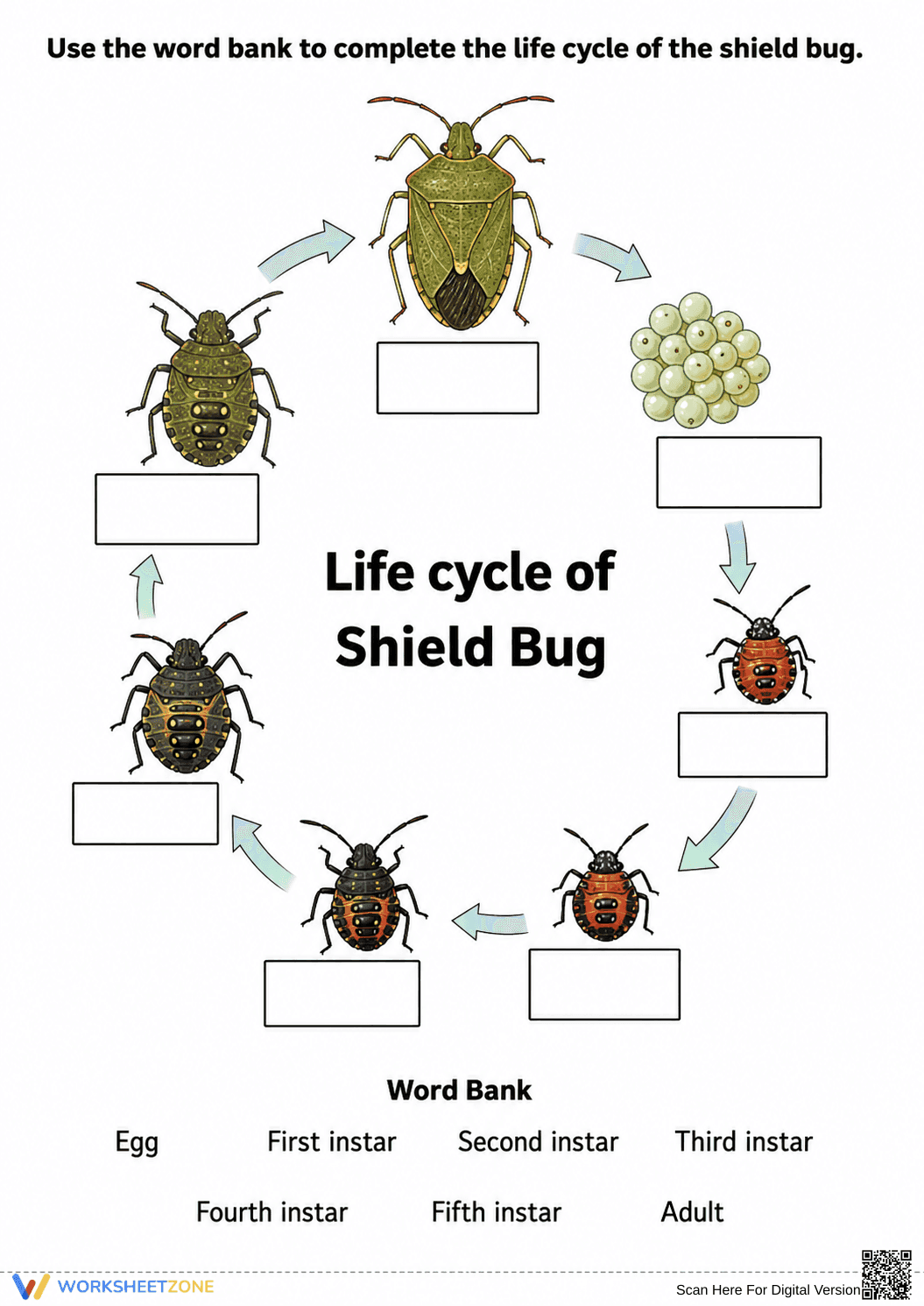

Grade 6 Shield Bug Life Cycle — Printable No-Prep Worksheet
Paste this activity's link or code into your existing LMS (Google Classroom, Canvas, Teams, Schoology, Moodle, etc.).
Students can open and work on the activity right away, with no student login required.
You'll still be able to track student progress and results from your teacher account.
This Grade 6 science worksheet helps students master the stages of insect development by labeling the complete life cycle of a shield bug. By tracing the organism's growth from egg through multiple instar phases to adulthood, learners build a strong foundation in biological growth processes and life science concepts.
At a Glance
- Grade: 6 · Subject: Science
- Standard:
MS-LS1-5— Identify and describe the growth stages of organisms- Skill Focus: Labeling insect life cycle stages
- Format: 1 page · 7 problems · Answer key included · PDF
- Best For: Independent practice and review
- Time: 10–15 minutes
This single-page resource features a clear, full-color biological diagram illustrating the circular life cycle of a shield bug. Students are provided with seven distinct fill-in-the-blank boxes corresponding to each developmental phase. A comprehensive word bank at the bottom of the page supplies the exact terminology needed, including "Egg," "Adult," and the specific "First" through "Fifth instar" stages. A complete answer key is included to ensure accurate grading and immediate student feedback.
Designed for maximum efficiency, this resource requires zero teacher setup.
- Print (1 min): Download the PDF and print a class set.
- Distribute (1 min): Hand out the worksheets. The word bank lets students begin immediately without external references.
- Review (2 mins): Use the answer key to quickly check work or project it for self-correction.
Total prep time is under two minutes, making this ideal for emergency sub plans or quick science transitions.
This worksheet is aligned to MS-LS1-5, focusing on how organisms grow and develop through specific life stages. By identifying the distinct instar phases, students gather evidence of biological maturation and structural changes over time. Both standard codes can be copied directly into lesson plans, IEP goals, or district curriculum mapping tools.
This diagram is perfect for independent practice after direct instruction on insect life cycles. Teachers can assign it as a quick formative assessment to verify students understand the sequence of instar development. Alternatively, it serves as an excellent science station activity. While students work, teachers can observe if they correctly sequence the numbered instars—a quick formative-assessment observation tip to gauge attention to detail. Expected completion time ranges from 10 to 15 minutes.
This resource is primarily designed for middle school science students in grades 5 through 7. The built-in word bank provides essential scaffolding, making it highly accessible for English Language Learners and students requiring vocabulary support. It pairs naturally with a direct instruction lesson on incomplete versus complete metamorphosis, or alongside an anchor chart detailing the characteristics of true bugs.
Understanding biological development through visual diagrams is a critical component of middle school science education. Aligned with MS-LS1-5, this resource requires students to identify and describe the growth stages of organisms, specifically focusing on the sequential instar phases of the shield bug. According to a recent ScienceDirect TpT Analysis, integrating labeled diagrams with targeted word banks significantly improves vocabulary retention and conceptual understanding in life science curricula. By actively engaging with the visual representation of the life cycle, learners transition from passive observation to active application of biological terminology. This structured approach ensures that students can accurately trace the organism's maturation process, reinforcing foundational knowledge necessary for advanced biological studies. The clear visual cues combined with explicit vocabulary support create an optimal learning environment for mastering complex scientific sequences.


