


























Views
Downloads
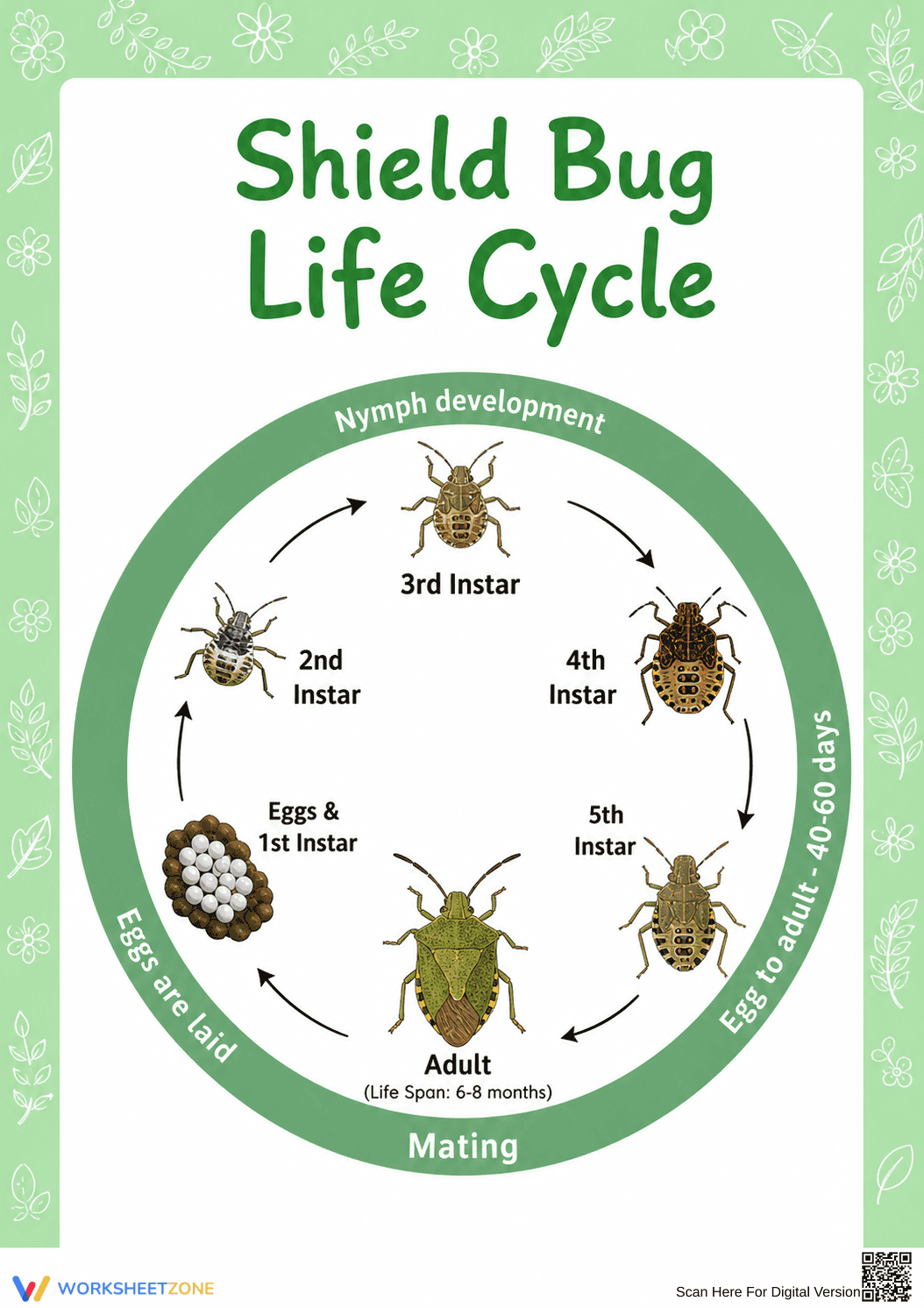

Shield Bug Life Cycle Diagram | Essential Grade 5-7 Science
Paste this activity's link or code into your existing LMS (Google Classroom, Canvas, Teams, Schoology, Moodle, etc.).
Students can open and work on the activity right away, with no student login required.
You'll still be able to track student progress and results from your teacher account.
This Grade 5-7 science worksheet provides a comprehensive visual breakdown of the shield bug life cycle, focusing on the complex stages of nymph development. Students gain a clear understanding of incomplete metamorphosis by observing the transition from eggs through five distinct instar stages to the final adult form. This resource is designed to bridge the gap between basic life cycle concepts and advanced biological observation.
At a Glance
- Grade: 5-7 · Subject: Life Science
- Standard:
MS-LS1-4— Use evidence to support how animal behaviors and structures affect reproduction- Skill Focus: Insect metamorphosis and development
- Format: 1 page · 1 diagram · Reference sheet · PDF
- Best For: Science journals and classroom reference
- Time: 10–15 minutes
The worksheet features a high-resolution circular diagram illustrating the chronological progression of a shield bug. It includes specific labels for the 1st through 5th instars, highlighting the subtle morphological changes during nymph development. The diagram also provides critical biological data, such as the 40-60 day egg-to-adult timeline and the 6-8 month adult lifespan, making it a robust tool for data-driven science lessons.
This resource is designed for a zero-prep workflow. Teachers can print the diagram in less than 1 minute. Distribute the sheets to students during the "Explain" phase of a 5E lesson model to provide a concrete visual anchor. Finally, spend 5 minutes reviewing the specific terminology, such as "instar" and "mating," to ensure students can identify these stages in real-world biological observations or during outdoor field studies. It is an ideal addition to emergency sub plans due to its self-explanatory nature.
Standards Alignment: Primary standard `MS-LS1-4` requires students to "Use argument based on empirical evidence and scientific reasoning to support an explanation for how characteristic animal behaviors and specialized plant structures affect the probability of successful reproduction of animals." This diagram provides the visual evidence of those structures across the insect's lifespan. Both standard codes can be copied directly into lesson plans, IEP goals, or district curriculum mapping tools.
Use this diagram as a primary reference during a unit on arthropods or life cycles. It serves as an excellent anchor chart for student science journals, providing a professional-grade illustration for students to reference during independent writing. For formative assessment, ask students to compare the shield bug's nymph stages to the larval stages of a butterfly to identify the differences between complete and incomplete metamorphosis. This comparison helps solidify their understanding of biological diversity.
This worksheet is ideal for Grade 5, 6, and 7 students, particularly visual learners who benefit from seeing biological transitions in a structured format. It pairs naturally with a live insect observation lab or a digital presentation on hemiptera. It is also suitable for homeschoolers looking for clear, scientifically accurate biological diagrams that meet middle school rigor without requiring extensive teacher preparation.
According to research by Fisher & Frey (2014) on visual literacy in the science classroom, the use of annotated diagrams significantly improves a student's ability to retain complex biological sequences. This shield bug life cycle worksheet utilizes clear spatial organization to represent the MS-LS1-4 standard, allowing students to map the temporal progression of insect growth. By identifying the five distinct instar stages, learners move beyond basic life cycle knowledge toward a more nuanced understanding of nymph development and adult longevity. This resource provides the necessary scaffolding for middle school students to engage with evidence-based scientific reasoning regarding animal structures and reproductive success. The inclusion of specific timeframes, such as the 40-60 day development period, offers quantitative data that supports cross-curricular integration with mathematical modeling in science.


