


























Views
Downloads

Essential Shield Bug Life Cycle Worksheet | Grade 5-7
Paste this activity's link or code into your existing LMS (Google Classroom, Canvas, Teams, Schoology, Moodle, etc.).
Students can open and work on the activity right away, with no student login required.
You'll still be able to track student progress and results from your teacher account.
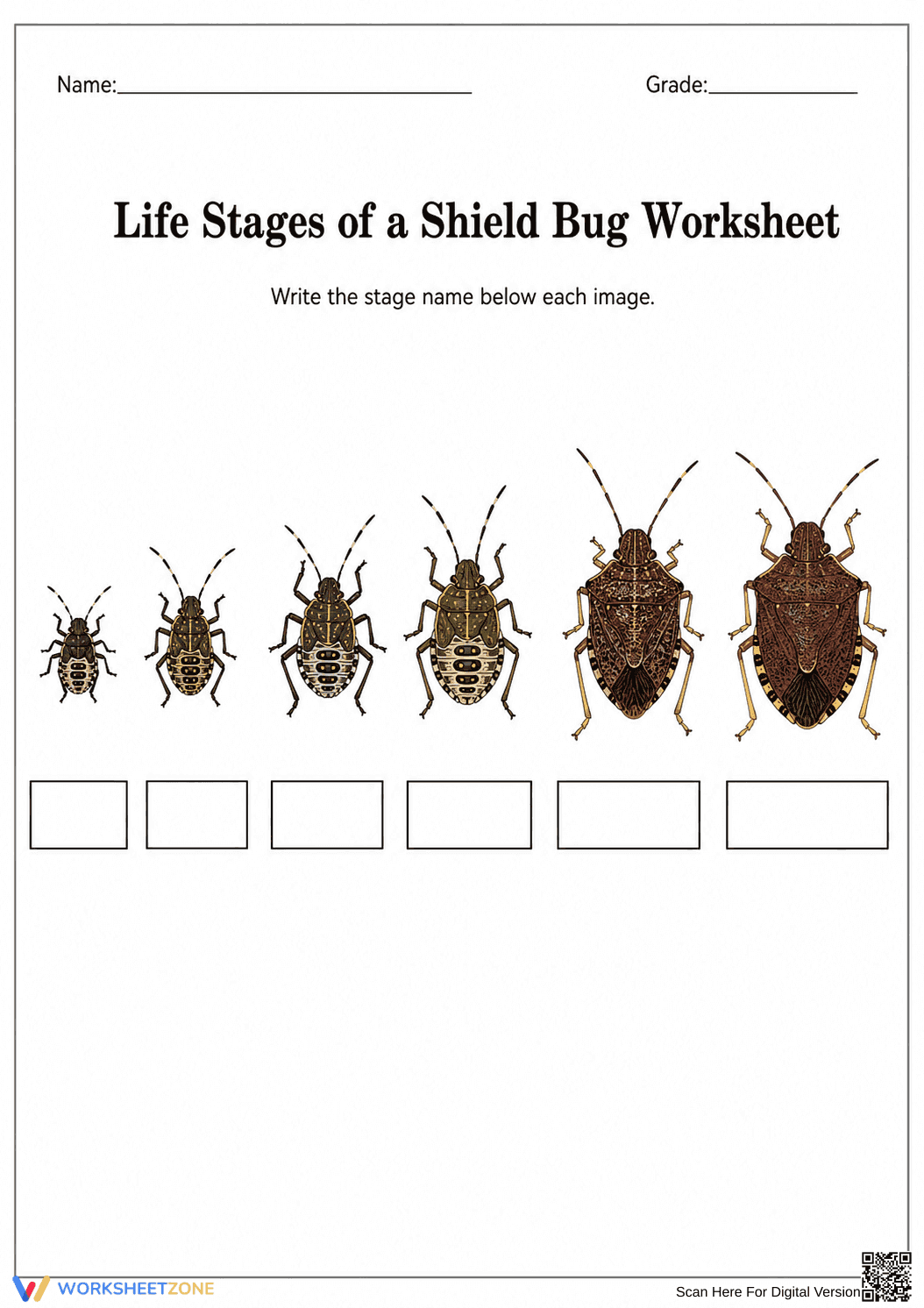
This Grade 5-7 science worksheet provides a clear visual framework for students to master the developmental stages of the shield bug. By identifying specific instar phases and the final adult form, learners develop a concrete understanding of hemimetabolous metamorphosis. This activity ensures students can accurately sequence biological growth patterns in life science units.
At a Glance
- Grade: 5-7 · Subject: Life Science
- Standard:
MS-LS1-4— Explain how animal growth and development stages lead to successful reproduction- Skill Focus: Insect life cycle sequencing
- Format: 1 page · 6 problems · Answer key included · PDF
- Best For: Formative assessment or science bell ringers
- Time: 10–15 minutes
What's Inside
This single-page PDF features six high-quality, realistic illustrations of a shield bug at various points in its development. Below each image is a dedicated labeling box where students must record the correct stage name, ranging from early instars to the fully developed adult. The layout is clean and distraction-free, focusing entirely on the morphological changes visible in the insect's body structure and size.
Zero-Prep Workflow
- Print: Generate the single-page PDF for your entire class in under 30 seconds.
- Distribute: Hand out the worksheets as students enter the room for an immediate 1-minute transition.
- Review: Use the included answer key for a rapid 2-minute whole-class check or self-grading session.
This streamlined process makes the worksheet an ideal choice for unexpected sub plans or as a quick check for understanding during a busy lab day.
Standards Alignment
This resource aligns with `MS-LS1-4`, which requires students to understand the growth and development of organisms. By observing the physical changes across six distinct stages, students gather visual evidence of how insects mature and prepare for reproduction. Both standard codes can be copied directly into lesson plans, IEP goals, or district curriculum mapping tools.
How to Use It
Use this worksheet as a formative assessment after a lecture on incomplete metamorphosis to check for student comprehension of the term "instar." Alternatively, assign it as a quiet bell-ringer activity to settle the class at the start of a period. Teachers should observe if students can distinguish between the later instar stages and the adult bug based on wing pad development. Expected completion time is 12 minutes.
Who It's For
This activity is tailored for middle school students in Grades 5, 6, and 7 who are exploring entomology or general life science. It serves as an excellent scaffold for English Language Learners (ELLs) who benefit from the direct visual-to-vocabulary connection. Pair this worksheet with a live specimen observation or a digital microscope gallery of local hemiptera for a comprehensive lesson.
According to the RAND AIRS 2024 report on science literacy, visual sequencing tasks significantly improve long-term retention of biological processes in middle school learners. This shield bug worksheet utilizes these principles by requiring students to map specific vocabulary to observable physical traits across the MS-LS1-4 standard. By focusing on the shield bug, a common representative of the Hemiptera order, the resource provides a practical application of metamorphosis concepts. Research from Fisher & Frey (2014) supports the use of such structured labeling activities as a vital component of the gradual release of responsibility, moving students from guided observation to independent mastery of scientific terminology. The inclusion of six distinct stages challenges students to look beyond simple models, fostering a more nuanced understanding of insect maturation and the specific biological markers of the instar phases.


