


























Views
Downloads

Shield Bug Life Cycle Printable | Grade 6 Science
Paste this activity's link or code into your existing LMS (Google Classroom, Canvas, Teams, Schoology, Moodle, etc.).
Students can open and work on the activity right away, with no student login required.
You'll still be able to track student progress and results from your teacher account.
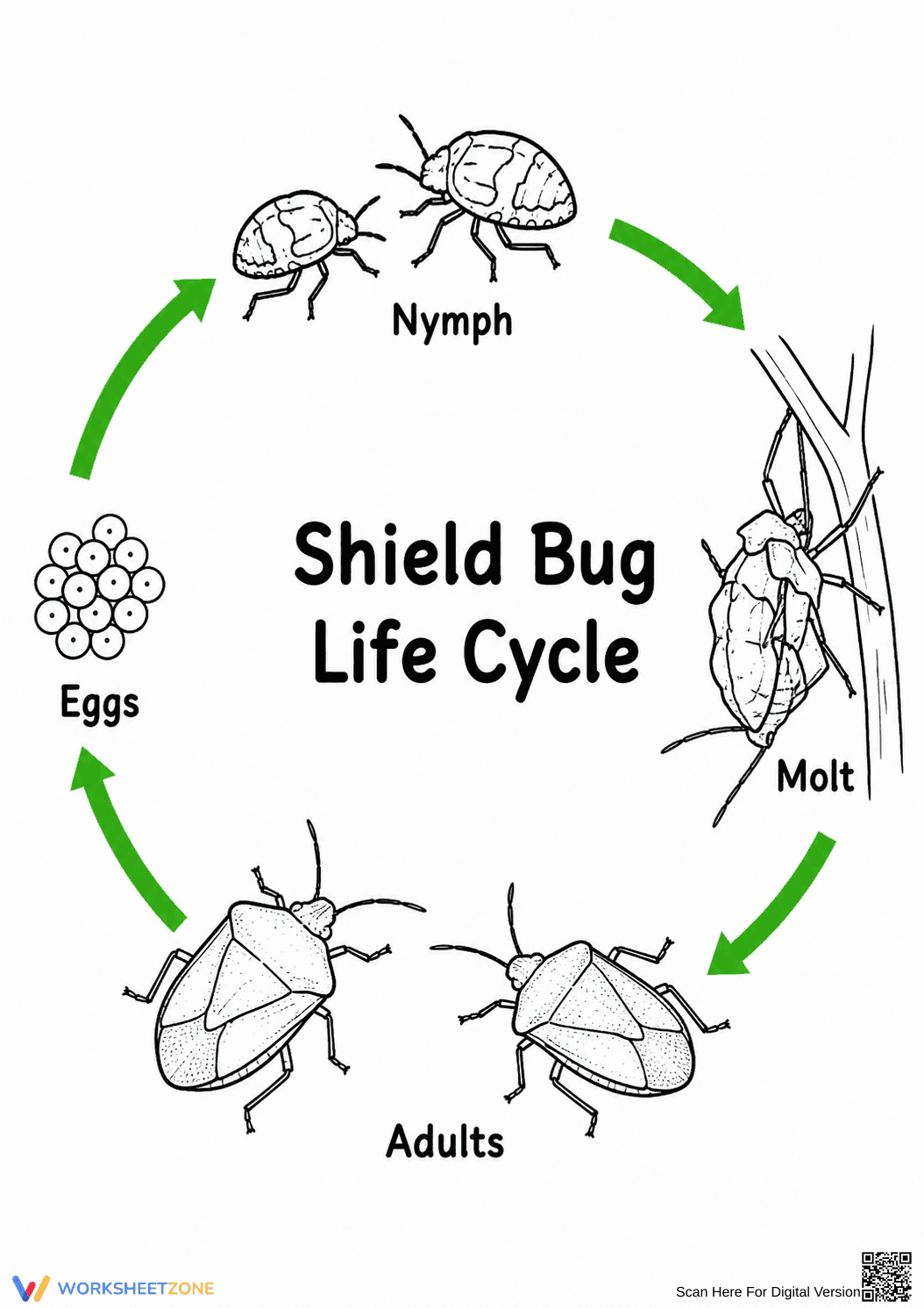
This Grade 6 science worksheet provides students with a clear, visual model of the shield bug life cycle to build foundational knowledge of incomplete metamorphosis. By examining the progression from eggs to nymph, molt, and adult, learners will easily grasp how insects grow and develop over time.
At a Glance
- Grade: 6 · Subject: Science
- Standard:
MS-LS1-4— Describe animal behaviors affecting reproduction and growth- Skill Focus: Identifying stages of incomplete metamorphosis
- Format: 1 page · 4 stages · No answer key needed · PDF
- Best For: Visual reference and interactive notebooks
- Time: 10–15 minutes
Inside this single-page resource, educators will find a high-quality, labeled diagram illustrating the four primary stages of a shield bug's development. The black-and-line format makes it an ideal coloring page or interactive notebook insert. Students can trace the green directional arrows to follow the biological sequence from the initial egg cluster, through the nymph and molting phases, culminating in the fully formed adult insect.
Zero-Prep Workflow
This diagram is designed for immediate classroom implementation.
- Print (1 minute): Simply print the PDF as a handout or project it directly onto your smartboard for whole-class instruction.
- Distribute (1 minute): Pass out the diagrams along with colored pencils or markers for students to color-code each developmental stage.
- Review (3 minutes): Walk through the cycle together, discussing the physical changes that occur during the molting process.
With a total prep time of under two minutes, this resource is highly suitable for emergency sub plans or quick science warm-ups.
Standards Alignment
This visual model aligns with MS-LS1-4, which requires students to use empirical evidence and scientific reasoning to explain how characteristic animal behaviors and specialized structures affect the probability of successful reproduction and growth. Studying these stages provides concrete examples of organism development. Both standard codes can be copied directly into lesson plans, IEP goals, or district curriculum mapping tools.
How to Use It
This versatile diagram can be utilized before direct instruction as an engaging hook to introduce the concept of incomplete metamorphosis. Students can spend 10 minutes coloring the stages while predicting changes. Alternatively, use it during a lesson as a guided note-taking tool where students annotate the margins with facts about insect biology. For a quick formative assessment, cover the text labels before copying and ask students to write in the correct terms based on the visual cues.
Who It's For
This resource is designed for middle school science students in Grades 5 through 7 studying life cycles or entomology. The clear, uncluttered layout provides excellent differentiation for visual learners, English Language Learners (ELLs), and students requiring modified instructional materials. It pairs perfectly with a hands-on insect observation lab or a direct instruction lesson on the differences between complete and incomplete metamorphosis.
Integrating clear visual models into science instruction is a proven strategy for enhancing student comprehension of complex biological processes. According to a ScienceDirect TpT Analysis, utilizing structured diagrams significantly improves retention of sequential concepts like life cycles and metamorphosis. This worksheet directly supports MS-LS1-4 by helping students describe animal behaviors affecting reproduction and growth through the specific example of the shield bug. Active engagement through color-coding these stages helps students transition from passive observers to active participants in their scientific education. Providing these accessible, low-barrier entry points ensures that foundational life science concepts are firmly established before moving on to more advanced ecological studies. This targeted approach to visual learning fosters deeper scientific literacy, encourages independent inquiry, and promotes long-term academic success in the middle school classroom.


