


























Views
Downloads
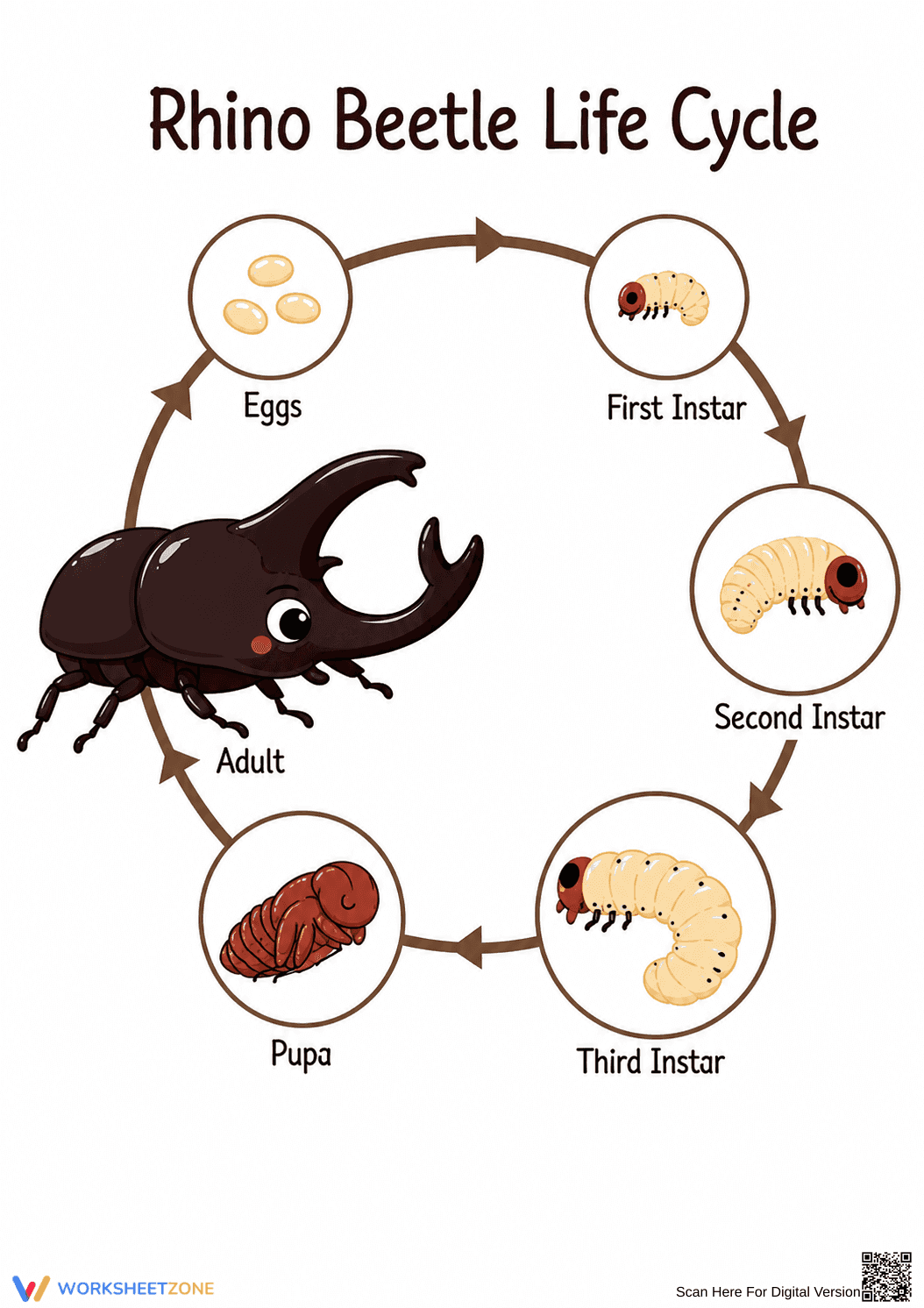

Rhino Beetle Life Cycle — Essential Grade 3 Science
Paste this activity's link or code into your existing LMS (Google Classroom, Canvas, Teams, Schoology, Moodle, etc.).
Students can open and work on the activity right away, with no student login required.
You'll still be able to track student progress and results from your teacher account.
This Grade 3 science resource provides a clear visual model of the Rhino Beetle life cycle, enabling students to identify the specific stages of insect metamorphosis. By observing the transition from egg to adult, learners develop a foundational understanding of biological growth and development. This printable reference simplifies complex biological concepts into an accessible circular diagram.
At a Glance
- Grade: 3 · Subject: Science
- Standard:
3-LS1-1— Develop models to describe that organisms have unique and diverse life cycles- Skill Focus: Insect Metamorphosis Sequencing
- Format: 1 page · 6 stages · Answer key included · PDF
- Best For: Science centers and visual reference
- Time: 10–15 minutes
This single-page PDF features a high-quality circular diagram illustrating the six distinct phases of a Rhino Beetle's life. The stages include the egg, three separate larval instar stages (first, second, and third), the pupa, and the final adult beetle. Each stage is accompanied by a clear, student-friendly illustration and bold labeling to ensure vocabulary acquisition and conceptual clarity during study.
This resource is designed for maximum efficiency in busy classrooms. First, print the required number of copies for your cohort, which takes less than one minute. Second, distribute the worksheets during your direct instruction on life cycles or place them in a dedicated science center. Finally, review the six stages as a group to check for understanding. The total teacher preparation time is under two minutes.
The primary focus is `3-LS1-1`: "Develop models to describe that organisms have unique and diverse life cycles but all have in common birth, growth, reproduction, and death." This worksheet serves as a concrete model for students to compare insect development with other animal groups. Both standard codes can be copied directly into lesson plans, IEP goals, or district curriculum mapping tools.
Use this worksheet as a visual anchor during a whole-group lesson on metamorphosis. Students can use the diagram to create their own narrated presentations or as a reference for a comparative biology research project. As a formative assessment, observe if students can correctly identify the difference between the three instar stages and the pupa phase. Expected completion for a labeling activity is 10 to 15 minutes.
This resource is tailored for elementary students in grades 2 through 5 who are exploring life sciences. It is particularly effective for visual learners and English Language Learners who benefit from the direct pairing of images and labels. Pair this worksheet with a non-fiction passage about beetles or an anchor chart on complete metamorphosis to deepen student engagement and retention.
According to Fisher & Frey (2014), the use of visual models and graphic organizers is essential for scaffolding complex scientific information, particularly when students are required to sequence biological events. This Rhino Beetle life cycle worksheet aligns with these evidence-based practices by providing a structured circular model that highlights the 3-LS1-1 standard. By breaking down the metamorphosis process into six distinct, labeled stages—including the specific instar phases—the resource reduces cognitive load while promoting the acquisition of domain-specific vocabulary. Research indicates that students who interact with clear visual representations of life cycles demonstrate higher retention rates and a better ability to compare life cycles across different species. This worksheet provides the necessary scaffolding for Grade 3 students to meet mastery in life science standards. The inclusion of the pupa and adult stages ensures that the commonalities of birth, growth, and reproduction are clearly visible for classroom analysis and discussion.


