


























Views
Downloads

Rhino Beetle Life Cycle Printable Worksheet | Grade 3
Paste this activity's link or code into your existing LMS (Google Classroom, Canvas, Teams, Schoology, Moodle, etc.).
Students can open and work on the activity right away, with no student login required.
You'll still be able to track student progress and results from your teacher account.
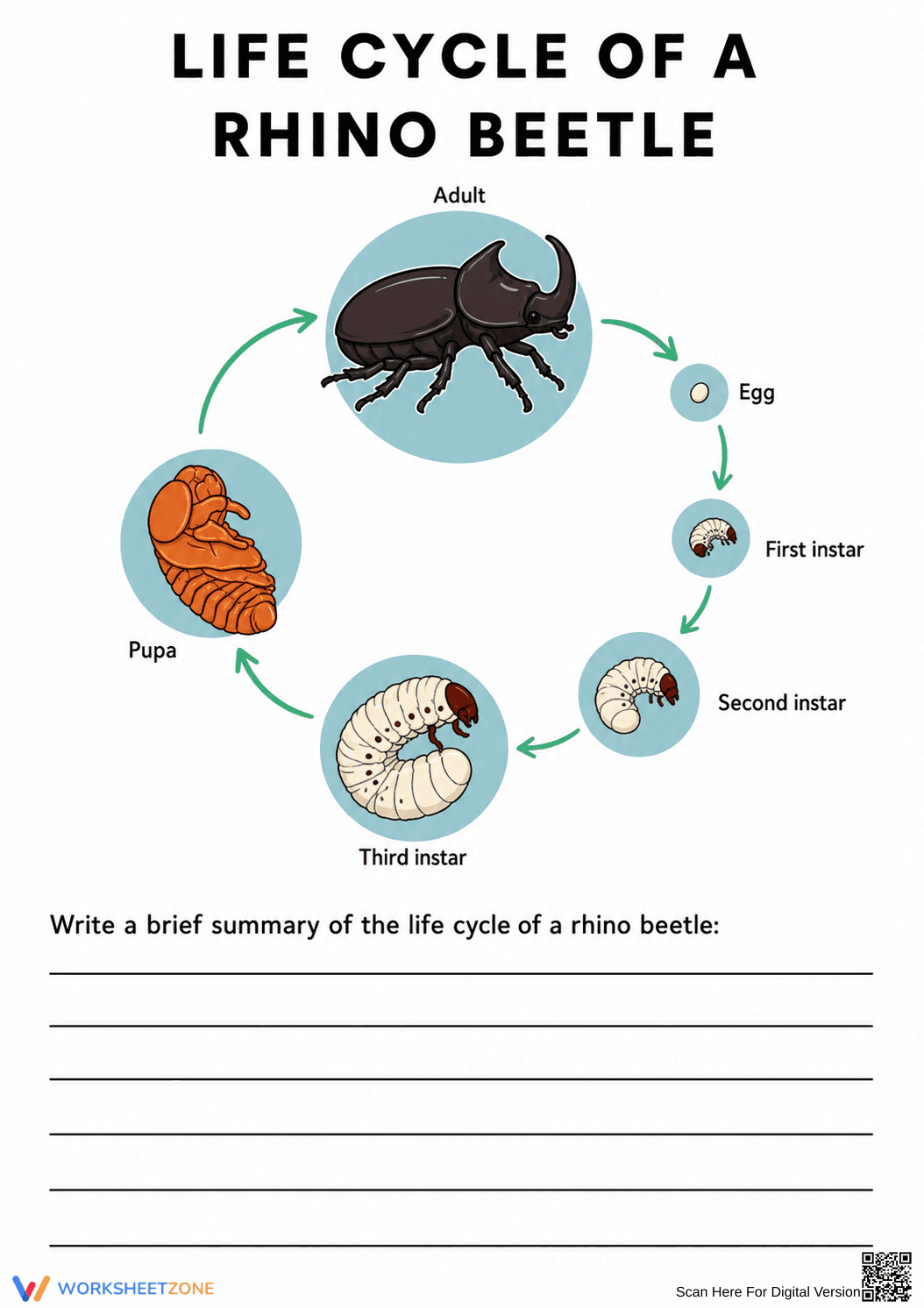
This printable rhino beetle life cycle worksheet helps students translate visual science diagrams into clear, informative writing. By examining the distinct stages from egg to adult, learners practice sequencing events and summarizing biological processes. It bridges the gap between scientific observation and explanatory writing.
At a Glance
- Grade: 3 · Subject: Science
- Standard:
3-LS1-1— Describe unique and diverse organism life cycles- Skill Focus: Summarizing life cycles
- Format: 1 page · 1 writing task · No answer key · PDF
- Best For: Independent practice
- Time: 15–20 minutes
Inside this single-page resource, educators will find a clearly labeled diagram illustrating the six stages of a rhino beetle's development: egg, first instar, second instar, third instar, pupa, and adult. Below the visual model, a structured writing prompt provides lined spaces for students to draft a brief summary. The layout guides students to use visual evidence to construct their written explanation.
Zero-Prep Workflow
- Print (1 minute): Simply print the PDF. The clear diagram requires no special formatting or teacher preparation.
- Distribute (1 minute): Hand out the worksheet as a science center activity, morning work, or quick formative assessment.
- Review (3 minutes): Collect and review the summaries to check for accurate sequencing. Total teacher prep time is under two minutes, making it an ideal sub plan.
Standards Alignment
Aligned to primary standard 3-LS1-1: Develop models to describe that organisms have unique and diverse life cycles but all have in common birth, growth, reproduction, and death. It also supports cross-curricular literacy goals by requiring students to write informative texts examining a topic and conveying ideas clearly. Both standard codes can be copied directly into lesson plans, IEP goals, or district curriculum mapping tools.
How to Use It
Use this worksheet during the independent practice phase of a life science unit. After a whole-class lesson on insect metamorphosis, assign this page to evaluate how well students can independently interpret a diagram and sequence the stages. As a formative assessment observation tip, monitor whether students are correctly using terms like "instar" and "pupa" in their written summaries rather than generic words. Expected completion time is 15 to 20 minutes.
Who It's For
This resource is designed for third-grade general education students, but it easily scales for fourth and fifth graders needing cross-curricular science and writing practice. For differentiation, teachers can provide sentence starters for English Language Learners or challenge advanced students to research and add a sentence about the beetle's habitat. It pairs perfectly with an anchor chart on insect metamorphosis or a direct instruction lesson on life cycles.
Integrating visual models with writing tasks significantly enhances student retention of biological concepts. When addressing 3-LS1-1 to describe unique and diverse organism life cycles, students benefit from translating a visual diagram into a written summary. According to Fisher & Frey (2014), requiring learners to verbalize or write about visual data solidifies their understanding of complex sequences and academic vocabulary. This rhino beetle worksheet provides the exact structure needed for this cognitive transfer, moving students from passive observation of the egg, instar, pupa, and adult stages to active scientific explanation. By combining the visual model with a targeted writing prompt, educators can effectively measure both science content mastery and explanatory writing proficiency in a single, streamlined activity.


