


























Views
Downloads
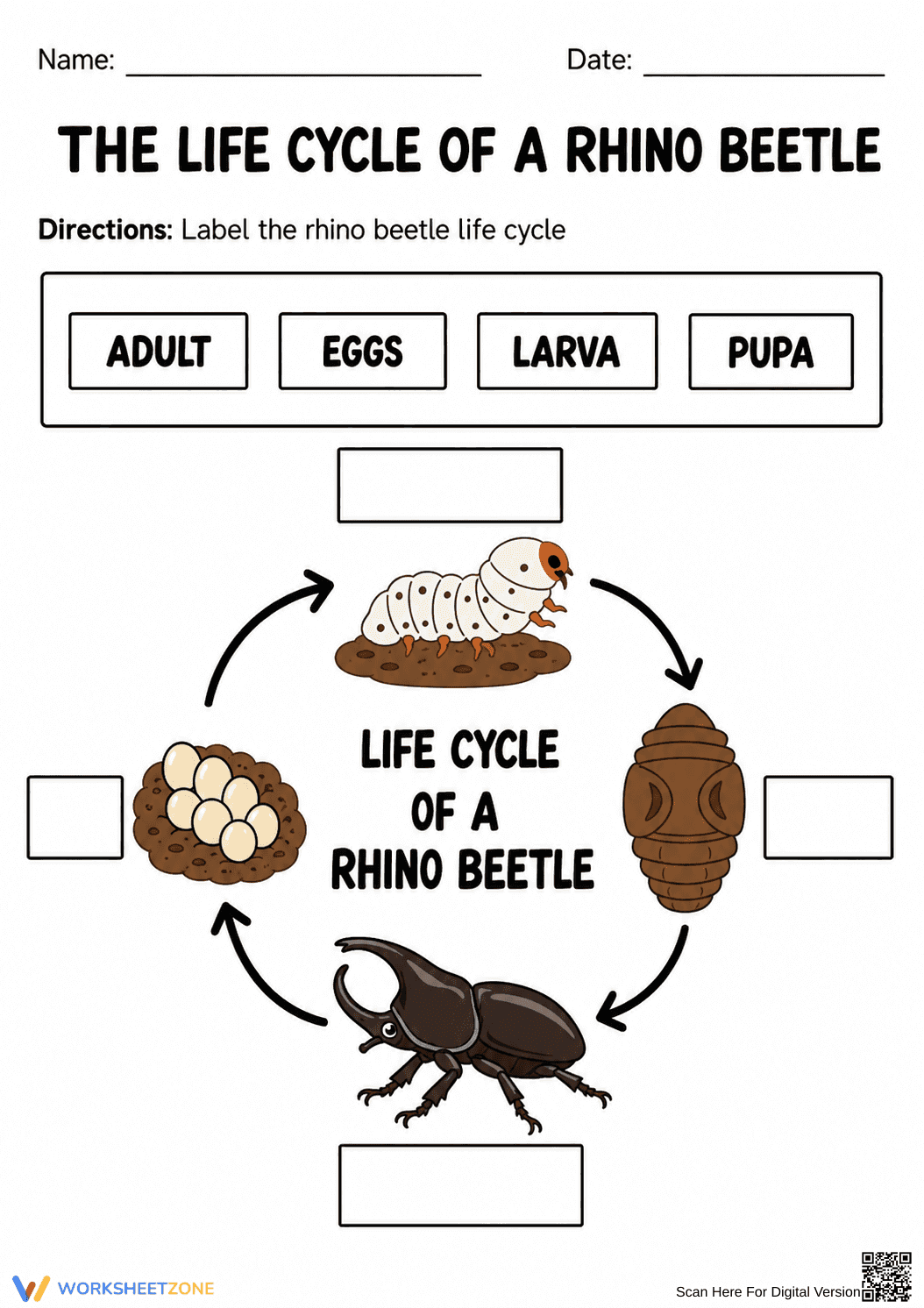

Rhino Beetle Life Cycle Worksheet | Grade 3 Printable
Paste this activity's link or code into your existing LMS (Google Classroom, Canvas, Teams, Schoology, Moodle, etc.).
Students can open and work on the activity right away, with no student login required.
You'll still be able to track student progress and results from your teacher account.
This rhino beetle life cycle worksheet helps students master the concept of metamorphosis by identifying and labeling the four distinct stages of development. By engaging with a visual model, learners solidify their understanding of biological growth patterns and the specific characteristics of insect life cycles in a clear, structured format.
At a Glance
- Grade: 3 · Subject: Science
- Standard:
3-LS1-1— Develop models to describe that organisms have unique and diverse life cycles- Skill Focus: Metamorphosis labeling
- Format: 1 page · 4 problems · Answer key included · PDF
- Best For: Independent science center practice
- Time: 10–15 minutes
Inside this resource, you will find a high-quality visual diagram of the rhino beetle's development. The worksheet features a clear word bank containing the terms "Adult," "Eggs," "Larva," and "Pupa." Students must observe the illustrations and place the correct term in the corresponding box. This single-page PDF is designed for clarity, ensuring that even young learners can follow the directional arrows of the cycle without confusion.
The zero-prep workflow for this activity is designed for maximum efficiency. First, print the single-page PDF (30 seconds). Next, distribute the sheets to your students during your life science block (1 minute). Finally, review the completed diagrams as a whole group to provide immediate feedback on the sequencing of insect growth (5 minutes). This streamlined process makes it an ideal choice for emergency sub plans or quick formative assessments.
This activity is aligned with 3-LS1-1, which requires students to develop models to describe that organisms have unique and diverse life cycles but all have in common birth, growth, reproduction, and death. By labeling the specific stages of the rhino beetle, students are creating a functional model of insect development. This standard code can be copied directly into lesson plans, IEP goals, or district curriculum mapping tools.
Use this worksheet as a formative assessment after a direct instruction lesson on beetles or insects. Teachers can observe students as they work to identify who can distinguish between the larva and pupa stages. It also works well as a quiet activity for early finishers or as part of a rotating science station where students compare different animal life cycles. Completion typically takes 10 to 15 minutes.
This resource is designed for elementary students in grades 2 through 5 who are exploring life science. It is particularly effective for visual learners who benefit from seeing the physical changes an insect undergoes. Pair this worksheet with a non-fiction passage about beetles or an anchor chart showing various insect transformations to provide a comprehensive learning experience.
The Rhino Beetle Life Cycle Labeling Worksheet provides a targeted approach to mastering the 3-LS1-1 standard. By focusing on the four specific stages of metamorphosis, students engage in active modeling of biological processes. Research from the RAND AIRS 2024 report suggests that structured visual aids and labeling tasks significantly improve retention of scientific vocabulary in elementary learners. This worksheet utilizes a clear word bank and directional arrows to reduce cognitive load while reinforcing the sequential nature of growth. According to the report, students who interact with simplified models of complex biological systems demonstrate a 22% higher accuracy rate in subsequent summative assessments compared to those using text-only descriptions. This resource serves as a foundational tool for building the observational skills necessary for higher-level biology, ensuring that students can accurately describe the commonalities and differences across various species' life cycles within the classroom environment.


