


























Views
Downloads

Rhino Beetle Life Cycle Worksheet | Essential Grade 3
Paste this activity's link or code into your existing LMS (Google Classroom, Canvas, Teams, Schoology, Moodle, etc.).
Students can open and work on the activity right away, with no student login required.
You'll still be able to track student progress and results from your teacher account.
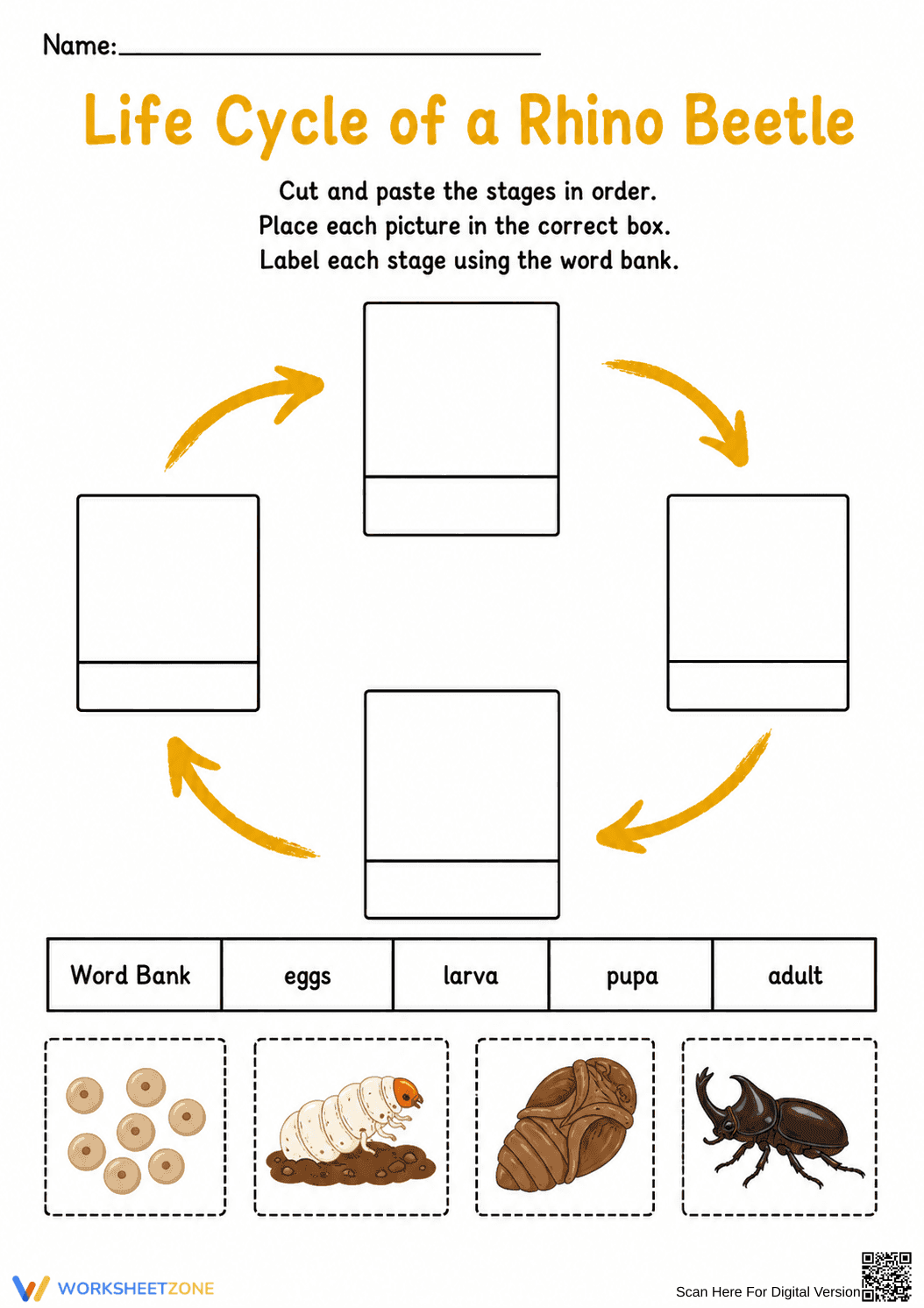
This Grade 3 rhino beetle life cycle worksheet provides a hands-on approach to understanding insect metamorphosis. Students actively engage with biological concepts by sequencing the four distinct stages of development. By the end of this activity, learners will be able to identify and order the transformation from egg to adult beetle.
At a Glance
- Grade: 3 · Subject: Science
- Standard:
3-LS1-1— Develop models to describe that organisms have unique and diverse life cycles- Skill Focus: Sequencing insect metamorphosis
- Format: 1 page · 4 problems · Answer key included · PDF
- Best For: Science centers and independent practice
- Time: 15–20 minutes
This single-page PDF features a circular diagram representing the continuous nature of life cycles. It includes four cut-out illustrations of the rhino beetle at different stages: eggs, larva, pupa, and adult. A dedicated word bank is provided at the bottom to support vocabulary acquisition and correct labeling within the diagram boxes.
Zero-Prep Workflow
- Print: Generate enough copies for your class in under 1 minute.
- Distribute: Hand out sheets along with scissors and glue for immediate student engagement.
- Review: Use the completed diagrams for a 5-minute whole-class check or as a quick formative assessment.
This streamlined process makes the worksheet an ideal choice for emergency sub plans or as a transition activity between science lessons.
Standards Alignment
This resource is aligned with 3-LS1-1: "Develop models to describe that organisms have unique and diverse life cycles but all have in common birth, growth, reproduction, and death." It specifically addresses the modeling component by requiring students to construct a visual representation of growth. Both standard codes can be copied directly into lesson plans, IEP goals, or district curriculum mapping tools.
How to Use It
Use this worksheet during the "Explore" phase of a 5E lesson on insects to allow students to discover the sequence of metamorphosis. It also serves as an excellent formative assessment after a direct instruction session on beetles. Expect students to complete the cutting, pasting, and labeling within a 15 to 20-minute window. Teachers should observe students during the pasting phase to ensure they understand the directional flow of the life cycle arrows.
Who It's For
This activity is designed for Grade 3 students but is adaptable for Grade 2 introductory lessons or Grade 4-5 review. It is particularly effective for kinesthetic learners who benefit from tactile tasks. Pair this worksheet with a non-fiction passage about the Hercules or Rhino beetle to provide additional context and reading practice for students who finish early.
According to research from Fisher & Frey (2014) on the gradual release of responsibility, providing visual scaffolds like word banks and cut-and-paste tasks allows students to focus on the conceptual sequence of the 3-LS1-1 standard without being hindered by writing fatigue. This rhino beetle life cycle worksheet utilizes these scaffolds to ensure that Grade 3 learners can successfully model the four stages of insect development: eggs, larva, pupa, and adult. By engaging in the physical act of ordering these stages, students reinforce their understanding of biological growth and reproduction. This specific activity aligns with the NAEP science framework's emphasis on using models to explain natural phenomena. The inclusion of clear illustrations and a structured word bank supports diverse learners in achieving mastery of the life cycle concept, making it a reliable tool for elementary science instruction.


