


























Views
Downloads
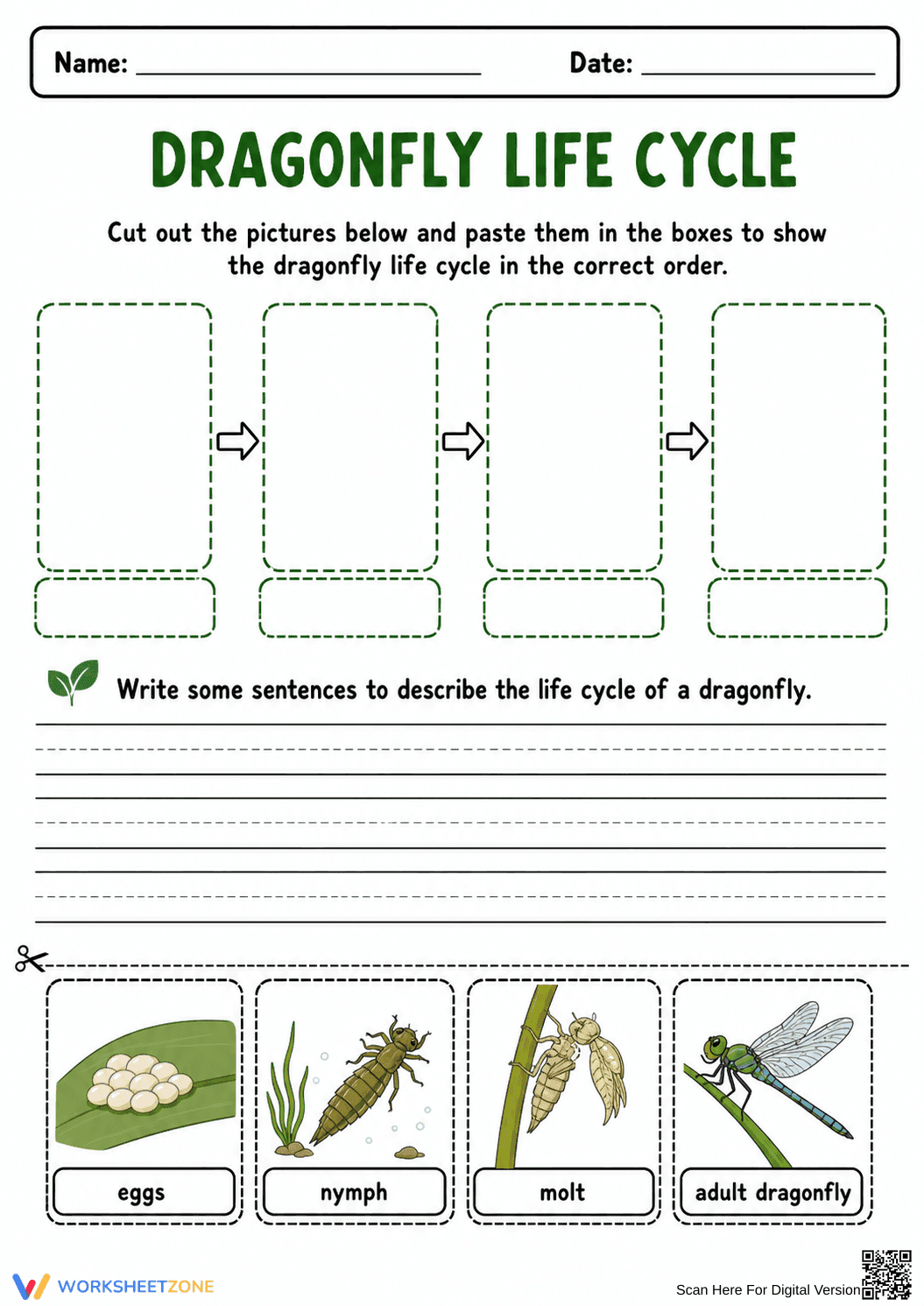

Grade 3 Dragonfly Life Cycle — Printable No-Prep Worksheet
Paste this activity's link or code into your existing LMS (Google Classroom, Canvas, Teams, Schoology, Moodle, etc.).
Students can open and work on the activity right away, with no student login required.
You'll still be able to track student progress and results from your teacher account.
This printable dragonfly life cycle worksheet helps students understand insect metamorphosis through hands-on sequencing and descriptive writing. By cutting, pasting, and explaining the four distinct stages of a dragonfly's development, learners actively build both their foundational science knowledge and their informative writing skills in one engaging activity.
At a Glance
- Grade: 3 · Subject: Science
- Standard:
3-LS1-1— Describe the unique life cycles of organisms- Skill Focus: Life cycle sequencing and descriptive writing
- Format: 1 page · 5 tasks · PDF
- Best For: Independent science practice
- Time: 15–20 minutes
This single-page resource features a clear, four-step sequencing chart where students arrange the stages of a dragonfly's life: eggs, nymph, molt, and adult dragonfly. The bottom of the page provides the four illustrated cut-out cards needed to complete the visual model. Below the sequencing boxes, primary-lined writing space prompts students to write descriptive sentences explaining the biological process they just organized, bridging the gap between visual identification and scientific explanation.
Designed for immediate classroom implementation, this worksheet requires zero teacher preparation.
- Print (1 min): Print the PDF master copy. No special materials needed beyond scissors and glue.
- Distribute (1 min): Hand out the sheets. Instructions are self-explanatory, allowing immediate starts.
- Review (3 mins): Quickly check the visual sequence and read the sentences to assess comprehension.
With prep time under two minutes, this is an ideal addition to your science block or an emergency sub plan.
This activity is directly aligned to 3-LS1-1, requiring students to develop models to describe that organisms have unique and diverse life cycles but all have in common birth, growth, reproduction, and death. It also supports cross-curricular ELA standards by incorporating informative writing practice. Both standard codes can be copied directly into lesson plans, IEP goals, or district curriculum mapping tools.
This worksheet works perfectly as independent practice following a direct instruction lesson on insect life cycles. Students complete the cut-and-paste model to solidify understanding before writing summaries. Alternatively, use it as a formative assessment; observe how accurately students sequence the nymph and molt stages to gauge their grasp of incomplete metamorphosis. Expected completion time is 15 to 20 minutes.
This resource is primarily designed for third-grade science students, though it can easily be adapted for second graders with guided sentence starters or fourth graders needing a quick review. It is especially beneficial for visual and kinesthetic learners who thrive on hands-on manipulation of the cut-out cards. Pair this worksheet with a nonfiction read-aloud about pond ecosystems or a visual anchor chart detailing the differences between complete and incomplete metamorphosis.
Integrating hands-on modeling with explanatory writing significantly enhances student retention of complex biological processes. When students engage with standard 3-LS1-1 to describe the unique life cycles of organisms, the physical act of sequencing reinforces cognitive mapping. According to Fisher & Frey (2014), combining visual manipulation with immediate writing tasks promotes deeper conceptual understanding and helps transfer knowledge from short-term to long-term memory. By requiring learners to first build the dragonfly life cycle model and then articulate the process in their own words, this worksheet ensures that students are not merely memorizing vocabulary, but actively constructing scientific meaning. This dual-modality approach supports diverse learning profiles and provides educators with a clear, observable measure of student mastery regarding insect development, growth, and metamorphosis in a single, efficient activity.


