




























Views
Downloads

Dragonfly Life Cycle Writing Worksheet | Grade 3 Essential

Paste this activity's link or code into your existing LMS (Google Classroom, Canvas, Teams, Schoology, Moodle, etc.).
Students can open and work on the activity right away, with no student login required.
You'll still be able to track student progress and results from your teacher account.
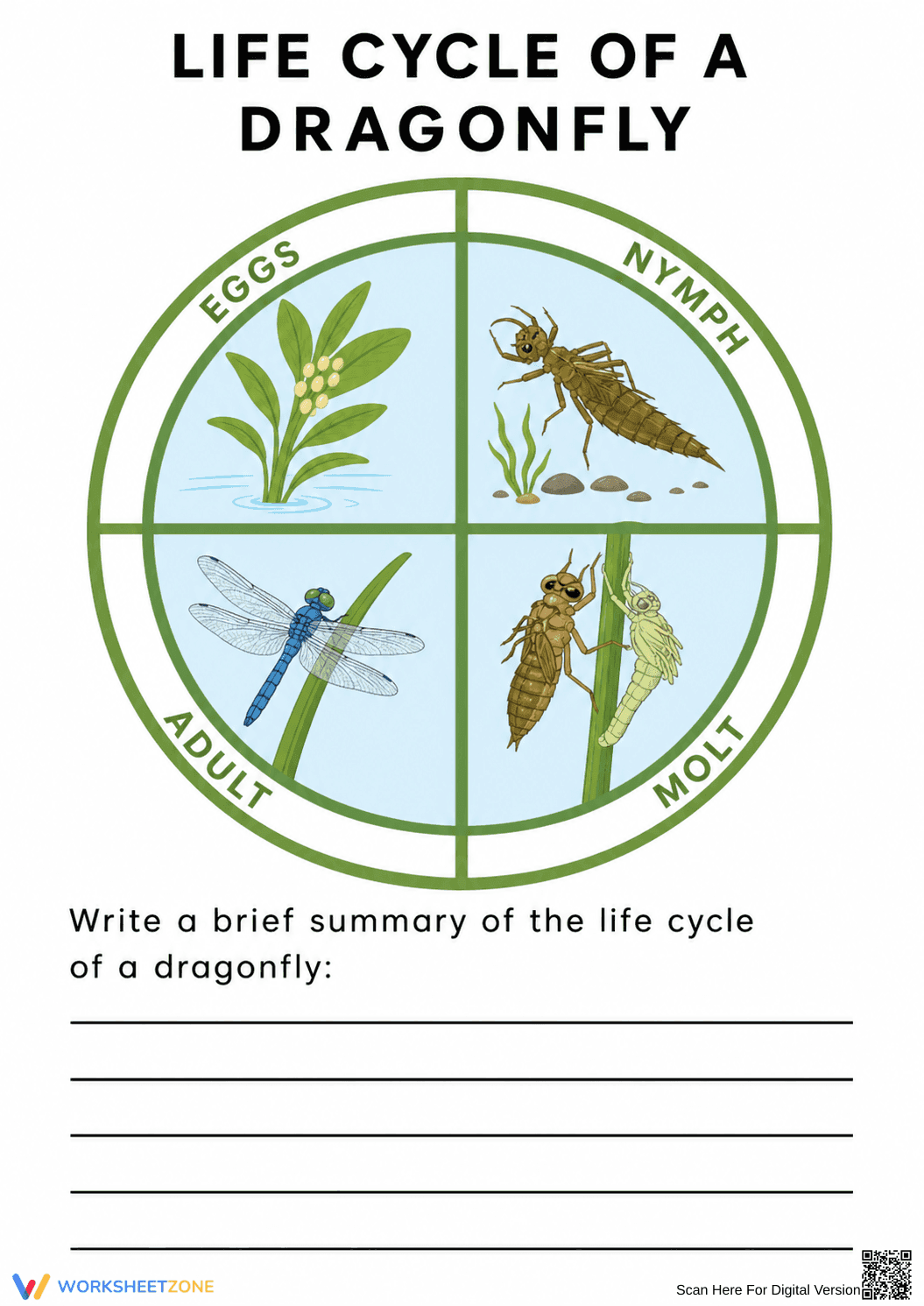
This dragonfly life cycle writing worksheet helps students synthesize biological observations into a coherent written summary. By analyzing the four distinct stages—eggs, nymph, molt, and adult—learners develop the ability to explain complex natural processes using scientific vocabulary. It bridges the gap between visual diagrams and informational writing to ensure students grasp the nuances of insect metamorphosis.
At a Glance
- Grade: 3 · Subject: Science & ELA
- Standard:
3-LS1-1— Develop models to describe that organisms have unique and diverse life cycles- Skill Focus: Informational Writing & Life Cycles
- Format: 1 page · 1 summary task · No-prep · PDF
- Best For: Science journals or formative assessment
- Time: 15–20 minutes
The resource features a high-quality, four-quadrant diagram illustrating the metamorphosis of a dragonfly. Each quadrant is clearly labeled with the specific stage: Eggs, Nymph, Molt, and Adult. Below the visual model, students are provided with five wide-ruled lines to draft their summary. This structure ensures that students have a constant visual reference while they practice their descriptive writing skills and scientific observation.
This worksheet is designed for a zero-prep workflow in busy classrooms. First, print the single-page PDF (30 seconds). Second, distribute the sheets to students during your life science block (1 minute). Third, review the completed summaries to check for understanding of the nymph and molting stages (5 minutes). Total teacher preparation time is under two minutes, making it an ideal choice for emergency sub plans or quick lesson transitions.
This activity aligns with `3-LS1-1`, which requires students to develop models to describe that organisms have unique and diverse life cycles but all have in common birth, growth, reproduction, and death. It also supports CCSS.ELA-LITERACY.W.3.2 by asking students to write informative/explanatory texts to examine a topic and convey ideas and information clearly. Both standard codes can be copied directly into lesson plans, IEP goals, or district curriculum mapping tools.
Use this worksheet as a formative assessment after a direct instruction lesson on insect metamorphosis. It works effectively as a "show what you know" activity where students must use transition words like first, next, then, and finally to describe the dragonfly's progression. Alternatively, assign it as a science center task where students use a classroom textbook or anchor chart to find specific details about the nymph stage to include in their summary.
This resource is tailored for Grade 2 through Grade 5 students, with varying expectations for writing complexity. It is particularly beneficial for English Language Learners (ELLs) who need the visual support of the diagram to anchor their vocabulary. Pair this worksheet with a live specimen observation or a time-lapse video of a dragonfly molting to provide a multi-sensory learning experience for all students.
According to the RAND AIRS 2024 report on elementary science integration, combining visual models with writing tasks significantly improves long-term retention of biological concepts. This dragonfly life cycle worksheet applies these findings by requiring students to translate visual data from the 3-LS1-1 aligned diagram into a structured written summary. Research by Fisher & Frey (2014) emphasizes that the gradual release of responsibility is most effective when students are given clear visual scaffolds before independent writing. By focusing on the specific stages of the dragonfly—including the often-overlooked molting phase—this resource ensures that students move beyond simple identification toward true conceptual mastery. The inclusion of specific scientific terminology within a familiar writing format allows for a 15-minute instructional intervention that meets both NGSS and CCSS requirements. This dual-purpose design reduces cognitive load while maximizing the time spent on core curriculum standards in the upper elementary classroom.


