


























Views
Downloads
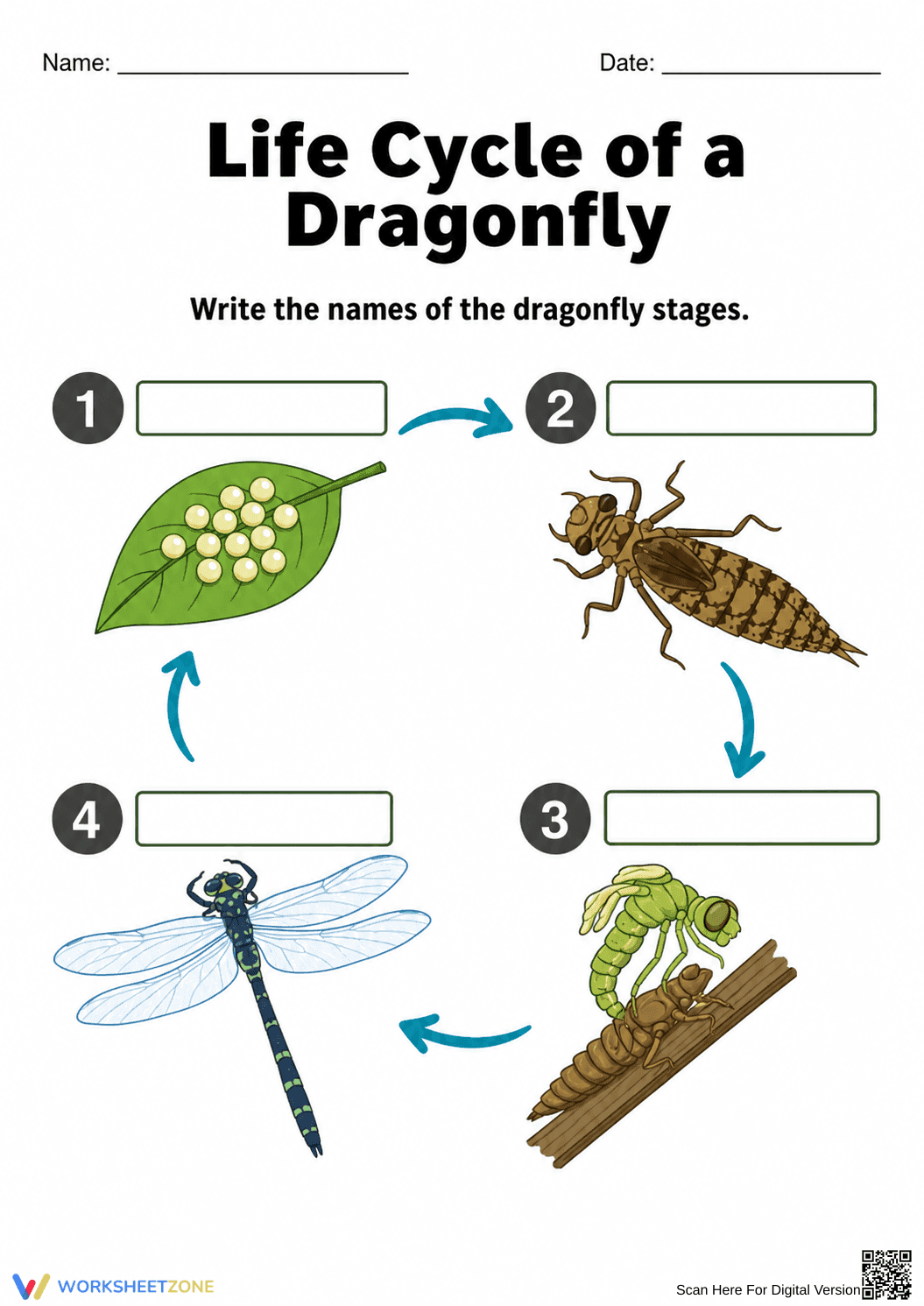

Grade 3 Dragonfly Life Cycle — Printable No-Prep Worksheet
Paste this activity's link or code into your existing LMS (Google Classroom, Canvas, Teams, Schoology, Moodle, etc.).
Students can open and work on the activity right away, with no student login required.
You'll still be able to track student progress and results from your teacher account.
This Grade 3 science worksheet provides a clear, visual activity for students to identify and label the stages of a dragonfly's life cycle. By filling in the four distinct phases—egg, nymph, emerging adult, and mature adult—students reinforce essential biology vocabulary and develop a concrete understanding of insect metamorphosis.
At a Glance
- Grade: 3 · Subject: Science
- Standard:
3-LS1-1— Develop models describing diverse organism life cycles.- Skill Focus: Labeling life cycle stages
- Format: 1 page · 4 problems · Answer key included · PDF
- Best For: Independent science practice
- Time: 10–15 minutes
Inside this PDF download, educators will find a single-page diagram featuring high-quality, full-color illustrations of a dragonfly at four different developmental stages. Students are tasked with writing the correct vocabulary word in the blank boxes corresponding to each numbered stage. The clear layout minimizes distractions, while the sequential arrows help students visualize the continuous nature of the life cycle. A complete answer key is provided to ensure accurate grading and easy review.
- Print (1 minute): Simply download the PDF and print a class set. The high-contrast design ensures the illustrations remain clear even if printed in grayscale.
- Distribute (1 minute): Hand out the worksheets as a quick warm-up, science center activity, or independent practice assignment following a lesson on insects.
- Review (3 minutes): Use the included answer key to quickly check student work or project the completed diagram on the board for a whole-class review.
With under two minutes of total teacher prep time required, this resource is an excellent addition to any emergency sub plan or busy instructional week.
Aligned to primary standard 3-LS1-1: Develop models to describe that organisms have unique and diverse life cycles but all have in common birth, growth, reproduction, and death. This labeling activity serves as a foundational model for students to observe these commonalities in a specific insect. Both standard codes can be copied directly into lesson plans, IEP goals, or district curriculum mapping tools.
This worksheet is highly effective as a formative assessment tool immediately following direct instruction on insect metamorphosis. Teachers can observe whether students correctly sequence the nymph and emerging stages, which are often confused. Alternatively, it serves as an excellent science center station where students can reference classroom anchor charts or textbooks to complete the diagram independently. Expected completion time ranges from 10 to 15 minutes.
This resource is primarily designed for third-grade general education students, though it is easily adaptable for second-grade guided practice or fourth-grade review. The strong visual supports make it particularly beneficial for English Language Learners and students requiring visual accommodations. It pairs perfectly with an introductory reading passage on wetland ecosystems or a hands-on observation activity with live insects.
Aligning instructional materials with standard 3-LS1-1 ensures students can accurately develop models describing diverse organism life cycles. According to a recent ScienceDirect TpT Analysis, integrating clear visual diagrams with targeted vocabulary practice significantly improves long-term retention of complex biological processes in elementary students. When learners actively label sequential stages rather than passively observing them, they build stronger cognitive connections regarding how organisms grow, reproduce, and change over time. This dragonfly life cycle activity provides the exact visual scaffolding necessary to support these cognitive connections, allowing students to map specific vocabulary terms directly to high-quality biological illustrations. By utilizing structured, visually supported tasks, educators can effectively reduce cognitive load while maximizing scientific literacy and vocabulary acquisition in the elementary science classroom.


