


























Views
Downloads
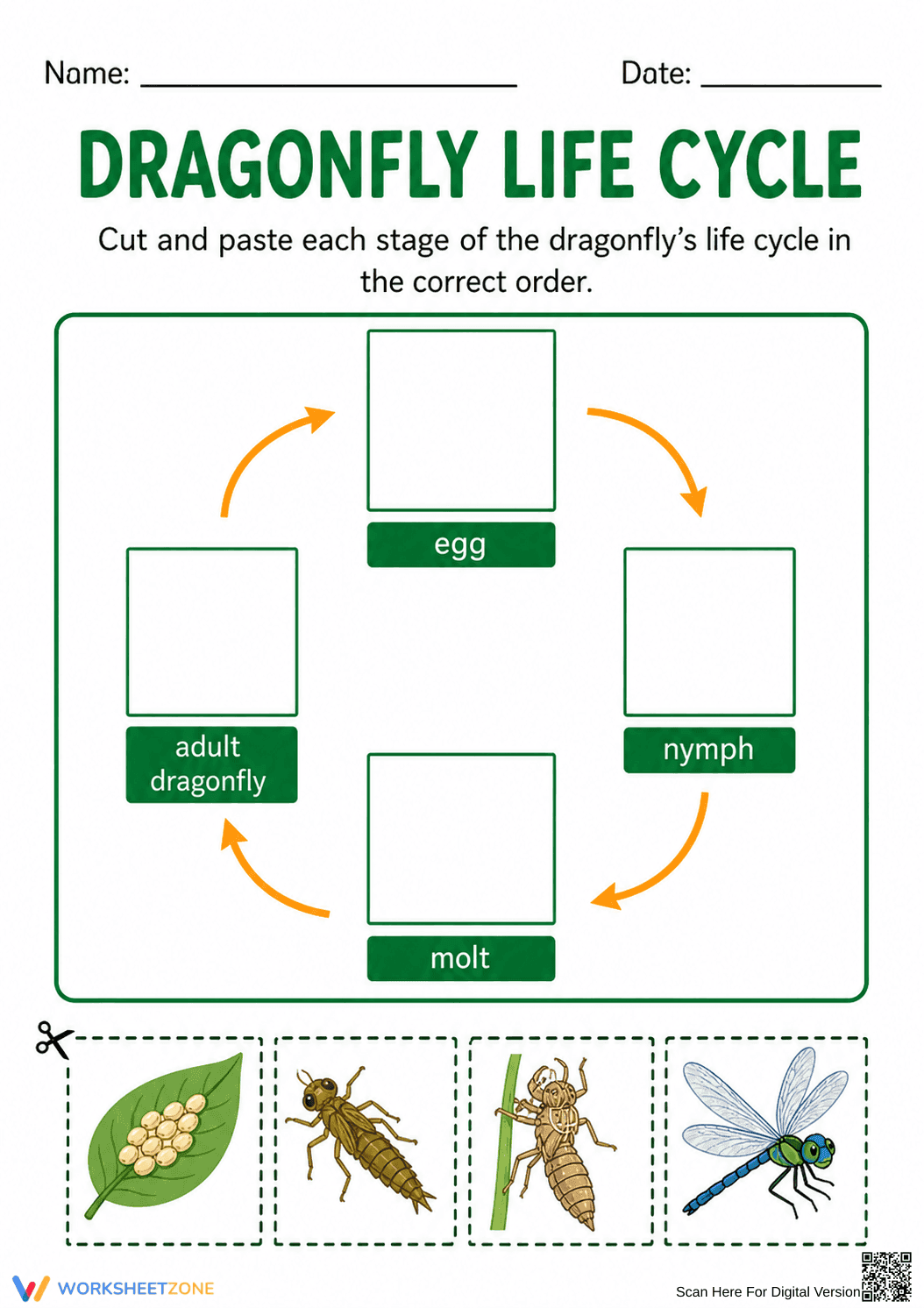

Grade 3 Dragonfly Life Cycle — Printable No-Prep Worksheet
Paste this activity's link or code into your existing LMS (Google Classroom, Canvas, Teams, Schoology, Moodle, etc.).
Students can open and work on the activity right away, with no student login required.
You'll still be able to track student progress and results from your teacher account.
This interactive science worksheet helps students master the stages of a dragonfly's life cycle by sequencing key developmental phases. By physically cutting and pasting images into the correct order, young learners solidify their understanding of biological growth, metamorphosis, and the continuous nature of animal life cycles.
At a Glance
- Grade: 3 · Subject: Science
- Standard:
3-LS1-1— Develop models to describe diverse organism life cycles- Skill Focus: Sequencing biological life cycles
- Format: 1 page · 4 problems · PDF
- Best For: Independent science practice
- Time: 10–15 minutes
This single-page printable features a clear, circular diagram with four labeled boxes: egg, nymph, molt, and adult dragonfly. At the bottom, students find four illustrated images ready to be cut out. The visual layout includes directional arrows to reinforce the continuous, cyclical nature of insect metamorphosis, providing built-in scaffolding for early readers and visual learners.
This resource requires zero teacher setup:
- Print (1 minute): Simply print the PDF master copy. The black-and-white friendly design ensures crisp copies for the whole class.
- Distribute (1 minute): Hand out the worksheet along with scissors and glue sticks. No complex instructions are needed.
- Review (3 minutes): Quickly check student work as they paste the four stages, or review together as a class.
With a total prep time of under two minutes, this activity is an ideal, stress-free addition to any biology unit or emergency sub plan.
This activity is directly aligned to the Next Generation Science Standards, specifically focusing on 3-LS1-1: Develop models to describe that organisms have unique and diverse life cycles but all have in common birth, growth, reproduction, and death. By sequencing the dragonfly's specific stages, students create a functional model of this biological concept. Both standard codes can be copied directly into lesson plans, IEP goals, or district curriculum mapping tools.
Deploy this worksheet after a read-aloud about insects as a hands-on reinforcement activity. Alternatively, it serves as an excellent independent science center task while the teacher works with small groups. As a formative assessment tip, observe students before they glue the pieces down; asking them to explain their sequence verbally can reveal misconceptions about the molt stage versus the nymph stage. Students typically complete this engaging task within a 10 to 15-minute timeframe.
Designed for third-grade students, this resource is also adaptable for first and second graders receiving introductory life science instruction. The hands-on, visual nature of the cut-and-paste format provides excellent differentiation for English Language Learners and students who benefit from tactile learning experiences. It pairs perfectly with an anchor chart detailing insect metamorphosis or a direct instruction lesson on wetland habitats.
Understanding biological sequencing through visual models is a foundational component of elementary science education. This activity targets 3-LS1-1, requiring students to develop models to describe organism life cycles. According to a recent ScienceDirect TpT Analysis, integrating tactile tasks like cut-and-paste sequencing significantly improves retention of complex biological vocabulary and processes in early elementary students. When learners physically manipulate the stages of a dragonfly's development—moving from egg to nymph, molt, and finally adult—they engage multiple cognitive pathways, reinforcing the cyclical nature of life. This multimodal approach not only builds essential fine motor skills but also deepens conceptual understanding of metamorphosis, ensuring that abstract scientific principles become concrete and accessible for young minds. By transforming a standard diagram into an interactive puzzle, educators can foster higher engagement and better long-term recall of critical life science standards.


