Why leaf worksheets belong in an elementary plant unit
If you're teaching plant structures to elementary students, leaf worksheets give you a low-prep way to move kids from simply spotting a leaf to explaining what each part actually does. A single printable can anchor a warm-up, a science station, or an exit ticket, and it pairs naturally with the leaves your students can collect right outside the classroom. The goal here isn't decoration. It's getting students to connect a structure they can hold in their hands to a function they can describe in their own words.
Most teachers reach for these pages during a life science unit in grades 1 through 4, when the standards shift from naming plant parts toward reasoning about how those parts help a plant survive. A well-built leaf worksheet scaffolds that jump, starting with straightforward labeling and ending with a short written explanation that asks students to think like scientists.
What a strong leaf worksheet actually labels
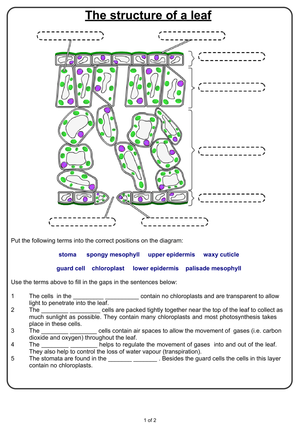
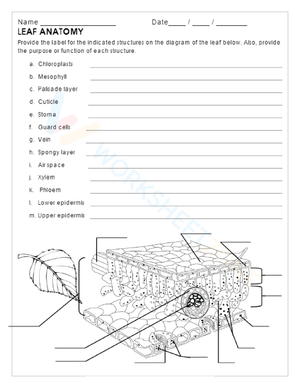
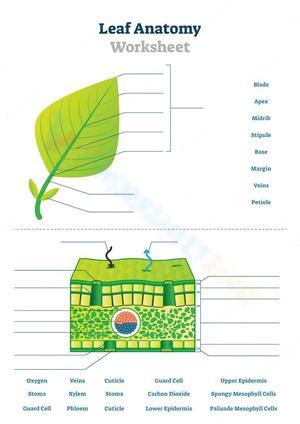
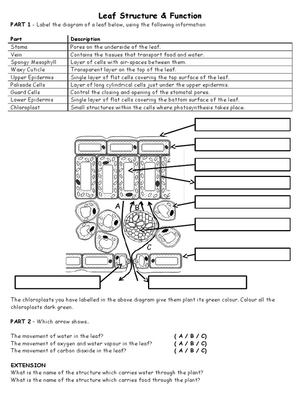
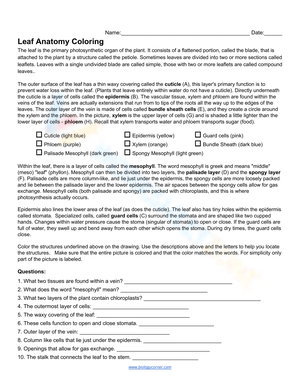
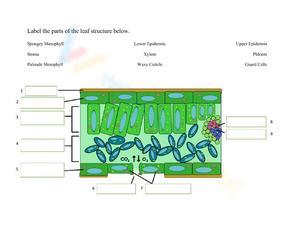
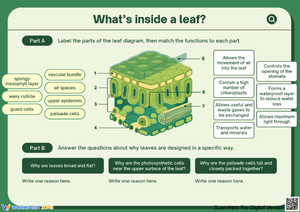
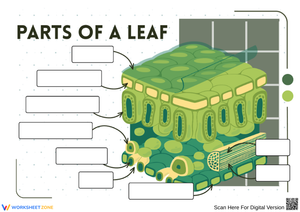
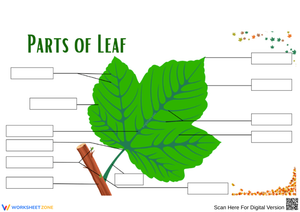
The vocabulary load is where many leaf worksheets either support students or quietly overwhelm them. At minimum, a solid page covers the blade, vein, petiole, and midrib so students can map the flat light-catching surface, the transport lines, the stalk, and the central rib. As learners move up, worksheets add stomata and chlorophyll to push from part-naming into genuine function.
- Blade — the broad, flat surface that captures sunlight
- Vein — the network that carries water and food through the leaf
- Petiole — the stalk that connects the blade to the stem
- Midrib — the thick central vein running down the middle
- Stomata — tiny pores that control gas exchange and water loss
A helpful rule of thumb: limit a single worksheet to five or six labeled parts. Beyond that, students spend more energy managing the word bank than understanding the leaf, and the page starts to feel like a spelling test rather than a science task.
Sequencing these terms matters more than it looks. When a worksheet introduces stomata before students are comfortable with the blade and veins, early readers tend to stall on pronunciation instead of meaning. Order the vocabulary from visible to microscopic and the page reads far more smoothly.
Matching worksheets to the right grade band
The same leaf diagram can serve very different objectives depending on the grade. In grade 1, the target is recognition: students match words to parts and build the vocabulary that all later reasoning depends on. This lines up with the expectation that first graders use plant parts, including leaves, to think about how a plant meets its needs, grows, and survives.
By grade 4, the bar rises from labeling to argument. Instead of filling blanks and stopping, students construct a claim that external structures like leaves and veins function to support survival, growth, and reproduction. The practical implication for your worksheet choice is specific: a grade 4 page should include at least one open-response prompt, not just a word bank, because the standard is assessed through explanation rather than recall. A printable that only asks students to fill in labels under-serves the fourth-grade performance expectation even when the diagram itself looks advanced.
This is exactly why differentiation across a multi-grade building works best when the diagram stays constant and the prompt changes. Same leaf, different question stem, and every teacher in the hallway can pull from one master page.
One quick way to make this concrete is the 'shape follows job' sort. Give students three leaf parts and three jobs on separate cards and have them match each structure to what it does. It takes five minutes, travels easily into a worksheet as a matching column, and surfaces misconceptions before they harden.
Connecting leaf structure to photosynthesis and survival
Structure-and-function reasoning clicks for students when they see that a leaf's shape serves its job. The blade is wide because catching light is the whole point. Veins branch everywhere because every cell needs water delivered to it. Stomata open and close because the plant constantly balances taking in air against losing too much water.
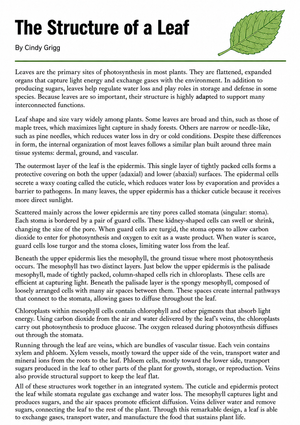
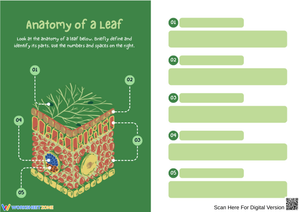
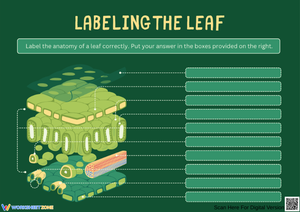
According to CK-12's Leaf Structure and Function resource, the palisade mesophyll layer just beneath the upper epidermis holds the most chloroplasts and performs the majority of a leaf's photosynthesis, which is why labeling worksheets that stop at the blade quietly skip the single most productive tissue in the entire leaf.
For elementary students you don't need the full biochemistry. You need them to link sunlight, water, and air to the parts that handle each one, which sets up photosynthesis later as a satisfying answer rather than a memorized vocabulary word.
Classroom Implementation
Leaf worksheets do their best work when they're paired with something students can actually touch. A fall station rotation is a reliable structure that keeps hands and pencils busy at the same time.
- Station 1: Collect and sort real leaves by shape and vein pattern.
- Station 2: Complete the labeling worksheet using a collected leaf as a reference.
- Station 3: Make leaf rubbings to reveal the veins and midrib under paper.
- Station 4: Write one sentence explaining how a single leaf part helps the plant survive.
For small-group intervention, use the labeling page as a quick pre-assessment, then reteach only the two or three parts your group missed. The EL Education Grade 4 plant structures lessons treat plant parts as a connected system, so framing your worksheet as one piece of that system, rather than an isolated diagram, keeps students focused on how parts relate instead of memorizing them in isolation.
If you only have a single class period, compress the rotation into a whole-group flow: label together on the document camera, hand out real leaves for two minutes of observation, then release students to finish the written prompt independently. The worksheet becomes the through-line that holds the lesson together instead of a stand-alone handout.
Frequently asked questions about leaf worksheets
1. What grade level are leaf anatomy worksheets best suited for?
They fit grades 1 through 4 most naturally. Grade 1 focuses on matching words to parts, while grade 4 asks students to explain how each structure supports the plant's survival and growth.
2. How can teachers use leaf worksheets to meet structure-and-function standards?
Use the diagram for labeling, then add an open-response prompt asking students to argue how a leaf part helps the plant. That explanation step is what the fourth-grade standard actually assesses.
3. What vocabulary should a leaf structure worksheet include?
Start with blade, vein, petiole, and midrib for younger students, then add stomata and chlorophyll as learners move toward explaining photosynthesis and gas exchange.
4. How do leaf worksheets fit into a broader plant life science unit?
They work as one connected piece of a plant-structures system. Pair them with roots, stems, and flower lessons so students see how each part contributes to the whole plant.
5. Can leaf worksheets be used for both labeling practice and formative assessment?
Yes. The same page can serve as guided practice one day and a quick formative check the next, especially if you add a short written prompt to reveal student reasoning.












 Interactive Worksheet Maker
 Quiz Maker
 Word Search Maker
 Crossword Puzzle Maker
 Word Scramble Generator
 Sentence Scramble Generator
 Handwriting Worksheet Generator
 Name Tracing Generator
 Fill In The Blank Generator